Angela Merkel Quotes
I have nothing but contempt for this. The tone seems to be similar across all banks
Germany, as one of the wealthier and solvent countries in the Eurozone, as a de facto matter, had to help bail out Ireland when they bailed out the Anglo Irish Bank. See {635440}. This bank was one of many throughout the Common Market and the United States that obtained taxpayer bailouts based on information that was not correct. Merkel observed similarities of banks in the different nations in terms of their honesty, greed, and lack of ethics.
Angela Merkel, German Prime Minister, First female Prime Minister of Germany, Statement when she reviewed a secret conversation that key members of the Anglo Irish bank had proving that they scammed the Irish government into bailing out the bank by assuming its debts and eventually nationalizing it, June 28, 2013, Quoted in http://www.wsws.org/en/articles/2013/06/29/bank-j29.html
Sourced by: Eigen's Political and Historical Quotations

He told the government that the bank was 7 billion Euros short, and after much soul searching, the Irish government agreed to assume the debts of the bank lest all the depositors would only get a small fraction of their deposits back. However, the real deficit that the Irish government had to cover was many times the 7 billion. This led to the complete collapse of the Irish economy. Bowe and the other bank officials maintained that they thought the deficit was only 7 billion when they told that to the government. Four years later, confidential audio tapes of some telephone conversations between Bowe and other bank officials turned up and it was clear that Bowe had picked the 7 billion number out of thin air. It was a number that Bowe thought would be large enough that the Government would have to bail the bank out, but not so large that the government officials might conclude that the bailout cost was too high and it would be better to let the bank fail. By 2013 neither Bowe or any of the other Anglo Irish Bank officials had gone to jail or even been indicted. But millions of Irish citizens had their personal and business economies destroyed. See {635438} for a reaction to the exposure of the meeting.

This was the country which for the first time in its history, the U. S. lost a war.

There were few if any consumer protection laws in those days and many wealthy aristocrats made their money by taking advantage of the poor. They were the landowners, bankers, financiers and often the industrialists. Shaw was a sarcastic social critic and this is a typical line he gave his upper class characters. Today, we have more controls on business and finance, and many wealthy business people have gotten that way by providing great value to the consumers and being honest. However, we still have large numbers of wealthy members of society who do make their money from the poor and middle class by unethical and often illegal means. In the aftermath of the Meltdown of 2008. hundreds of thousands of the homes of the working poor and middle class were foreclosed by the major banks forging the legal documentation for the foreclusures. Millions of consumer contracts are issued that even a PhD cannot understand the terms of without special legal and financial training. There is even a legal definition of a salesperson lying to make a sale which is so commonplace that our law excuses it and calls it "puffing". However, there has been over time, improvement over Shaw's era.

She warned of some of the structural weaknesses of American Banks three decades before the 2008 Great Recession and the Banking Meltdown showed the flaws.


In early 1933 President Hoover was a lame duck, but the country was in the midst of a banking panic in the Great Depression. Hoover tried to get President-elect Roosevelt to join him in some joint action, but Roosevelt didn't want to commit to anything in advance and preferred not to associate his administration with the banking debacle of the Hoover administration. He felt that the public was so soured on Hoover’s incompetence and lack of apparent empathy, that anything he did with Hoover would be perceived fas bad and doomed to failure. What Roosevelt wanted to do is diminish fear and despair and have new hope. However, Hoover was erroneously told by aids that Tugwell, a Roosevelt assistant, had suggested that Roosevelt should let the situation deteriorate, and then there would be more to blame on the Republicans when Roosevelt took office. Tugwell was as far from being a partisan politician as one could get. He was an academic with a PhD in agricultural economics. He had never been involved in politics before. Surprisingly, Hoover believed the story about Tugwell, but by then, the was a very frustrated man who felt that he had almost no good options.


The bill passed, but Jackson, true to his word, vetoed it.

This was in the midst of the debate over The Recharter Of The Bank bill
This almost unbelievable memo was written by bank officials to help the bank’s mortgage sales staff cheat and “trick” the computer system which the bank used to determine whether or not a mortgage customer was worthy of mortgage credit. Why would the bank officials want their sales force to lie and “trick” their own system. In the Meltdown of 2008, most of the larger banks were REQUIRED to have a system to check the credit quality of the prospective borrower. However, the regulators never expected this kind of fraud from a supposedly reputable firm.
The President, like most Americans, was outraged at the immoral, insensitive, and incompetent behavior of the financial industry in the Meltdown of 2008. However, the President learned how dependent the economy of the entire country was dependent on having solvent banks and how vulnerable the entire nation was to major failures of the investment and regular banks. So he was faced with very poor options. The government could have nationalized the banks, but that would produce an economic system which in the long run would not be very sound. Of the banks could be allowed to fail or risk failure in which case the entire population would suffer. Or he could lend money to the banks to stabilize and strengthen them while the bank executives were paying themselves huge bonuses even though they performed so poorly. He chose the latter and Warren was typical of criticism he received from many of his supporters. Even though the banks had broken the law and forged documents and committed perjury in tens of thousands of mortgage foreclosures, the President, as a practical matter, could not even prosecute the bank officials who were responsible because there were thousands of bank and other company officials who had committed the same crime. The guilty included almost every senior officer of the major banks, and jailing all these people was deemed impractical. So, to recover the economy, justice and fairness suffered.

In the Great Recession thousands of bank executives of the banks that received government bailouts committed fraud and perjury providing false information under oath and foreclosing on mortgages illegally. There were so many bank felons that the Justice Department decided not to prosecute any of them and let the Banks pay relatively small fines instead. Then the banks paid the crooked employees bonuses. Paul was one of the few members of Congress who favored prosecution of all the guilty bankers regardless of the number.
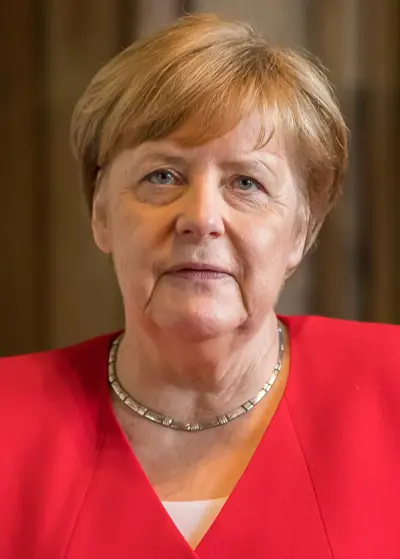
- Born: July 17, 1954
- Nationality: German
- Profession: Statesman
Angela Dorothea Merkel is a German politician serving as the chancellor of Germany since 2005. She served as leader of the Opposition from 2002 to 2005 and as leader of the Christian Democratic Union (CDU) from 2000 to 2018. A member of the Christian Democratic Union, Merkel is the first female chancellor of Germany. Merkel has been widely described as the de facto leader of the European Union, the most powerful woman in the world and by many commentators since 2016 as the "leader of the free world".
