James Stockdale Quotes
I had the best seat in the house to watch that event, and our destroyers were just shooting at phantom targets -- there were no PT boats there. There was nothing there but black water and American fire power
Stockdale was then a Navy pilot flying over the scene. It was a supposed attack by North Vietnamese PT boats against our ships that was President Johnson’s justification for escalating U. S. involvement in the Vietnam war. Some argue that the President acted on the basis of insufficient and uncorroborated information while opponents believe that the administration trumped up an excuse to escalate the war.
James Stockdale, Navy Admiral, Independent Vice Presidential Candidate, Description of the Gulf of Tonkin Incident
Sourced by: Eigen's Political and Historical Quotations


This referred to ships being torpedoed by the German U-Boats in the poster.

Months after the Tonkin Gulf incident, the President complained about the reliability of the information he had gotten from the navy, The escalaton of the Vietnam War was the result of Johnson acting on this information.

This was his most famous speech.

George was referring to the brutal realities of war (during the First World War).

For some people it was shocking that an administration would establish a high level White House group to "market" a war. See {583420} for one of the ways WHIG functioned.


A false flag operation is one where a country’s covert operatives attack some asset of the nation and blame it on a foreign enemy—often to consolidate political power or gain public support for a war. For example, the Nazi’s secretly burned down the German parliament and blamed it on the Russian communists.

He became one of the great heroes of the American navy and this statement is taught to every American sailor. Actually, although a very good Captain, in the battle with the Shannon, he made a number of mistakes which was unusual for him, but the Shannon won the battle. The American sailors did not give up the ship, but they were overcome with one of the highest casualty rates of any sea battle of the time. Had Lawrence lived—he dies of infection from his wounds—he probably would have faced a board of inquiry or a court martial, but his death turned him into an American hero. See {625129}. Commodore Perry, a friend of Lawrence, had “Don’t Give Up The Ship” sewn on to his battle flag, and the motto has been part of the United States Navy ever since.
The president had publicly stated that two American ships—Turner Joy and Maddox—had been attacked off the coast of North Vietnam. The ships returned fire an “drove the attackers off”. This incident was the justification of the Gulf of Tonkin Resolution which authorized the American military to bomb Hanoi and the rest of North Vietnam. The NSA had issued a secret report stating that there was no evidence of any attack at all even though the ships had fired their guns. One theory was that the very sensitive radar the shipps carried had detected a large school of flying fish, many of whom were out of the water at any one time. The President, who had escalated the war to respond to this “attack”, privately gave this explanation.


This quotation illustrated a military phenomenon whereby leading military commanders are important as long as they have and control many military assets. Therefore, they avoid serious battles where the might lose. Preserving assets becomes more important than the war objectives and honor and reputation trumps contribution to the war effort. History remembers well military leaders who battle and win. It also remembers leaders who control many assets and who do not lose or win. But the losing military leaders are consigned to the “dustbin of history”.

The French manipulated the war news more than the other nations but nations all did to some extent tending to exaggerate the positive and minimize the negative.

Before American entry into the War with Japan, Chiang Kai-shek and the Soongs maintained that they were fighting the Japanese but it was not generally true. They were fighting Mao and his Communists while Mao was fighting the Japanese. By 1942, under pressure from the United States and Russia, the Nationalists and Communists agreed to a truce so that they could both fight against Japan. Based on the promises made to President Roosevelt by Madam Chiang, the Soongs, and Chiang himself, there was an expectation of extensive military attacks against the Japanese. The U. S. then sent a large amount of military aid to Chiang Kai-shek, but there did not appear to be any significant attacks against the Japanese other than those mounted by the Communists. Magruder, General Marshall’s emissary to Chiang Kai-shek was instructed to investigate. When the war ended, Chiang Kai-shek used the assets he was saving in to attack Mao and his communists just as he had done before the truce. Magruder had been right. However, just as Chiang could not defeat the militarily inferior Communists before the truce, he could not do so after. Soon Mao turned the tables and drove Chiang Kai-shek and his Nationalists out of Mainland China. President Roosevelt had brilliantly judged the ability of England, Russia, and Yugoslavia to fight the Germans, but as this quotation and {641677} shows, he listened to the wrong people. He had been sold a “bill of goods” by the China Lobby, the Soongs and Chiang Kai-shek.


The sloop Margaretta was escorting 2 small merchant vessels came into the port of Machias, Massachusetts to purchase some lumber and firewood. However the commanding officer of Margaretta did not like the terms of the negotiations and threatened the town. An aroused and angry group of patriots then boarded and attacked the two merchant ships. The commander of Margaretta then maneuvered out of the port having lost the two small ships. But the Patriots were angry with the commander of the sloop and being excellent seamen who knew the local waters, used one of the merchant ships and a small local vessel to chase down the Naval sloop. They then boarded and captured Margaretta and fatally wounded the commander, James Moore. While Lexington was the first land victory for the patriots, this was the first sea victory and the Margaretta was the first British warship that was captured by the Patriots.

Koxinga had an overwhelmingly superior force, and wanted the Dutch to surrender and avoid bloodshed. The Dutch with their typical European colonial attitude, had great difficulty surrendering to “natives” even if outnumbered. Finally, the Dutch Commander agreed to surrender. Koxinga then established a Chinese Government on the Island and became a great hero of the Ming Dynasty. Note the graphic of the statue to him which is one of the very few Chinese memorial statues to a military hero showing him in action—very similar to European statues. Already Koxinga’s massed wooden junks with small cannon and fire torches had sunk one of the Dutch warships (they were not iron but had some iron plates on the deck to protect the gunners) and there were so many junks that the other Dutch ships sailed out to sea to avoid the Chinese huge number of junks.

Military men tend to rely so much on military history that they are almost always fighting the last war. Soon air power would supplant sea power as the critical factor. Then nuclear power, and then nuclear weapons became too severe for actual use and yet wars still continued with no consensus as to that will be in the future.


Most Americans do not realize that our naval forces were disbanded after the Revolution and even the Constitution did not require a navy. We had some Federal revenue cutters to interdict smugglers but no warships and no permanent sailors or officers. The Barbary Pirates had an incredible extortion racket going in the Mediterranean. If nations would pay them an annual sum each year, they would not attack and seize merchant ships of that country and sell the ships and goods while holding the sailors for ransom. See {640850},86703,{640846} & {640848}
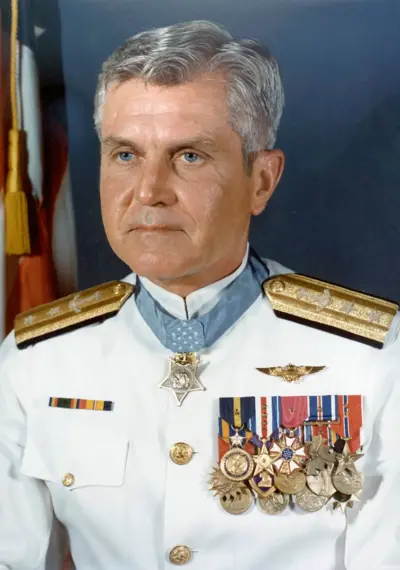
James Bond Stockdale was a United States Navy vice admiral and aviator awarded the Medal of Honor in the Vietnam War, during which he was a prisoner of war for over seven years.
