Lyndon B. Johnson Quotes
Those damn stupid sailors were just shooting at flying fish.
The president had publicly stated that two American ships—Turner Joy and Maddox—had been attacked off the coast of North Vietnam. The ships returned fire an “drove the attackers off”. This incident was the justification of the Gulf of Tonkin Resolution which authorized the American military to bomb Hanoi and the rest of North Vietnam. The NSA had issued a secret report stating that there was no evidence of any attack at all even though the ships had fired their guns. One theory was that the very sensitive radar the shipps carried had detected a large school of flying fish, many of whom were out of the water at any one time. The President, who had escalated the war to respond to this “attack”, privately gave this explanation.
Lyndon Baines Johnson, 1908-1973, 36th President of the United States (Democrat, TX), Admission by the President that the Gulf of Tonkin incident which justified the escalation of the Vietnam War to bomb North Vietnam never really occurred, Quoted in Hanyok, Skunks, Bogies, Silent Rounds, and the Flying Fish
Sourced by: Eigen's Political and Historical Quotations


The day before, Helms’ deputy testified about the high number of civilian casualties that American bombing of North Vietnam had caused.


He had just digested his predecessor’s reports and briefings as well as key interviews with senior military officers. See {637677} for his predecessor’s statement in the previous White House meeting on the War.


1914 was the outbreak of WWI in which all the belligerents had very different interests and reasons for war—even allies on the same side greatly differed as to their motivation for fighting.


Later, when he ran for the Democratic Presidential Nomination had had changed his mind and was a major opponent of the Vietnam War. This was the pattern of so many Americans whose first instinct was to support the government’s decision to wage war, and over time grew disenchanted with the war and ended up opposing the war actively.

sending American troops to Vietnam
After the French were driven out, Vietnam was supposed to have a national election to choose a government but the people of Vietnam were deeply split between those supporting the Communists and Ho Chi Min (who had led the campaign to oust the French from their colony) on one side and Vietnamese who were more Westernized and favored a democracy. Vietnam was mostly Buddhist but most of the Western oriented leadership of the Democracy advocates were Christians. They wanted to delay the election to give them a chance to organize to catch up with the communists at political organization. Ho Chi Min and the Communists already do facto controlled the North of Vietnam and decided to use force against the Western oriented forces whose military was much smaller than the Communists who had ejected the French. The United States provided financial aid and supplied weapons and Central Intelligence Agency assistance to the South Vietnam forces who were afraid of being overrun by the Communists headquartered in the North. Taylor’s mission was to go to Vietnam, assess the situation and make recommendations to President Kennedy.


The Viet Cong used Cambodia as a sanctuary from American bombing in the Vietnam War. They would transport arms and ammunition without the chance of American interdiction. The King wanted them out, and the American government started secretly bombing the Vietnamese in Cambodia. The Cambodians and the North Vietnamese obviously knew about the bombing and shared it with different intelligence agencies friendly to them. The only people who did not know about the Cambodian bombing were the American public as the administration kept it “secret” for domestic political purposes when the anti-war movement was gaining much support.


This quotation is of critical importance as it shows that the Germans were actually planning the First World War. See {642092} for another quotation on the subject.

Dreadnoughts were huge battleships. Britain had the dominant navy of the world and controlled the seas. A European war would be a land war where a navy would be of little use. Hence, Britain would not want to get involved in such a war where she could not use her greatest military strength. He was wrong about this and so much else. Britain entered WWI when Germany invaded Belgium fulfilling her treaty obligations. The Germans intelligence operators and analysts were well aware of the treaty obligations, but had little understanding of English culture and tradition. The German aggression against a small power like Belgium was morally offensive to many in Great Britain, and Britain had a tradition of fighting for moral principles. The Germans would never militarily disadvantage themselves for the sake of a treaty obligation to a small nation, and they did not believe that the British would be so different and fulfill their treaty obligations even though their strongest military asset—their navy would not be very helpful.

The Polk Administration wanted War with Mexico but felt it would not have public support if the Unites States was the aggressor. So the Army was sent to the border to provoke the Mexicans to attack first. The strategy worked and President Polk had much more support since he claimed that Mexico had attacked American Soldiers and retaliation was necessary. In the aftermath of the Mexican War, the United States obtained much new territory including the Southwestern States and Mexico was destabilized.


One of the major reasons that President George W. Bush had given for invading Iraq was that Iraq had weapons of mass destruction. None were found.

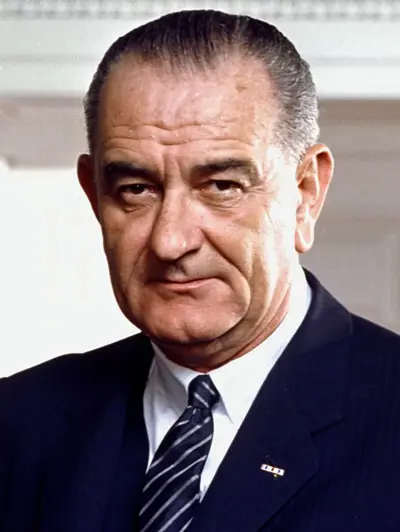
Lyndon Baines Johnson, often referred to by his initials LBJ, was the 36th president of the United States, in office from 1963 to 1969. He served as the 37th vice president from 1961 to 1963 and assumed the presidency following the assassination of President John F. Kennedy. A Democrat from Texas, Johnson was also a United States representative and later majority leader in the United States Senate. Johnson is one of only four people to have served, at various times, in all four federal elected positions.
