Condoleezza Rice Quotes
I feel that we're dividing along class lines for the first time in our history. Now one thing that has happened in this reaction to globalization is that the elites are not respectful of the values of those who are ordinary citizens, so we seem to be dividing ourselves into ever-smaller identity groups, each with its own narrative, each with its own grievance, and that's a problem.
Rice, Condoleezza. Interview by Charlie Rose. CBS This Morning, CBS, 9 May 2017.


This was his most famous speech.


This was the prevailing view in Europe at the time; it was less so in the United States, where there were so many people who owned their own land and farmed it or developed manufacturing facilities and hence were the mind AND the limbs of the enterprises. However, the upper classes tended to agree with the European view. The difference between the American and European views was one of class mobility. In America “limbs” who demonstrated capacities of “mind” were much more able to advance in America. However, even into the 21st century here was a general feeling of the upper class that the “minds” made the critical and impactful decisions. This is one of the reasons that executive and CEO pay advanced so rapidly when compared with workers (the “linbs”).


After Roosevelt, most eras of American politics more or less followed the pattern Roosevelt described herein as a “calamity”, with the anger becoming more or less intense. Jefferson thought that these were natural divisions of politics in all societies--{604810}. The thing that masked this for years was race and slavery. In Lincoln’s time there were liberals and conservatives in both parties if race were ignored. In Theodore Roosevelt’s era, he, Taft and others were generally liberal reformers, while a large number of Republicans were conservative supporters of the status quo. Some democrats were radical reformers like William Jennings Bryan while others were arch conservatives. Until 1964 and the Civil Rights Act there were many conservatives in the Democratic Party, but almost all switched to the Republican Party in anger. The Republican conservatives tended to drive the Republican liberals out of the party and for the last part of the 20th century Roosevelt’s “calamity” well described the American political scene, and the anger increased carrying partisan bitterness into the 21st century.


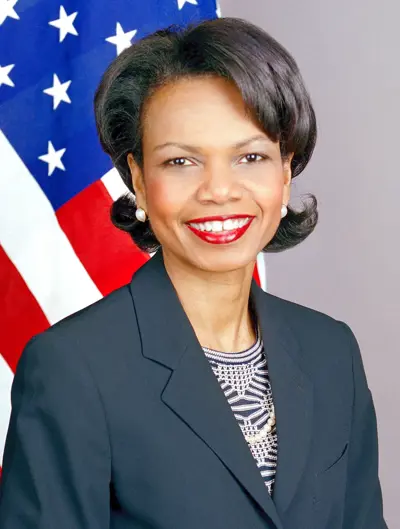
Condoleezza "Condi" Rice is an American diplomat, political scientist, civil servant, and professor who is the current director of the Hoover Institution at Stanford University. Rice served as the 66th United States Secretary of State from 2005 to 2009 and as the 20th United States National Security Advisor from 2001 to 2005. A member of the Republican Party, Rice was the first female African-American secretary of state and the first woman to serve as National Security Advisor. Until the election of Barack Obama as president in 2008, Rice and her predecessor, Colin Powell, were the highest-ranking African Americans in the history of the federal executive branch (by virtue of the secretary of state standing fourth in the presidential line of succession).
