Thomas More Quotes
I die the King’s good servant, but God’s first.
Thomas More, 1478-1535, Speaker of the House of Commons, Lord Chancellor of England, Catholic Saint, Statement prior to his execution for high treason, July 6, 1535
Sourced by: Eigen's Political and Historical Quotations

Thomas of London. Tennyson’s quotations was not literal but the synthesis of the conflict. Beckett was the friend of King Henry and his Chancellor. Henry against Becket’s advice appointed him Archbishop of Canterbury, the head of the church in England. Soon Henry came into conflict with the Church and Thomas sided with the Church and against his old friend and king. The king had him assassinated despite their friendship.

Clark had Hancock and Adams for dinner. Paul Revere arrived to announce that “the British are coming.” The guests asked Reverend Clark if he thought that the people of Lexington would fight. They did, and some died.


They became Company C of the 125th Regiment of the Pennsylvania Volunteers, and were known as the Huntington Bible Company. See {618057}.

The Poles were fighting the Russians. Pulaski was a Field Marshall. This was before he had come to America and fought in the American Revolution.

Joseph Addison had earlier written of such a situation. Recent research has strongly suggested that Hale may never have said these words. The American patriots wanted to have heroes and may not have been too worried about the documentation and historical research. See {621112}


This is the type of person who suicide bomber recruiters seek out.


Compare Nathan Hale's last words.


The city was besieged by the Ottoman Turks. The Emperor stayed and died in the siege. Ironically, if he had escaped earlier and allowed the city to surrender to the Sultan and his troops, very few of the city residents would have died, and the rapine and pillaging never would have occurred. The negative result is that the Muslims would have controlled what was regarded by many Christians as a holy Christian city. But that is exactly what occurred.


Saint-Just himself was executed at the age of 27 by the mechanism he had created.
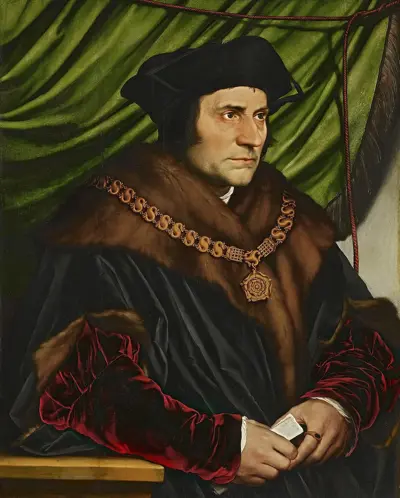
Sir Thomas More, venerated in the Catholic Church as Saint Thomas More, was an English lawyer, judge, social philosopher, author, statesman, and noted Renaissance humanist. He also served Henry VIII as Lord High Chancellor of England from October 1529 to May 1532. He wrote Utopia, published in 1516, which describes the political system of an imaginary island state.
