Dwight D. Eisenhower Quotes
I deplore the need or the use of troops anywhere to get American citizens to obey the orders of constituted courts.
Eisenhower, Dwight D. "Telegram to Senator Richard B. Russell." 27 Sept. 1957. Public Papers of the Presidents of the United States: Dwight D. Eisenhower, 1957, Office of the Federal Register, 1958, p. 694.


South Carolina passed a state law which overrode and nullified Federal Laws that they did not like. It was a type of secession. President Jackson, in his own blunt style, let them know that they had better not try to implement their nullification law. Of all the Presidents in American History, Jackson had the least respect for Constitutionality and due process. He had a history of summary execution where he was the judge, jury and almost the personal executioner. He is the only president in American history who refused to obey and order of the Supreme Court. There were few who doubted that he would make good on his threat. The South Carolina convention reconvened and repealed its Nullification Ordinance on March 11, 1833.


This proclamation was obviously unconstitutional, but at the time no one challenged it in the courts. It is yet another example, where in an emergency, executive officers of government tend to over-reach and expand their power and authority using the necessity of the emergency as the justification. This case was particularly ironic in that the mayor, so concerned with law and order that he would summarily kill people suspected of looting, was indicted and convicted for corruption the following year. His jail time was limited by a successful court appeal, and he then lost as a mayoralty candidate, but did finally get elected to the San Francisco City Council. Of course, had he been shot when first suspected of his crime—as he proscribed for others--he would never have had the opportunity to appeal and be acquitted.

This is a very important political, historical, and philosophical quotation. This is a view that is very common amongst many Americans—especially those who are religious. As a factual matter, it is not clear that ALL the founding fathers personally believed in the creator--God. All the views have never been discerned. However it is almost certain that the majority of the Founders so believed. The complication with taking this viewpoint too literally is that while our rights may have come from God, it is men who determined exactly what rights would be enumerated on our constitution. For example. the original draft of the Constitution did not include, the right to a free press, the right of due process, the right of being free from religious compulsion and others. Yet it passed. Then other men and women wanted more rights added and the Constitution was ratified on condition that the Bill or Rights would be incorporated as the first 10 amendments. There were other rights that were not explicitly mentioned. For example, there is no right to an education mentioned in the Constitution or any of the amendments. Blacks had no rights until additional amendments were passed. And later there was an amendment that denied Americans the right to drink alcohol. Then another that gave the rights back. There are rights that other nations have which we do not—ie the right to medical care. Which if these did God grant and which, not? So even if we assume that every one of the founding fathers not only believed in God, but believed the rights were all God given, we would still be in the practical dilemma of having to specify the language of each right and always to, by amendment, adding additional rights or modifying or even deleting older rights. Many believe that Americans were divinely inspired when we added (or changed) rights. Others, not. However, regardless, we must go through the same procedures of enumerating American rights and amending the constitution. So the process is the same for both those who believe that our rights come from God and those who do not. To change rights, we need the action of Americans divinely inspired or otherwise, but they can and have been changed. For example, before 1963 Americans did not have a right to use birth control devices. After the Supreme Court Griswald v. Conn. We did and now have a right to use birth control devices. The mode that rights are manifested, defined, enumerated and implemented is a political one—one that in our American system allows us all to implement that system whether or not we believe that our rights come from our Creator.


In a 1949 dissenting opinion in Terminiello v. Chicago Jackson claimed the majority view would “convert the Bill of Rights into a suicide pact.”

He had no authority to do this. He just took it upon himself. This was one of the incidents which caused later Congresses to pass very strict laws limiting the authority of all Federal Military and other intelligence and police forces so that they have little or no authority within the United States. President Lincoln did not allow the order to stand, although he repudiated it very delicately and as privately as possible. Many in his own party strongly favored this proclamation as it cracked down on the Southern Rebels and emancipated slaves—both objectives of many Republicans. In addition, Fremont was very popular with the people and had strong political connections. (He would later run for President.) See {635739}.


‘Necessity’ is another word that governments use in such situations. To deal with “National Security” governments tend to extend their power over individuals, encroach upon civil rights” and repress their population. This is true of right and left wing governments, democracies and dictatorships.


This is just the opposite of the American Democracy in which the government serves the citizens rather than the Fascist opposite notion.

Americans are divided as to whether this should be encouraged and helped or not.

Later that year he sent federal troops to Little Rock, Arkansas to enforce a desegregation order.
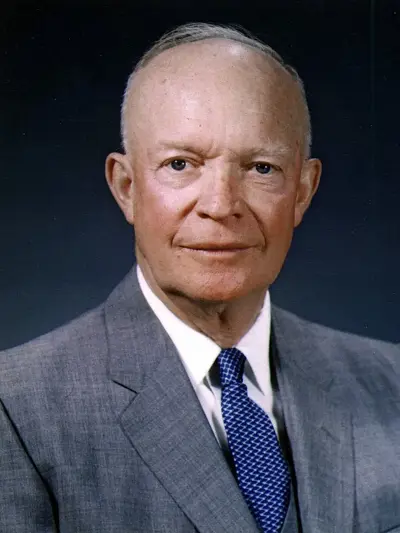
Dwight David "Ike" Eisenhower GCB OM GCS CCLH KC NPk was an American military officer and statesman who served as the 34th president of the United States from 1953 to 1961. During World War II, he became a five-star general in the Army and served as Supreme Commander of the Allied Expeditionary Force in Europe. He was responsible for planning and supervising the invasion of North Africa in Operation Torch in 1942–43 and the successful invasion of Normandy in 1944–45 from the Western Front.
