Antonin Scalia Quotes
[The] government has room to scale back individual rights during wartime without violating the Constitution. The Constitution just sets minimums. Most of the rights that you enjoy go way beyond what the Constitution requires.
Scalia, Antonin. Public lecture. John Carroll University, Cleveland, OH, 18 Mar. 2003.


This is a very important political, historical, and philosophical quotation. This is a view that is very common amongst many Americans—especially those who are religious. As a factual matter, it is not clear that ALL the founding fathers personally believed in the creator--God. All the views have never been discerned. However it is almost certain that the majority of the Founders so believed. The complication with taking this viewpoint too literally is that while our rights may have come from God, it is men who determined exactly what rights would be enumerated on our constitution. For example. the original draft of the Constitution did not include, the right to a free press, the right of due process, the right of being free from religious compulsion and others. Yet it passed. Then other men and women wanted more rights added and the Constitution was ratified on condition that the Bill or Rights would be incorporated as the first 10 amendments. There were other rights that were not explicitly mentioned. For example, there is no right to an education mentioned in the Constitution or any of the amendments. Blacks had no rights until additional amendments were passed. And later there was an amendment that denied Americans the right to drink alcohol. Then another that gave the rights back. There are rights that other nations have which we do not—ie the right to medical care. Which if these did God grant and which, not? So even if we assume that every one of the founding fathers not only believed in God, but believed the rights were all God given, we would still be in the practical dilemma of having to specify the language of each right and always to, by amendment, adding additional rights or modifying or even deleting older rights. Many believe that Americans were divinely inspired when we added (or changed) rights. Others, not. However, regardless, we must go through the same procedures of enumerating American rights and amending the constitution. So the process is the same for both those who believe that our rights come from God and those who do not. To change rights, we need the action of Americans divinely inspired or otherwise, but they can and have been changed. For example, before 1963 Americans did not have a right to use birth control devices. After the Supreme Court Griswald v. Conn. We did and now have a right to use birth control devices. The mode that rights are manifested, defined, enumerated and implemented is a political one—one that in our American system allows us all to implement that system whether or not we believe that our rights come from our Creator.


The Grammar Curmudgeon. Almost every government action to protect rights impinges on the rights of some. For example, laws to protect minorities from discrimination in the workplace impinge on the right of employers to hire whomever they want. The Voting Rights Act eliminating the Poll Tax instituted to prevent Negroes from voting, impinged on the Southern States’ rights to determine the election rules and standards for their states. Laws requiring all pharmaceuticals to be approved by the Food and Drug Administration to protect the public from dangerous drugs interfere with the doctor’s and patient’s rights to determine the best treatment and the drug company’s right to sell whatever products they want.

In a 1949 dissenting opinion in Terminiello v. Chicago Jackson claimed the majority view would “convert the Bill of Rights into a suicide pact.”


The early legal meaning of Civil Rights was very narrow. It referred to rights in normal non-governmental activities---shopping, education, social interaction, etc. However, it was the government who was depended on to enforce these rights. Later activities operated by state and local government were included like public education or the right to use a public bathroom, and for many even includes voting rights. Modern definitions consider civil rights to include all those rights to which an individual is entitled by virtue of his citizenship—including voting rights and others having to do with government—especially those of the 13th and 14th Amendments.


The major phrase was first used in a dissent by Justice Robert Houghwout Jackson in 1949 {633526} and later by Chief Justice Earl Warren {601702}
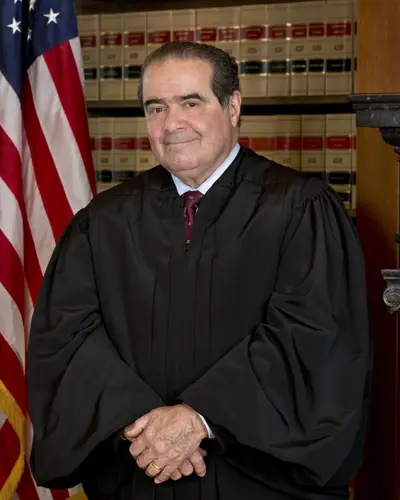
Antonin Gregory Scalia was an American jurist who served as an associate justice of the Supreme Court of the United States from 1986 until his death in 2016. He was described as the intellectual anchor for the originalist and textualist position in the Court's conservative wing. For catalyzing an originalist and textualist movement in American law, he has been described as one of the most influential jurists of the twentieth century, and one of the most important justices in the Supreme Court's history. Scalia was posthumously awarded the Presidential Medal of Freedom in 2018 by President Donald Trump, and the Antonin Scalia Law School at George Mason University was named in his honor.
