Albert Einstein Quotes
[There is] a duty in refusing to cooperate in any undertaking that violates the Constitutional rights of the individual. This holds in particular for all inquisitions that are concerned with the private life and the political affiliations of the citizens.
Einstein, Albert. "Einstein Letter Warning On Inquiries." The New York Times, 12 Jun. 1953, p. 9.


Note the use of the phrase “against the government.” One of the unique aspects of the American Constitution and The Bill of Rights is that the government is considered a potential and even probable infringer on the liberties of the people. It is almost as though the government was the potential enemy. Modern libertarians state this very explicitly and it is ever present in the views of both the right and left wings of American politics. Most centrists recoil at the thought that some citizens see the government as the enemy, but even in America there have been times where the government has infringed on the rights of citizens only to have the courts or future administrations and Congresses correct the error.

The major phrase was first used in a dissent by Justice Robert Houghwout Jackson in 1949 {633526} and later by Chief Justice Earl Warren {601702}


See {587703} for a similar statement by a Supreme Court Justice.

The early legal meaning of Civil Rights was very narrow. It referred to rights in normal non-governmental activities---shopping, education, social interaction, etc. However, it was the government who was depended on to enforce these rights. Later activities operated by state and local government were included like public education or the right to use a public bathroom, and for many even includes voting rights. Modern definitions consider civil rights to include all those rights to which an individual is entitled by virtue of his citizenship—including voting rights and others having to do with government—especially those of the 13th and 14th Amendments.


This is probably the first known use of the Bill of Rights phrase in the English language. For the earliest American use, see Edward Rutledge.

For the classic formulation, see Brandeis, Olmstead v. U.S., 1927

Hayward claimed that Wilson was the first American President who ever criticized the American Constitution. Many do not agree as Madison and Jefferson in part, along with most other Americans, found the Constitution so wanting that it was ratified only on condition of the passage of the Bill of Rights. Jackson, was distressed by the limitations on the President and many others had their objections, but Wilson, before he became a politician was a prominent academic political scientist and wrote voluminously and had an intellectual following so his criticism was not considered so “political” as others.

Many New Yorkers and others felt that since the attack on the World Trade Center was made in the name of Islam, the mosque and commuity center should be built in another location further from Ground Zero. Ellison was debating someone who argued that the Mosque should not be built so that sensitivity can be shown for those New Yorkers who lost relatives and friends in the attack of September 11. Rather than insist on their Constitutional rights, the Muslim leadership of the project, moved the location somewhat further away from Ground Zero.
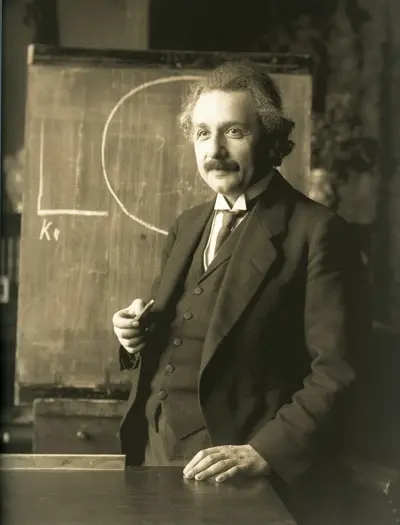
Albert Einstein was a German-born theoretical physicist, widely acknowledged to be one of the greatest physicists of all time. Einstein is known for developing the theory of relativity, but he also made important contributions to the development of the theory of quantum mechanics. Relativity and quantum mechanics are together the two pillars of modern physics. His mass–energy equivalence formula E = mc2, which arises from relativity theory, has been dubbed "the world's most famous equation". His work is also known for its influence on the philosophy of science. He received the 1921 Nobel Prize in Physics "for his services to theoretical physics, and especially for his discovery of the law of the photoelectric effect", a pivotal step in the development of quantum theory. His intellectual achievements and originality resulted in "Einstein" becoming synonymous with "genius".
