Lawrence Wilkerson Quotes
I can still hear George Tenet telling me, and telling my boss in the bowels of the CIA that the intelligence was rock solid. I sat in the room, looking into his eyes, as did the Secretary of State and heard it with the firmness that only George Tenet could give it …. George Tenet assuring Colin Powell that the information he [Powell] was presenting to the United Nations was ironclad.
Powell, after being assured that the intelligence about the Iraq WMD showing that they were about to deploy a nuclear weapon and they had poison gas was absolutely true, was the major spokesperson to the UN and much of the United States justifying the Iraq War. It was all untrue, and Powell’s credibility which had been exceptional was hurt very badly. He soon resigned.
Lawrence Wilkerson, Military Officer and Chief of Staff for Secretary of State Colin Powell Remarks, New America Foundation, October 19, 2005
Sourced by: Eigen's Political and Historical Quotations


This is a major issue for the nation. How can the president be responsible if he is not informed? However, some argue that the President must have “plausibility deniability” so he can deceive foreign leaders without lying to them. The laws require that nothing may be withheld from the President but there are some in the agency including past directors who believe that they sometimes should lie to the President or withhold information when it is in the national interest—which of course only they judge without any checks and balances.

After the invasion, much of the intelligence upon which America relied on Invading Iraq turned out to be completely wrong. It turned out that the Vice President at least, a major supporter of the invasion, had a role in “shaping” the intelligence and analysis to achieve a policy objective.

His catastrophic failure however was when he supported the Neocon ideology that Iraq had a nuclear bomb about to be deployed and urged a preventative war invading Iraq. Not only was there no bomb ready for deployment, there was net even a nuclear research or development program to do anything nuclear.

Agree resigned from the CIA in protest to its political position.

Kay was chasing around Iraq trying to find the weapons that the George W. Bush administration had said definitely existed. Based on the weapons existence, the United States went to War in Iraq. No weapons were ever found.

See {634917} for a recent example of lying under oath to the Senate.

As Secretary of State, Powell was going to address the UN Security Council on the 5th and he was coordinating his speech with the other agencies of the government. His criterion was that he only wanted to make accusations that were backed up by incontrovertible evidence. However, VP Richard Cheney and his aide, Scooter Libby, kept inserting an accusation that Iraq was involved with and supported Al Qaeda. This was one of the many speculations that those who wanted to justify attacking Iraq kept using as Domestic propaganda. When Powell asked for proof or intelligence reports and none could be provided, he removed the accusation from the speech explaining why. However, at the last minute, Cheney and his staff put the accusation back in, and that triggered the quotation. Unfortunately, Powell was so busy fending off totally absurd accusations, that he accepted the CIA assurances {79468} that Iraq was developing nuclear weapons that were about to be operationalized and never heard from those who questioned the credibility of the sources for the basic accusation. Powell had great trust among the diplomats of the world then gave the United States version to the Security Council and justified our coming invasion of Iraq. But the intelligence report, despite the assurances of the CIA and the Vice President, was false and Iraq not only was not close to a nuclear weapon but he had no program at all at that time to try and develop one. Powell resigned and his credibility about the world was ruined as he was then seen as just another lying politician.

Kennedy was a relatively new president and the Bay of Pigs Operation was prepared and planned by the CIA under the Eisenhower Administration. The president assumed that the intelligence was correct and there would be an uprising of the Cuban people when as soon as the landing took place. That was all wrong and the Cubans actually supported Castro and the operation was a disaster. Kennedy never trusted the CIA after that.

As a member of NATO, the Prime Minister was given the same faulty intelligence that the Bush Administration gave to Congress, our allies and gave to Colin Powell to brief the United Nations. All were similarly misled. There were no WMDs in Iraq and Iraq did not even have an active program to develop them.
He was the leader of the team that followed to invading troops into Iraq to find the nuclear and other WMDs that the CIA had said were deployed and ready to be used. They found none. Worse for the CIA, there were not even any development programs ongoing. The CIA Director was furious with Kay for admitting the CIA gross error. Kay was given minor assignments thereafter even though he was the best WMD analyst we had.

even though in this case the objective The State Department, the Defense Department and most important President Kennedy had decided to get rid of Diem. Most of the Central Intelligence Agency thought that this was a very unwise policy, because Diem was a known risk, and the people who would replace him and their talents and policies were unknown. The negatives of Diem—the facts that he, a Christian, was persecuting the majority Buddhists, was totally corrupt, and not a very good leader was less distressful to the CIA than to the President and the other agencies as the intelligence agency frequently not only tolerated “offensive” allies, but actually employed them including war criminals. Another importance of this quotation is that it shows that it was by no means certain that the CIA would always follow the orders of the President and the government policy makers. Colby, who was not the agency director at that time but was the head of the South East Bureau, was one high level official who argued that the policies should always be followed even if they were unwise or foolish. Another importance of this quotation is that it illustrate a common error that administrations are frequently forced to make: making a policy decision to eliminate a problem while not having much of an idea of what the alternative or consequence would be when the policy is implemented. The Syrian Civil War in 2013 was a good example. The Government side appeared to have used Chemical Warfare on Civilians and public opinion demanded that we do something. However, having a no-fly zone or any of the alternatives to prevent (punish) the government for the Chemical Warfare would strengthen the rebel side which was made up of numerous factions—some of which were known Islamic fundamentalist terrorists and jihadists. If the balance of power were tipped toward the rebels, the consequence for the American national interests were unknown—just as the consequence of ousting Diem was unknown and turned out to also be bad and was probably worse.

The then CIA Director, Allen Dulles, fostered a practice of “adjusting” intelligence reports to support ideological policies and theories that were then in vogue. The agents in the field knew what was wanted and many adjusted their reports to coincide with the overall intelligence and policy. The station chiefs and other supervisors often ignored reports of their agents that they knew were not exactly accurate. Copeland however, just fabricated reports and “information” from sources. The honesty and integrity of the CIA intelligence operations have varied from time to time and depended much on the CIA Director at the time. Allen Dulles, though brilliant and able, fostered an ideological intelligence agency. He even went so far as to lie to the President on several occasions.

The CIA intelligence had been shared with key world leaders to gain support for the George W, Bush administration invasion of Iraq. Blix was bothered by the fact that although the intelligence was so certain why were not any of the locations known. The answer, of course, was that there was no such development and the intelligence was faulty, but at the time, only he seemed to be bothered by this point. See also {588115}.
He was one of the few people with knowledge about Iraq and their so called WMD program who casted doubt on the CIA and George W. Bush’s “intelligence” that Iraq was about to deploy a nuclear weapon. They anonymously tried to discredit Blix. It was Blix however who turned out to be rights.


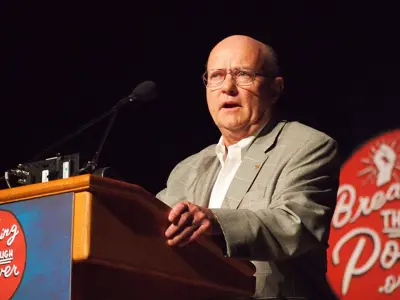
Lawrence B. Wilkerson is a retired United States Army Colonel and former chief of staff to United States Secretary of State Colin Powell. Since the end of his military career, Wilkerson has criticized many aspects of the Iraq War, including his own preparation of Powell's presentation to the UN, as well as other aspects of American policy in the Middle East.
