John Wayne Quotes
I believe in white supremacy, until the blacks are educated to a point of responsibility. I don't believe giving authority and positions of leadership and judgment to irresponsible people ... I don't feel we did wrong in taking this great country away from [the Native Americans] ... Our so-called stealing of this country from them was just a matter of survival. There were great numbers of people who needed new land, and the Indians were selfishly trying to keep it for themselves.
Wayne, John. Interview by Richard Warren Lewis. Playboy, May 1971.

Carson was one of the few Indian Agents who spent every penny of his budget on the Indians as opposed to himself. He was married to an Indian woman and was close enough to many Indians that he understood their resentment whenever they came into a town. They were treated terribly and while most of them were literally starving, seeing the white opulence produced resentment.

This quotation shows that the racism and master race of Nazi Germany was a norm in Germany well before Adolf Hitler and the Nazis. It was an endemic part of the culture. This makes the German post WWII reforms all the more remarkable as the vast majority of an entire nation had to radically change its world and personal views and perceptions.


The Boers, the early Dutch settlers to South Africa were a “scurvey lot” who were very uneducated, narrow minded, and insular. They eventurally esterminated whole tribes of Blacks, caused the Boer War, and operated the disasterous apartheid era of South Africa. But the early Dutch governors of South Africa had great trouble with the Boers as well. See {583928} & {583928} for English similar assessments.

Mexico was in a chaotic state with the central government not able to control the countries, especially in the North. There were numerous American proposals like this one. See {596921}.


Describing the ethnic immigration quotas that Congress was debating in 1924:


The Boers were lower class, uneducated, farmers from Holland who came to South Africa before the English did. They were at the bottom of the Dutch socioeconomic ladder. Unlike the English who were interest in establishing a trading colony, the Boers just wanted to own and farm the land and use blacks as slave or cheap labor. The Dutch Government and Trading companies lost interest in South Africa as there were much more profitable parts of the world, and they felt no obligation to the Boers whom they were glad to be rid of. So the Boers found themselves having to follow the British laws and rules of the British Colonial Office. Slavery was outlawed, and Blacks could be educated and become citizens under British law. They could own land, and contest the right of the Boers who had settled in some uninhabited land and some that was owned by Black tribes. The Blacks outnumbered the whites in general and the Boers, and there were educated Blacks who “outclassed” the still relatively uneducated Boers. So the Boers, fighting for their “way of life” set up their own area in Southern Africa and claimed independence. But Blacks claimed that it was their land and looked to the British to exercise English law. The Boer war ensued. Although the Boers lost the war, the bred at a much faster rate than the English, many of whom did not even have their families in South Africa. By the end of WWII, the Boer white majority controlled the government and kept the majority Blacks from voting and having full citizenship rights. They dominated Apartheid South Africa until the Black Revolutionists obtained control and although Black and white relations are better in South Africa than most countries, the extemeist Boers and most militant Blacks are in political, but not violent, conflict. Churchill and the British have always perceived themselves as being caught in the middle between the Boers and the Blacks.


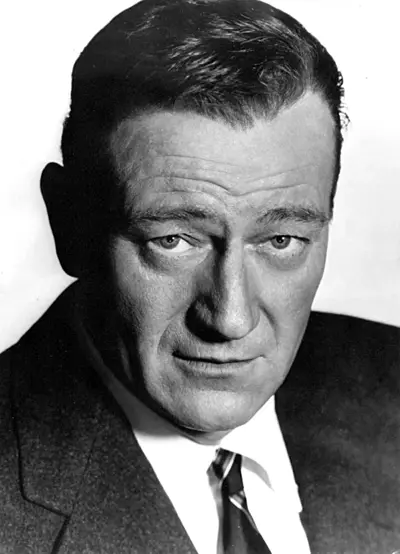
Marion Robert Morrison, known professionally as John Wayne and nicknamed Duke, was an American actor and filmmaker who became a popular icon through his starring roles in Western films. His career spanned from the silent era of the 1920s, through the Golden Age of Hollywood and eventually American New Wave, appearing in a total of 179 film and television productions. He was among the top box office draws for three decades, and appeared with many other important Hollywood stars of his era.
