Rutherford B. Hayes Quotes
I am now in a contest on the question of the right of Senators to dictate or control all nominations. Mr. [Roscoe] Conkling insists that no officer shall be appointed in New York without his [Conkling's] consent, obtained previously to the nomination.
Rutherford B. Hayes, 1822-1893, 19th President of the United States (Republican, OH), Diary, December 9, 1877
Sourced by: Eigen's Political and Historical Quotations

The "single Senator" was Roscoe Conkling. He was the Republican Party Leader (Boss) and a great proponent of the Spoils System of giving all Federal appointments to loyal party men without regard for competency and merit. See {622341} and {622340} for Hayes’ contest with Conkling.


Most legislative bodies have rules about when and under what conditions a vote is taken. Amendments, procedures, committees all have procedures where votes may be taken that could defeat a nomination or a proposed law but if those defeats fail, there still is not necessarily a law passed or a nomination confirmed. That has to be a separate vote, often called an “up or down vote.” One parliamentary mechanism for opposing a bill or a nomination is to keep voting on amendments and procedures and never have an up or down vote. This is actually true with the vast majority of the laws proposed in both houses of the Congress. Most never do have an up or down vote. Why Gerhatdt and other ask should judicial nominations be different from any law, or any other presidential nomination? Also see {588517} for another factor.


a posh upper-class private club joined by most Conservative politicians


The title is borrowed from Senate Rule 38, which asks whether the Senate will advise and consent the given nomination.


Senator Conkling was the Republican Leader of the Republican Party and a party boss of the old school. Hays was a reformer, especially about appointments where he generally tried to pick the most meritorious candidate instead of the party loyalists desired by Conkling. There was (and still is) a tradition in the Senate that the Senators from the state of residence of any Presidential appointment had a veto of any Federal appointments in the state. Conkling, in addition to being the party leader, was the senior senator from New York and wanted two party loyalists for the jobs. Hayes appointed the better qualified men and decided to fight for the nomination of his candidates, but expected tha Conkling was strong enough to assure that the Senate would not confirm Hayes’ New York appointments. See {622341} for the outcome.

Platt was the boss of the Republican Party which controlled New York State, His personal office was at 49 Broadway in New York City. See {622998} for more on Platt power in New York.
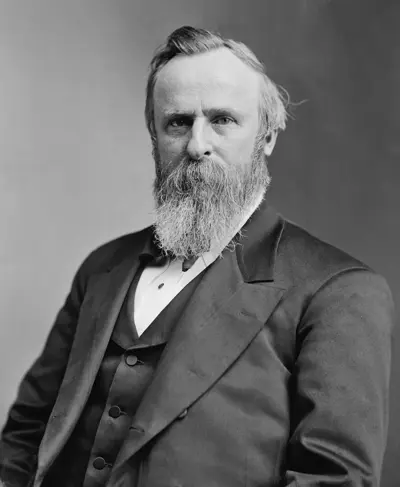
Rutherford Birchard Hayes was an American politician and attorney who served as the 19th president of the United States from 1877 to 1881, after serving in the U.S. House of Representatives and as governor of Ohio. A lawyer and staunch abolitionist, he had defended refugee slaves in court proceedings during the antebellum years. He negotiated the political agreement to end federal support of Reconstruction.
