Elihu Root Quotes
The government of the State has presented two different lines of activity, one of the constitutional and statutory officers of the State, and the other of the party leaders,—they call them party bosses. They call the system—I don’t coin the phrase, I adopt it because it carries its own meaning—the system they call "invisible government." For I don’t remember how many years, Mr. Conkling was the supreme ruler in this State; the Governor did not count, the legislatures did not count; comptrollers and secretaries of state and what not, did not count. It was what Mr. Conkling said, and in a great outburst of public rage, he was pulled down. Then Mr. Platt ruled the State; for nigh upon twenty years he ruled it. It was not the Governor; it was not the Legislature; it was not any elected officers; it was Mr. Platt. And the capitol was not here; it was at 49 Broadway.
Platt was the boss of the Republican Party which controlled New York State, His personal office was at 49 Broadway in New York City. See {622998} for more on Platt power in New York.
Elihu Root, 1845-1937, U. S. Secretary of War & U. S. Secretary of State, U. S. Senator (Republican, NY), Nobel Laureate in Peace, Speech, 1915
Sourced by: Eigen's Political and Historical Quotations


Republican Party primary elections had become very contentious. The radical right and the Tea Party, though a minority of the party, had the power to destroy almost any Republican candidate’s chances. So those Republican political candidates were forced to pander to the extreme right and then try and backtrack to the center for the general election. As a result, few people believed the statements of Republican office seekers as no one knew what they really believed including members of their own party, Bush, no longer running for any political position, found himself with much more credibility and influence in the party than those who were running for office. The problem of appealing to party extremes was not unique to the Republicans at that time, but the degree and extent was unprecedented accounting for the distrust.

2nd Viscount Melbourne. Party discipline has been a problem for party leaders whenever there are political parties.


The 2014 House of Representatives was probably the worst in American History. The Republican Speaker of the House did not have any control over the Tea Party wing of his caucus, but they controlled him in most instances. Even when he made bargains with the President and the Democrats, he could not get his caucus to go along. Almost no legislation was passed and the few bills that were passed were symbolic, were never considered by the Senate and the President did not even have to exercise his power of veto during that Congress.

Samuel Langhorne Clemens, 1835-1910


San Francisco Machine Boss Abraham At that time, there were very few jurisdictions with primary elections. Most, like California, selected the party candidates at party conventions. At the time the Railroads had bribed or employed enough delegates to the Party Convention to veto any candidate they did not like. And Pardee was in their sights as he was a supporter of the Theodore Roosevelt concept of preservation of public lands. That meant less land for the Railroads to obtain, develop, build a railroad line and station in the area and then sell the land in smaller parcels at a huge profit.


Roosevelt was running again for the presidency, however this time as a Third Party Candidate. He lost to Woodrow Wilson but outpolled the Republicans. This was the Third Party performance since Abraham Lincoln.

Hanna, managing William McKinley’s Presidential Campaign against William Jennings Bryan, outspent is opponents by a factor of ten to one. Few understood that at the time or the profound effect that money could play in national politics. Hanna was a political strategist far ahead of his time.


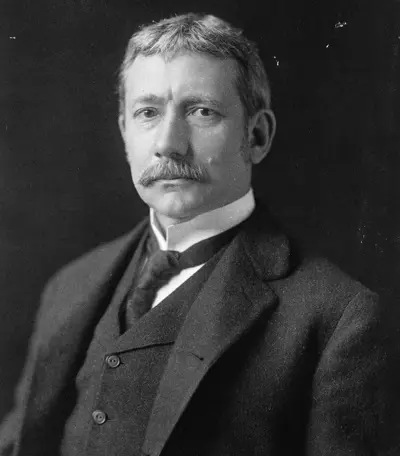
- Born: February 15, 1845
- Died: February 7, 1937
- Nationality: American
- Profession: Lawyer
Elihu Root was an American lawyer and statesman who served as Secretary of State under President Theodore Roosevelt and as Secretary of War under Roosevelt and President William McKinley. He moved frequently between high-level appointed government positions in Washington, D.C. and private-sector legal practice in New York City. For that reason, he is sometimes considered to be the prototype of the 20th century political "wise man", advising presidents on a range of foreign and domestic issues. He was elected by the state legislature as a U.S. Senator from New York and served one term, 1909–1915. Root was awarded the Nobel Peace Prize in 1912.
