Marquis de Lafayette Quotes
I am astonished but not discouraged by my enormous responsibility. Devoted both from affection and duty to the cause of the people, I shall combat with equal ardor aristocracy, despotism, and faction.
Lafayette, Marie Joseph Paul Yves Roch Gilbert Du Motier. Memoirs, Correspondence and Manuscripts of General Lafayette. Vol. 3, Saunders and Otley, 1837.

This quotation is historically important because Davis clearly states the reason for the rebellion of the South. The anti-slave states were growing at a greater rate than the slave states and despite the greater voting power that a southerner had (a result of the 3/5 count of slaves for census purposes, and the Senate), the handwriting was on the wall and the majority of the United States was against the vicious institution of slavery and would make it unprofitable, impossible and/or illegal in the coming years. Southern slavery advocates saw this as a “tyranny of the majority” and therefore took up arms. In the early 20th century, apologists for the Southern rebellion tried to promote the idea that there were reasons other than slavery, but this quotation and the resolutions of the states who withdrew from the Union make it clear that the right to maintain slavery was the only significant issue. In that sense it was a States’ Rights issue, but the South was opposed to States’ Rights when it came to States refusing to return fugitive slaves when Federal Law required such under the Dred Scott Supreme Court Decision.

Although English, Cobett spent time in America and published a newspaper, The Porcupine Gazette, in Philadelphia. We was very conservative and even proposed legally enslaving the lazy poor. One of the reasons that he spent time in America was that he thought that England had become hopelessy democratic but thought there might be hope for America. Cobbett and his paper represented the extreme right wing fringe of the then Federalist Party. His Porcupine Gazette had a paying readership of 3,200, the largest circulation of any American daily newspaper.


He was arguing that the government should be able to prohibit public demonstrations on the grounds that the protesters are “irresponsible power.” This position has been taken sometimes by the American right, and is common in all totalitarian states.

This illustrated the problem with Nazi Germany where Hitler was elected by the people. In a Constitutional democracy such as the United States, when an elected President attempts to cut away constitutionally insured freedoms, there is public opinion, the press, a Congress and a Supreme Court to check him as occurred in the George W. Bush Administration over wiretapping, torture, and handing of war captives. These were checked, but they were minor and trivial compared to Nazi Germany’s abuse of freedom. In Germany, Hitler weakened or destroyed all those who might check his power and therein lies the essential difference. The despot must eliminate or weaken the checks on him. In the American democracy, the Congress finally checked John Adams’ Alien & Sedition Act as did public opinion by turning him out of office after one term. But in each case, in democracy or dictatorship, the same argument is often made if the elected leader impinges on some freedoms: it is legitimate because he represents the will of the people. Spencer and many others have always disagreed.


Paine was totally wrong on this count. It is true that monarchy and aristocracy were never the same as they had been, but the American and French Revolutions were catalysts for the monarchs and aristocrats to reform. In a Darwinian sense, monarchy and aristocracy evolved, and the early members would hardly recognize the modern aristocracy of Britain and other European countries that still have them and the Constitutional monarchs of today have almost evolved into a new specie.


This quotation is a great demonstration of how much wiser and the better politician of all the crowned heads of Europe that Queen Victoria was. There were stirrings of freedom and desire for parliamentary government throughout Europe. Queen Victoria, even though and perhaps because she was a young woman, had a great feel for fairness and reasonableness and had read a great deal of history. There were some radical red socialists calling for complete radical revolution scaring European Royalty profoundly. They reacted very conservatively and with reaction, reverting to more tyrannical practices of the past urged in that path by very conservative, right wing advisors. Victoria also had little respect for some of the monarchs who had little interest in their people and much with their personal power and wealth. In the end, it was England which was the only nation which never had a serious radical socialist / communist threat, and that had much to do with Victoria’s political acumen and wisdom.


This is one of the more passionate and colorful descriptions of Conservatives in the political literature. The conservative party were called Orangists as they were supporters of the monarchy of William V, Prince of Orange. As in modern times the conservatives included the upper classes, business people, religious advocates. The political conservatives were passionate, respected established authority, and in general, reactionary. The tended even then to flip-flopping as the conservatives had several factions--business conservatives, religious conservatives, monarchial conservatives, authoritarian conservatives and others. Depending on which faction was most powerful at the time, conservatives might advocate one position and change later when another faction was in control. Valckenaer also had some choice words to reflect his disdain for them. It is noteworthy that this description could describe political conservatives in almost any time period, in any culture. For example, it might have been a liberal writing about the Tea Party Republicans in 2014.

The revolutionists were disorganized and unfocused after the Coup that brought them to power. This speech provided some focus for a while. Early in his career, as a Journalist working in Leiden, Holland, he was very active and helpful to the Dutch Patriots and Revolutionaries in their takeover of the government. He helped draft the New Dutch Constitution and participated in most of the new governments conventions.


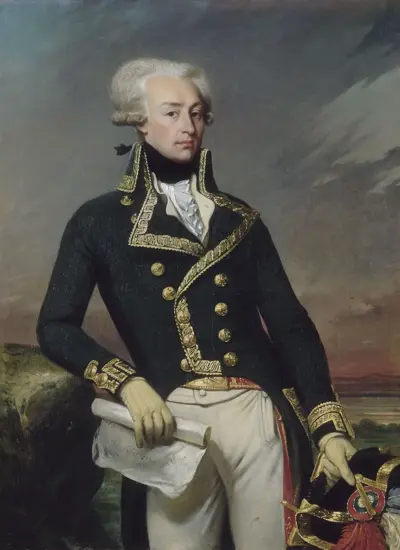
Marie-Joseph Paul Yves Roch Gilbert du Motier, Marquis de La Fayette, known in the United States as Lafayette (/ˌlɑːfiːˈɛt, ˌlæf-/, French: [lafajɛt]), was a French aristocrat and military officer who fought in the American Revolutionary War, commanding American troops in several battles, including the siege of Yorktown. After returning to France, he was a key figure in the French Revolution of 1789 and the July Revolution of 1830. He has been considered a national hero in both countries.
