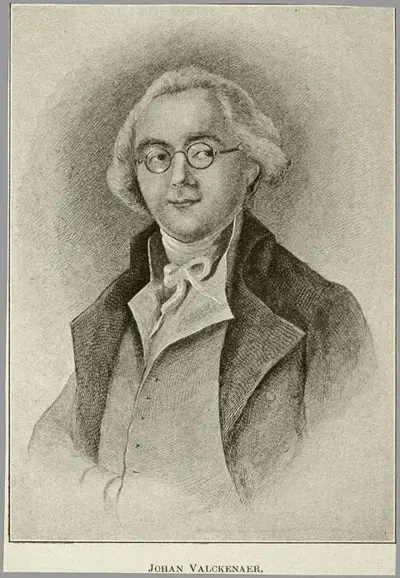
Johan Valckenaer Quotes
The will to liberty was flagging when the well-disposed part of the nation was being frustrated by the base slaves of Orange, Aristocrats, despots, political chameleons, fanatical zealots, clerical oppressors, mercenary egotists, reactionary agitators, profiteering merchants, slimy lickspittles…
This is one of the more passionate and colorful descriptions of Conservatives in the political literature. The conservative party were called Orangists as they were supporters of the monarchy of William V, Prince of Orange. As in modern times the conservatives included the upper classes, business people, religious advocates. The political conservatives were passionate, respected established authority, and in general, reactionary. The tended even then to flip-flopping as the conservatives had several factions--business conservatives, religious conservatives, monarchial conservatives, authoritarian conservatives and others. Depending on which faction was most powerful at the time, conservatives might advocate one position and change later when another faction was in control. Valckenaer also had some choice words to reflect his disdain for them. It is noteworthy that this description could describe political conservatives in almost any time period, in any culture. For example, it might have been a liberal writing about the Tea Party Republicans in 2014.
Johan Valckenaer, 1759-1821, Dutch lawyer, patriot and diplomat, Member of the Dutch Batavian Assembly, Financial Counsellor to Dutch King Louis Bonaparte, De Advocaatt van Nationale Vrijheid, 1796
Sourced by: Eigen's Political and Historical Quotations


This quotation is a great demonstration of how much wiser and the better politician of all the crowned heads of Europe that Queen Victoria was. There were stirrings of freedom and desire for parliamentary government throughout Europe. Queen Victoria, even though and perhaps because she was a young woman, had a great feel for fairness and reasonableness and had read a great deal of history. There were some radical red socialists calling for complete radical revolution scaring European Royalty profoundly. They reacted very conservatively and with reaction, reverting to more tyrannical practices of the past urged in that path by very conservative, right wing advisors. Victoria also had little respect for some of the monarchs who had little interest in their people and much with their personal power and wealth. In the end, it was England which was the only nation which never had a serious radical socialist / communist threat, and that had much to do with Victoria’s political acumen and wisdom.


She was particularly critical of some of the current conservative politicians who were advocating retaliation against the judiciary because judicial decisions thwarted some of their fundamentalist preferences and preferred policies.

Spinoza’s ideas were considered so radical and dangerous that he was the only man in history who was excommunicated by the Catholics, the Jews and the Muslims.


Early in his career, Santa Anna was an enthusiast for democracy. However, the republican form of government did not work at the time in Mexico and he developed into a despot and dictator.


He was referring to governments that imposed some form of morality in their citizens. Free governments do no dictate a morality and require their citizens to follow it. He was very much opposed to Prohibition which he saw as a poor government—Herbert Hoover’s Administration—which was imposing its narrow morality on all. He was very suspicious of government actions where the government claimed that the action was for moral objectives. This is a classic Libertarian view. In general, it is Fundamentalists and ideologues who want to impose their particular morality on all. See {620693} for a related idea.

With so many revolutionary rulers of new nations suppressing all opposition, the history of Ataturk and Turkey is unique. Ataturk was so popular and his People’s Party so successful that there was no opposition and Turkey had one party rule. However, Ataturk was determined to have Turkey become a parliamentary democracy as good as the Western nations of Europe. So a tradition of multi-party democracy was needed. So Ataturk actually went to his friend Fethi Okyar and asked him to start an opposition party and oppose the government. Fethi was a strong supporter of the revolution and generally was in concurrence with Ataturk and the People’s Party on everything. Ataturk however convinced him that they had to start a tradition that would take Turkey through the future, and he did create a new party-- Serbest Cumhuriyet Fırkası (Liberal Republican Party) and worked hard to find differences with the People’s Party and the Government. One immediate contribution was the oversight that the new party provided—a strong tradition that exists to this day in Turkey.

The revolutionists were disorganized and unfocused after the Coup that brought them to power. This speech provided some focus for a while. Early in his career, as a Journalist working in Leiden, Holland, he was very active and helpful to the Dutch Patriots and Revolutionaries in their takeover of the government. He helped draft the New Dutch Constitution and participated in most of the new governments conventions.