Mohamed ElBaradei Quotes
Historically, Islam was hijacked about 20 or 30 years after the Prophet and interpreted in such a way that the ruler has absolute power and is accountable only to God. That, of course, was a very convenient interpretation for whoever was the ruler.
ElBaradei, Mohamed. The Age of Deception: Nuclear Diplomacy in Treacherous Times. Metropolitan Books, 2011.


Gabriel exaggerates in the sense that while the quotation is correct for many Muslims, it is by no means true of all. Iran for example is an Islamic theocracy, but Turkey is a 99 percent Muslim nation which is totally secular and in some ways is much more restrictive of Islamic teaching and practice than most secular democracies. The fundamentalist Muslim view of the state and religion is essentially the same as the ultra orthodox Jews and Christians. It is true that a greater proportion of Muslims believe in the merging of civil and religious law than Jews and Christians, but by no means all. The non Arab Muslims are much less likely to see the unity of state and religion.


The notion that Islam would be practiced by individuals was in the Ayatollah’s view insufficient. Islam must also control the government—the head.


While the author represents the views of most Islamic Fundamentalists, a similar view is held by many ulta-orthodox Jews and fundamentalist Christians also.


England had, under Henry VIII, left the Roman Catholic Church where the King replaced the Pope as head of the English Church. Henry’s successors then had to organize and manage the national Christian church. James was discussing the hierarchy of the Church of England and there was a suggestion that Bishops be eliminated and have every priest directly responsible to the crown. Bishops would be powerful figures who might form a power center. (They did later). However, King James I observed that the King is God’s choice and rules by divine right. So there had to be bishops to crown kings. The bishoprics were retained.
This quotation illustrated the extreme polarization between the current fundamentalist Muslims, and the Muslim modernists and the West. Kamal Ataturk, the great leader and stateman who is the father of modern Turkey, is castigated by the author for leading the new Turkish parliament to depose the Caliph – the civil and religious autocrat, one of whom reigned from after the death of Muhammad till his abolishment in 1924. Most of the rest of the world credits Ataturk with being one of the great leaders of all time—one who led a democratic revolution which transformed Turkey into the only Muslim secular democracy, requiring pubic secular European type education for all children, giving women the right to vote (before the U. S. even), adopting a European alphabet and dress, and outlook on life—creating most remarkably a total cultural revolution with virtually no loss of life. No revolutionary leader, before or since has led so extensive a political and cultural revolution, and it was a bloodless revolution. Turkey, into the 21st century, was by far the most powerful, industrialized, scientific and modern nation of Muslims in the world and others were far behind. Yet many Islamic theologian still castigate Atatork for his great achievements as being against the will of God.


This notice of Excommunication was promulgated to the Catholic clergy in Ireland in May of 1538. It required all Roman Catholic leaders to size the property of Protestants or Catholics who sympathized with them. Those who did were then regarded as traitors by the Protestant King. The anti-Protestant feeling culminated with the massacre of about 100 Protestants who were drowned in Bann a few years later.

The Manual was found by the Manchester (England) Metropolitan Police during a search of an Al Qaida member's home.


This quotation is an excellent summary of view of most fundamentalist Muslims’ current views towards Christians and Jews. In the Koran, the Prophet made exceptions about required conversions to Islam for Jews, Christians, and Zoroastrians (the pre Islamic Iranian religion). However, although they were to be allowed to maintain their religion. They had to pay a special tax called “Jizya” described in the quotation. Islam interpreted these words of the Prophet very differently in different places and times. Jews and Christians were not only treated very well in Islamic Spain and in Ottoman Turkey when Turkey was the seat of Islamic religion and power in the world, but they achieved some of the most important positions of power in the Empire and in the professions: law, military, teaching, philosophy, science and medicine. However, in other times and places, non Muslims were not allowed to worship in public or hold any position of influence or power and certainly never teach Muslims. So Jews and Christians in this world view will be tolerated but they must exist under a Muslim theocracy. That is the view that most of the ultra fundamentalist Muslims have today, which of course sets up a serious conflict potential.
In almost every election in those Islamic counties that have elections, the fundamentalist political parties almost always lose by large margins.


At the time Turkey and Indonesia were the only Muslim nations that was not dictatorships or a theocracies.

This is a very important quotation as it focused on one critical difference between historical Islam and all the other major religions and fundamentally on the separation between church and state. In Islam there was a Caliph who was both the political ruler and the religious ruler. In comparison at the time, the Christians had a Holy Roman Emperor who was theoretically the overlord of all the Christian Kings but in reality he really could not exercise total or even much authority over all the other kings. At the same time, there was the Pope who was the religious leader of all the Christians. Since the distinction between Church and state was constantly in flux, the Christian Pope and Holy Roman Emperor were often at odds. The third Abrahamic religion, Judaism, had neither a secular leader or a religious one and no hierarchy other than local. Khaldun observed the theoretical advantage of Theocracy as a model, however he did not analyze the disadvantages among which were the assassination of many Caliphs and the laces. Even the Muslim Arabic states abandoned the idea of a Caliph in modern times until Iran adopted a Theocracy with a single Leader all powerful. However, all the other Arab nations wanted no part of a singular leader for all Muslim nations or even a single civil and religious leader within any other country. Al Qaeda however claimed to be fighting for a return to a Caliphate not only for the current Islamic Nations but for all nations which must be subservient to Islam.
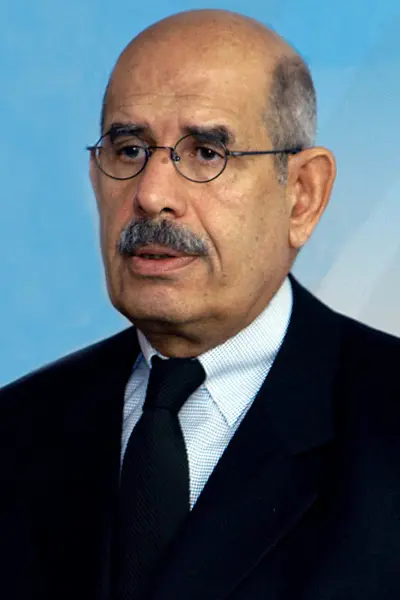
Mohamed Mustafa ElBaradei is an Egyptian law scholar and diplomat who served as Vice President of Egypt on an interim basis from 14 July 2013 until his resignation on 14 August 2013.
