Elizabeth Cady Stanton Quotes
Having deprived her [women] of this first right of a citizen, the elective franchise. thereby leaving her without representation in the halls of legislation, he [men] has oppressed her on all sides. He has made her, if married, in the eye of the law, civilly dead. He has taken from her all right in property, even to the wages she earns …. In the covenant of marriage, she is compelled to promise obedience to her husband, he becoming, to all intents and purposes, her master the law giving him power to deprive her of her liberty. and to administer chastisement.
In this famous declaration, Stanton summarized the relative status of men and women in the society at that time. Women then could not control their own property, have their own money. “Chastisement” referred to the fact that a husband could then legally discipline his wife physically and beat her if she were not suvviciently obedient.
Elizabeth Cady Stanton, 1815-1902, First President, National Woman Suffrage Association, The Seneca Falls Declaration, 1848
Sourced by: Eigen's Political and Historical Quotations


Jinnah was a modern Islamist who saw the role of females in a modern context. He, like the Indian Hindu leaders were in a sense products of the West and Western government and education. He would be very surprised that in his Pakistan men can murder their female relatives who they believe have dishonored the family, or that women would not be educated in the Madrassas, or that authorities could sentence a female relative of a man deemed guilty of seduction to be gang raped, but that is what happens in modern Pakistan. Jinnah and many of the early leaders believed that their new government could modernize Islam but the control and influence went the other way. Pakistan became a religiously dominated autocracy rather than the democracy that Jinnah foresaw.

Manava Dharma Shastra. This text is a part of the Hindu Holy Texts. Hindus believe that Manu was a prophet whose text is revealed or inspired.


This is the earliest surviving attempt of the Romans to formulate a legal code.


Samuel Langhorne Clemens, 1835-1910


We count on Mormon assemblages to

Billinghurst was physically handicapped without the use of her legs. She protested and marched in protest parades using a hand propelled tricycle which the police sometimes dumped her out of and left her immobile in alleys.

This observation has never been really taken seriously until the women’s movement stimulated historical and sociological studies to test such a hypothesis. More and more people are finding that Tocqueville may have been right on this point albeit still not a majority of scholarly opinion.
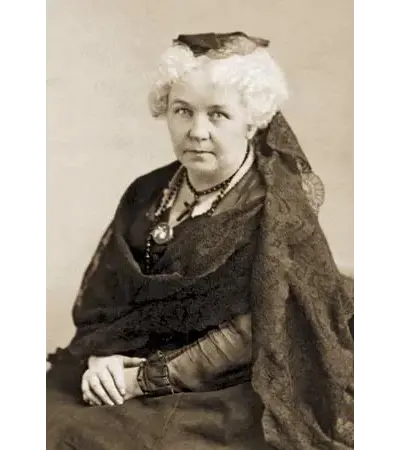
Elizabeth Cady Stanton was a leader of the women's rights movement in the U.S. during the mid- to late-1800s. She was the main force behind the 1848 Seneca Falls Convention, the first convention to be called for the sole purpose of discussing women's rights, and was the primary author of its Declaration of Sentiments. Her demand for women's right to vote generated a controversy at the convention but quickly became a central tenet of the women's movement. She was also active in other social reform activities, especially abolitionism.
