John Adams Quotes
has no equal in the world, excepting those only which are held by crowned heads; nor is the royal authority in all cases to be compared to it.
The Power of the President in the new Constitution
John Adams, 1735-1826, 2nd President of the United States (Federalist, MA), Quoted in Eric Nelson, “Are We on the Verge of the Death Spiral that Produced the English Revolution of 1642-1649?”, History News Network, December 14, 2014
Sourced by: Eigen's Political and Historical Quotations

This letter was written shortly after the Constitution had been signed by the convention delegates. This difference between Adams and Jefferson would be at the heart of the first great partisan struggle in American history. Adams, as the second President, tried to increase and use the power of the Presidency. Jefferson opposed him, especially when Adams tried to run for a second term. The Adams-led Federalists were pitted against Jefferson’s Democratic Republicans in the first, and perhaps still the most bitter partisan struggle in American political history. The Jeffersonians accused Adams and the Federalists of trying to unravel the American Revolution and revert to a monarchy. The people not only sided with the Democratic Republicans, ousting Adams, but also turned out most of the Federalists. It was the end of the Federalist Party, and a new conservative party—without monarchial tendencies—the Whigs became the new opposition party.


Although extremely enlightened and liberal in man ways, as an autocrat she saw virtues in monarchy.

In 1862 after a Sioux uprising, a U. S. military commission condemned 303 Indians to death. President Lincoln wanted to delegate reviewing the sentences for possible pardon. The President personally reviewed the records of each case and pardoned most. On December 26, 1862 the largest public execution in American history took place with 38 Indians hanged.

The issue of how the federal judiciary would be selected was one of the more hotly debated issues during the Constitutional Convention.

The priest had come to the Empress to complain about the debauchery of her Prime Minister and made the error of describing him as the first man of the empire. The story may be apocryphal but it illustrates the character of the Empress. The source of the exact words are given in the historical novel, Luise Muhlbach, Joseph II. and His Court

A veto power for the President would be absurd because

This quote is noteworthy that Jefferson thought that the President had too little power while the King of Poland was known the world over as having a very weak King.


Alberto Gonzalez, White House Counsel and later Attorney General who was forced to resign and David S. Addington, Counsel to the Vice President, had come up with a novel view of the powers of the presidency. They argued that since the President is the Commander in Chief, in a war situation or intelligence gathering thereto, has the Constitutional responsibility for that function, he need not obey any laws of Congress as in the conduct of the war Congress would be impinging on the Constitutional separation of powers which itself was prohibited by the Constitution. The argument did not find any significant legal support but for a while the George W. Bush White House behaved as if this were the law, despite the fact that even in the American Revolution and the War of 1812 Congress passed laws regulating the conduct of the armed forces as is provided for in other parts of the Constitution. Yet even Goldsmith would allow the President some powers that many think are unconstitutional and/or belong to Congress. See {32436}.


His role was the equivalent of the Mayor of Washington DC. Even though the Congress had generally been the most powerful branch of the government, public opinion on this was beginning to shift at the turn of the 20th century.


The assumption of one supreme authority being necessary for a state, has been the most common assumption in almost all cultures and times before the American Revolution. What is amazing is that the Founding Fathers rejected this notion in favor of our complex system of checks and balances restrained by a Constitution which no society had ever tried before. England in contrast as it became more democratic, simply shifted the supreme, uncontrollable entity from the King to the Parliament which it is even today. Parliament can do virtually anything unrestrained by anything except their judgment and tradition.


The Continental Congress told each colony should establish its own republican government quickly so that the people did not have to depend on England for anything, and that the English Monarchy be opposed and supplanted anywhere where they wanted to exercise authority.
Dwight D. Eisenhower had become President of Columbia University. At one of his first meetings with the Faculty Senate, Eisenhower in response to a question stated that the University could not countenance such a policy. At this point, Professor Highit, the Dean of the Faculty Senate, interrupted Eisenhower with this legendary quotation. At Columbia as well as many other of the best private universities, it is the faculty Senate that is the highest educational policy making organ. See {634253} for one of the origins of this. Eisenhower and the University were both great but they were a bad fit. Some historians believe that it was the bad experience at Columbia that brought Eisenhower into Presidential politics. If he had been successful at Columbia, he might have stayed there for his career.


Though not very dramatic or succinct, this is a very important quotation in American History. The original drafters of the Constitution concentrated on limiting the powers of the executive—the role of the King. But the Congress had no limits placed on them. In Britain, to this day, the Parliament can do whatever they wish as there is no restraint on them other than their prudence and reasonableness. Madison used the example of the Alien and Sedition Acts—huge infringements on the rights of Americans—to show why the legislative branch must also be more restrained and limited. And that was the logic behind adding the Bill of Rights to our Constitutions.
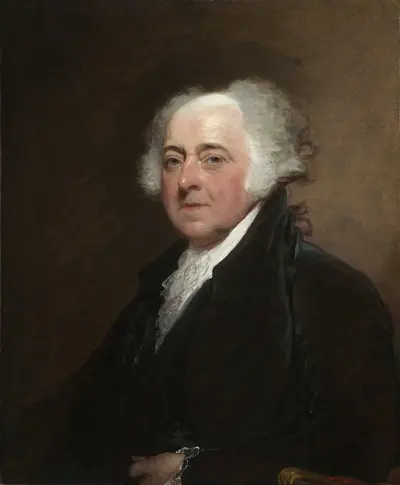
John Adams Jr. was an American statesman, attorney, diplomat, writer, and Founding Father who served as the second president of the United States from 1797 to 1801. Before his presidency, he was a leader of the American Revolution that achieved independence from Great Britain, and he served as the first vice president of the United States. Adams was a dedicated diarist and regularly corresponded with many important figures in early American history, including his wife and adviser Abigail Adams and Thomas Jefferson.
