John C. Calhoun Quotes
Every increase of protective duties is necessarily followed, in the present condition of our country, by an expansion of the currency, which must continue to increase till the increased price of production, caused by the expansion, shall be equal to the duty imposed, when a new tariff will be required.
Calhoun, John C. The Works of John C. Calhoun. Edited by Richard K. Crallé, vol. 4, D. Appleton and Company, 1854.


The issue of free trade has been controversial during the entire history of our Republic. At the time it was the Republicans who were the protectionists and the Democrats, the free traders.


It is interesting that the first national women’s political party was a strong advocate of protectionism and saw free trade as an unfair hurdle for mostly male workers. At the time, the Republicans were staunch protectionists, and the Democrats, the free traders thus illustrating that the major parties continuously flip-flop on major issues.

Ruffin is more widely known as the man who fired the first shot of the Civil War.

The popularly elected president Salvador Allende was a left leaning socialist and Nixon wanted a right wing Government in place who would deal more firmly with the communists. General Augusto Pinochet thus came to power, murdered Allende, and instituted a reign of terror with death squads, torture and disappearances, that eventually led him to be indicted for crimes against humanity.

This same argument was used before and since to justify protecting domestic manufacturing from foreign competition until it can mature sufficiently to compete in a global economy. One difficulty occurs if protective tariffs are imposed for this reason. The manufacturers protected never seem to reach the point where they can compete without the subsidy.


1st Earl of Beaconsfield

Republicans at that time were adamant protectionists and were violently opposed to free trade. They made a total flip flop on free trade after the Second Word War when the industrial capacity of all of the major industrial nations except America was completely emaciated. America still had production and there was huge money to be made from being the only nation that could deliver goods to the world. Meanwhile Germany, France, England, and Italy, our largest competitors could hardly manufacture for their own needs and could not compete in the American market. So the American corporations then wanted to become free traders.

There has always been pressure from different interests to exempt certain products from duty and place higher duties on others. Calhoun urged a policy that would be based on general economic prinicples and conditions and not on pressure from special vested interests. He was a senator at the time.


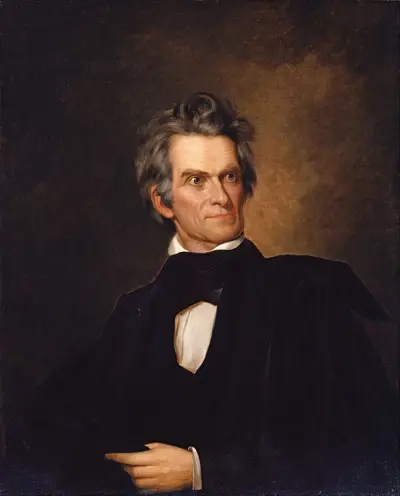
John Caldwell Calhoun was an American politician and political theorist from South Carolina who held many important positions including being the seventh vice president of the United States from 1825 to 1832, while adamantly defending slavery and protecting the interests of the white South when its residents were outnumbered by Northerners. He began his political career as a nationalist, modernizer, and proponent of a strong national government and protective tariffs. In the late 1820s, his views changed radically, and he became a leading proponent of states' rights, limited government, nullification, and opposition to high tariffs. He saw Northern acceptance of those policies as a condition of the South remaining in the Union. His beliefs and warnings heavily influenced the South's secession from the Union in 1860–1861.
