George Crook Quotes
[Describing Indian warriors:] ... a match for any man.
Crook had a deep respect for the Indians. The Native Americans in turn trusted their enemy in an usual mutual respect. See Red Cloud {46587}
George Crook, 1828-1890, Cavalry General and the Leading Indian Fighter, Quoted in Utley, Frontier Regulars: The United States Army and the Indian, 1973
Sourced by: Eigen's Political and Historical Quotations


He was referring to the fact that he had blocked the Meech Lake Accord preventing the Canadian Constitution being amended to recognize French-Speaking Quebec as a separate nation within Canada, but ignoring the Indians.

He allowed Indians the right of complete citizenship of the Rhode Island Colony {624272}.

The economic development contribution of military spending is not new and not limited to today’s military bases and defense contracts and plants. See {623902} for Sheridan’s famous prediction.

The Indians did not have the wheel when the whites came, but soon there were wagons, stage coaches and railroads.

This is one of the first Policy Statements of the new Republic about the Indians. Essentially, although the government policy was reasonable and fair, public opinion was totally different and the leadership could not persuade the people on this point. One complicating factor was the fact that most of the Indian tribes had overtly or covertly sided with the British in the Civil War. Many Indians were exiled to Canada. Even the Indians who were American allies, had their lands encroached upon however.

There was then legislation proposed to to nullify a number of Indian treaties. Indians themselves were divided as to the desirability. Mrs. Roosevelt favored negotiations and discussions with each tribe separately regarding their treaties as opposed to the proposed legislation which treated the tribes monolithically when indeed they were 500 separate tribes with different cultures, needs and desires.

The strife between the indigenous Fiji people and the Indian immigrants was not as serious when Indian immigration to Fiji began. The immigrants rented land from the natives at good prices and did the hard work of tilling the land. They had a different work ethic and developed the Fiji economy substantially. However, the Indians became more wealthy and better educated. The minority group became equal or dominant in most aspects of Fijian society and inter-ethnic strife and jealousy eventually developed. This became the modern problem of Fiji.

Wayne played so many parts depicting whites in the process of expanding Westward that many people saw him as an expert on the history of the Westward Expansion. He did not comment on the whites who then kept huge ranches “selfishly” for themselves or those who selfishly would not share the mineral rich land that they had taken with anyone including the original Indian owners. So in this view, the Indians should have not been capitalists but they should have been socialists and shared their resources.


Samuel Langhorne Clemens, 1835-1910. Twain was one of the few whites who realized that success in assimilating American Indians would destroy their culture and identity. Even today, whites and Indians alike constantly debate the desirability of assimilation policies and supporting independent reservations.
The Iroquois were among the most sophisticated of the North American Indian Tribes. They also were highly assimilated into the American society. In the next decades, they would switch their political position when New York State provided better legal guarantees for Iroquois land than the Federal Government. By the end of the 20th Century, led by the Iroquois, the Indian residents of New York State had the same level of earnings as the white man—and that was with NO INDIAN GAMING.
The intentions of the Founding Fathers towards the Indians was decent, respectful, and well intentioned. However, there was not enough of a system of enforcement or the will to enforce when the greed of the average whites grew too great. Many settlers saw these vast lands and could not see any harm in using a few acres for their farm. And if there had been only a few, there would have been little trouble. However, the settlers kept coming and coming and soon the Indians began to push back. In a sense, it was a class problem. The members of the Continental Congress who wrote the Northwest Ordinance were educated, affluent men who had plenty of land. Most of the men who contested for the Indian lands had little land or were newly affluent and saw few limits to America.
This is an important quotations for two reasons. First, one of the white Europan myths in the colonial era was that the Native America had not concept of land ownership and title. This quotation clearly refutes that/ Second, this shows that some Europeans coming to the new world opposed the view that the white Christians and a moral right to the Native American “heathen” land. A few like Williams did not.

This law provided for Individual Indian ownership of land which was seen as an essential step to stimulate assimilation of Indians into American society. For some it had that effect, but it also weakened the tribal community as the allotted land was then no longer controlled communality by the tribe and civil governance of the allotted lands were transferred to the state and local government and away from the traditional tribal government. In some cases traditional tribal government became impossible. Also, the Indians who were allotted the land could and often did sell it to whites. Land owned by Indians decreased from 138 million acres in 1887 to 48 million acres in 1934—a 65 percent reduction. This Act also imposed a patriarchal household onto many matrilineal Native societies, in which women had controlled property and descent, since under the sexist American law at that time all family property was owned and controlled by the husband. In 1934 President Franklin Delano Roosevelt supported the US Indian Reorganization Act. It ended allotment and created a "New Deal" for Indians, including renewing their rights to reorganize and form their own governments. Much of the damage of the Dawes Act had already been done however. See Senator Henry Moore Teller’s criticism of the Dawes Act {633120}.

See {633119} for the basic provision of the Dawes Act.

The Lenape Tribe (Delaware Tribe) were the strongest Indian nation in America until they were supplanted by the Iroquois and then dominated by the Colonial whites who took much of their land. See {592309}.

Carson was one of the few Indian Agents who spent every penny of his budget on the Indians as opposed to himself. He was married to an Indian woman and was close enough to many Indians that he understood their resentment whenever they came into a town. They were treated terribly and while most of them were literally starving, seeing the white opulence produced resentment.
John Sutter was an immigrant to California from Switzerland where he became a Mexican citizen. Slavery was outlawed in Mexico and its territories, yet Sutter and others maintained Indians as slaves. The Roman Catholic Missions of California also kept Indian slaves. This quotation is historically important because many people never realized that slavery was prevalent in California.

The Cherokee were settled Indians with farms and ranches. These lands were coveted by many whites and many including President Andrew Jackson was trying to get the Cherokee to trade their land for land in the Oklahoma Territory, despite the white promises of the past Ross took the case to the Supreme Court which ruled that the Cherokee land was theirs and it must be protected for them by the government. But President Andrew Jackson, disobeying the Supreme Court Opinion, forced the Cherokee at gun and bayonet point onto the Trail of Tears to Oklahoma, totally reneging on this quotation and deeds and promises of the past.
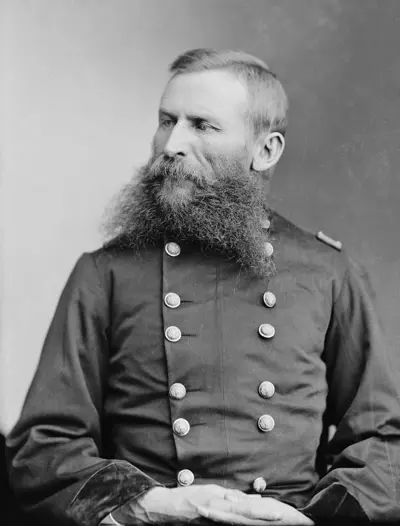
George R. Crook was a career United States Army officer, most noted for his distinguished service during the American Civil War and the Indian Wars. During the 1880s, the Apache nicknamed Crook Nantan Lupan, which means "Chief Wolf."
