Jose Rizal Quotes
China will consider herself fortunate if she succeeds in keeping herself intact and is not dismembered or partitioned among the European powers that are colonizing the continent of Asia.
Rizal, José. The Philippines A Century Hence. Translated by Austin Craig, Philippine Education Company, 1912, p. 110.


The issue of unilateral or multilateral foreign policy efforts faced America after WWII.

The United States and England maintained officially that their stance was moral and ethical. And it was for most Americans and Britons. However, there were some, whose motivation was economically self-serving as this quotation suggests. The less control Japan had over China, the more other countries could freely trade with China.


This was very much a minority opinion at the time, and has much historical significance as he was the father of the British Prime Minister, Neville Chamberlain, 1869-1940, whose appeasement of Germany led to Word War II. . See {585941}.
Quoted by Winston Churchill in his January 17, 1952 address to Congress.
The American concepts of democracy and human rights have been resented when U. S. policy advocated other nation’s adhering to them.
1st Baron & 1st Marquis Curzon of Kedleston

With the successful Chinese Communist Revolution, the Nationalists were driven off the mainland of China and occupied the island of Formosa (Taiwan) and had a small garrison of soldier on two tiny islands off the Chinese Coast, Quemoy and Matsu. The communist Chinese government wanted control of all three of the Nationalist held islands. It became a campaign issue or whether or not the United States should go to war to protect the two tiny islands from the communists even though there were no civilians on them and they had virtually no value other than symbolic. Nixon, took the position that the Chinese Communists must be stopped as they had world conquest as their objective. Philosophically, many Communists of the time, following Marxist theory, actually believed that Capitalism would crumble and communism would take its place. In that sense many felt that the world would be communist. China, as we now know, was more concerned with counterrevolution by the nationalists, expansionism and growth of Vietnam (her ancient enemy), the rise of Japan, border wars with India, and constant threats from Russia and China had no military plans for world conquest.

This was the 14th part of the Japanese reply to a previously made American peace proposal. The Japanese policy was to unite all of Asia into a co-prosperity sphere controlled by Japan where Japan would militarily conquer those Asian countries which did not “voluntarily” want to join. The Japanese were in the process of conquering China and the United States and Britain had embargoed oil and other material to Japan trying to pressure them to withdraw their troops from China and cease Japanese conquest by force. Japan believed that it was their right to conquer and control Asia and it was beneficial to the region, and that the U. S. and Britain had no right to curtail the expansion that Japan required to assure raw materials and other necessities. At the very time that these negotiations were on going, the Japanese fleet was sailing for the sneak attack on Pearl Harbor. The attack took place the very day this part of the Japanese reply was received.


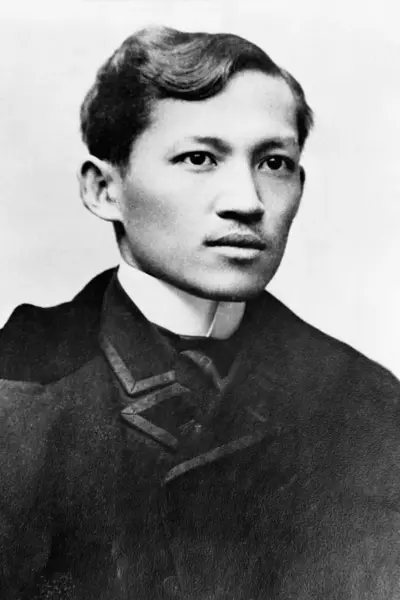
José Protasio Rizal Mercado y Alonso Realonda was a Filipino nationalist and polymath during the tail end of the Spanish colonial period of the Philippines. He is tagged as the national hero (pambansang bayani) of the Philippines. An ophthalmologist by profession, Rizal became a writer and a key member of the Filipino Propaganda Movement, which advocated political reforms for the colony under Spain.
