Leo XIII Quotes
Certain forms of property must be reserved to the state, since they carry with them an opportunity of domination too great to be left to private individuals without injury to the community at large.
Leo XIII, 1810-1903, Catholic Pope, Rerum Novarum, 1891
Sourced by: Eigen's Political and Historical Quotations

The founder was Charles E. Coughlin, 1891-1979, a demagogic Catholic Priest who drafted the principles and invited others to join him. Hundreds of thousands did in this organization which began in idealism, and ended in scandal and hate mongering, so much so that Father Coughlin was ordered off the radio and out of politics by the Catholic Church. The National Union in 1936 had morphed into the Union Party which ran Presidential candidates in the 1936 election. The Coughlin and the Union were a mixture of Fascist and Socialist principles. The prohibition of private ownership of banks and utilities was one of the radical socialist notions.


The Catholic view on the subject varied from time to time, even with the same Pope. See {638558} for another quote from this Pope that gives a different point of view.


The first part of this quotation has defined the attitude of most Americans towards private enterprise and government since then. The second part of the quotation—the undesirability of public ownership of railroads has given way to the modern problem that no passenger railroad can be operated profitably by anyone—private or public. So Roosevelt’s “far-reaching disaster” was finally complete with the Federal Government taking over responsibility for Amtrack.


This is a very interesting quotation in that right wing parties are usually opposed to any kind of Government ownership and control of business and industry. However, Fascist parties have usually wanted to commandeer business and industry for the central purposes of the dictatorial state. The French National Front Party had its roots in the WWII French Vichy Government—which was allied with the Nazis to bring Fascism and racism to France.
The Catholic view on the subject varied from time to time, even with the same Pope. See {360616} for another quote from this Pope that gives a different point of view.


While this principle is widely accepted in modern America, in the early 20th century this was a view considered radical, socialist and even communistic by many of the leading businessmen in the nation. For a president to utter these words, much less a Republican President of a rich, upper class background.

During The Depression although business in general was doing very poorly, there were a few which had grown immensely powerful and abused the power as there was little or no regulation at the time.

Ironically the far right wing Fascists and the far left wing Communists agreed on this point: nationalization.

money for the king's government In 1628 there was a classic English struggle between the king, Charles I, and Parliament. While Parliament was sitting, Dr. Manwaring, an Anglican Bishop, preached a sermon. He claimed that God intended all private property to be at the disposal of the King in times of national emergency. Further, that the King could levy an taxes without the consent of Parliament. The King liked the sermon so much that he had it printed and distributed by special command. The House of Commons went bonkers and impeached Manwaring. He was imprisoned by order of the House, fined the then huge sum of 1,000 pounds, and prohibited from holding any ecclesiastical or secular office in the future. As soon as the session of Parliament ended, the king pardoned him, gave him a huge salary raise, and several years later Manwaring was appointed Bishop of Asaph. King Charles I, perhaps England’s worst sovereign, then provoked two civil wars and was finally tried for treason and beheaded. Manwaring was in and out of prison during the conflicts. He faded from public view.


Arguing against government operation of businesses and nationalism of industry:

He was favoring state confiscation of land holdings in excess of four times the value of the standard land allotment. What is most interesting about this quotation is that the maximum ratio Plato would allow was 4 times the average. However in the 21st century, there were corporate executives being paid at 1000 times the averate wage with most conservatives believing that this (or any other ratio) was not excessive.
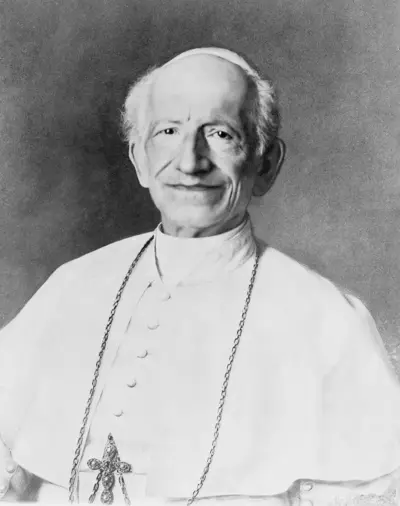
Pope Leo XIII was the head of the Catholic Church from 20 February 1878 to his death in 1903. He was the oldest pope (reigning until the age of 93), with the exception of Pope Benedict XVI as emeritus pope, and had the third-longest confirmed pontificate, behind those of Pius IX (his immediate predecessor) and John Paul II.
