Herbert Hoover Quotes
Even if government conduct of business could give us more efficiency instead of less efficiency, the fundamental objection to it would remain unaltered and unabated. It would destroy political equality. It would increase rather than decrease abuse and corruption. It would stifle initiative and invention. It would undermine the development of leadership. It would cramp and cripple the mental and spiritual energies of our people. It would extinguish equality and opportunity. It would dry up the spirit of liberty and progress.
Arguing against government operation of businesses and nationalism of industry:
Herbert Hoover, 1874-1964, 31st President of the United States (Republican, IA), Quoted in Dulles, The United States Since 1865, The University of Michigan Press, 1959
Sourced by: Eigen's Political and Historical Quotations


The first part of this quotation has defined the attitude of most Americans towards private enterprise and government since then. The second part of the quotation—the undesirability of public ownership of railroads has given way to the modern problem that no passenger railroad can be operated profitably by anyone—private or public. So Roosevelt’s “far-reaching disaster” was finally complete with the Federal Government taking over responsibility for Amtrack.


The 1964 Civil Rights Bill had as one of its greatest supporters Republican Minority Leader, Senator Everett Dirksen. His reasoning was:. The first sentence was Dirksen quoting Victor Hugo.


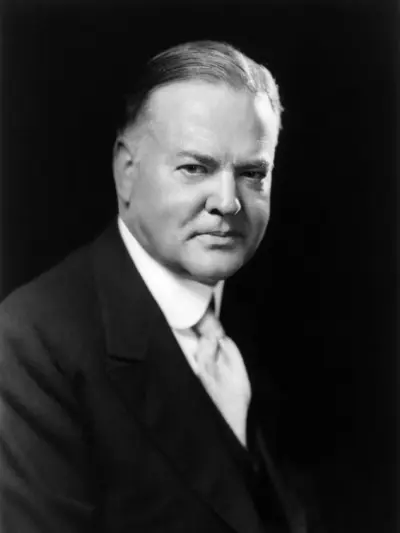
Herbert Clark Hoover was an American politician, businessman, and engineer, who served as the 31st president of the United States from 1929 to 1933. A member of the Republican Party, he held office during the onset of the Great Depression. Before serving as president, Hoover led the Commission for Relief in Belgium, served as the director of the U.S. Food Administration, and served as the third U.S. Secretary of Commerce.
