Martin Van Buren Quotes
Banks properly established and conducted are highly useful to the business of the country, and will doubtless continue to exist in the States so long as they conform to their laws and are found to be safe and beneficial.
Van Buren, Martin. "Second Annual Message." The American Presidency Project, edited by Gerhard Peters and John T. Woolley, 3 Dec. 1838.

The result was regulation of the banks and the creation of the SEC to regulate the stock market, However, over the years, the regulations were not able to keep up with the sophisticated development of new forms of investments and financial instruments and the financial industry were able to speculate with other people’s money in ways that FDR and his reformers never imagined. Finally, even the regulation that did exist was weakened by the policies of the George W. Bush administration and the combination brought about the Great Recession of 2008 where the profits from excess speculation were privatized and the losses, socialized with the taxpayer and the American worker bearing the brunt while most of the speculators were bailed out and made more money than ever. The Obama administration tried to reform the situation, but was unable to put an end to the legal speculation with other people’s money or of having institutions that were “too big to fail.”


After the Great Recession the Mexican bankers, like their American counterparts, tightened their credit standards so much that the only people who could get loans were the ones who didn’t need it. If banks do not make loans, it matters not that they are solid institutions that are well capitalized.


See Daniel Webster for an earlier expression of this notion.


For many general government regulations—labor, environment, non discrimination—the small business has a proportionately heavier burden of compliance. So large businesses have always been able to count on small business to lobby against regulation and for deregulation. However, when it comes to financial regulation such as the Dodd-Frank regulations essentially apply to large businesses. As a matter of fact, small businesses were on many ways the most frequent victims of the large banks and investment bank excesses in the Meltdown of 2008. Before most of the regulations could even take effect, the financial industry was already trying to get small business to lobby to roll back the protective regulations preventing future meltdowns and bank failure resulting from loose regulation and greedy irresponsible financial industry behavior. The President campaigned to convince the small business not to support the finance industry over their usual “knee jerk” reaction to any regulation.

The big priorities will focus on the security and economic side because they really go hand in hand.
This quotation Illustrates a conflation of American national security and economics.

She was the only major Federal Official who did not support the bailouts of the banks and their bondholders and shareholders. Not one of her insured bank depositors lost their insured funds in the financial crisis. She protected them all but would not protect the banks themselves. Other officials did that and the following year the bank executives took the bailout money and paid themselves and others in the bank huge bonuses when the banks lost billions.


The savings and loan crises became clear shortly thereafter.

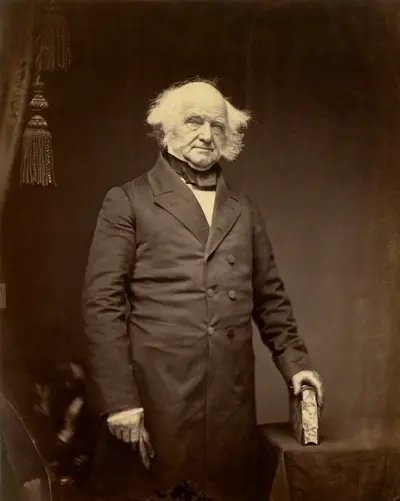
Martin Van Buren was an American lawyer and statesman who served as the eighth president of the United States from 1837 to 1841. A founder of the Democratic Party, he had previously served as the ninth governor of New York, the tenth United States secretary of state, and the seventh vice president of the United States. He won the 1836 presidential election with the endorsement of popular outgoing President Andrew Jackson and the organizational strength of the Democratic Party. He lost his 1840 reelection bid to the Whig nominee, William Henry Harrison, thanks in part to the poor economic conditions surrounding the Panic of 1837. Later in his life, Van Buren emerged as an elder statesman and an important anti-slavery leader who led the Free Soil Party ticket in the 1848 presidential election.
