Oscar Wilde Quotes
As one reads history, not in the expurgated editions written for schoolboys and passmen, but in the original authorities of each time, one is absolutely sickened, not by the crimes that the wicked have committed, but by the punishments that the good have inflicted; and a community is infinitely more brutalised by the habitual employment of punishment than it is by the occasional occurrence of crime.
Oscar Wilde, 1854-1900, Irish Writer, The Soul of Man Under Socialism
Sourced by: Eigen's Political and Historical Quotations

1st Baron Macaulay

This Pennsylvania prison was supposedly a “modern” reform in law enforcement. Rather than work gangs or mandatory factory work, this was the first “penitentiary” in America. The guilty convicts would be in a small cell for all but 1 hour or less a day, and the only thing in the cell other than soap and a toothbrush was a Bible. The convict was supposed to spend his sentence reading th Bible and being penitent for his crimes. It destroyed most inmates mentally until the Supreme Court Ruled total solitary confinement was unconstitutional. There are a fee high security prisons today where there is no social contact allowed the inmates and their constitutionality is being litigated based on Miller’s 1890 opinion. Another point that this quotation illustrates is that sometimes reform efforts produce a situation that was worse than before.


This has been the case in EVERY jurisdiction that has had capital punishment. Capital punishment does provide vengeance for victims, relatives and society. And in many societies execution is less expensive than prison for life. But it has never curtailed crime despite the example. In London, they used to have public executions as examples to inhibit crime. While the crowd was watching a pickpocket be hung, other pickpockets were relieving many spectators of their wallets and watches.


CREEP in the Nixon Campaign. He was himself a convicted Watergate conspirator


Vladimir Lenin. Uyezds were small towns and cities in an administrative subdivision of Russia. For Americans, hoarding has been a reprehensive policy for greed and personal gain, where the consequence for most people was inconvenience and loss of money. But in Russia hundreds of thousands of people starved to death while hoarders of food wanted to hold out for higher prices. To Lenin and many others, hoarding was mass murder and that was exactly its effect.


Charles Dickens himself, a true nineteenth-century liberal, lent his weight to the campaign to abolish public executions. After seeing the execution of Maria and Frederick Mannings for murdering Maria’s lover, Patrick O’Connor, in Horsemonger Lane, outside the Surrey County Gaol on 13 November 1849, he wrote this to the Times. Public hangings were abolished in 1868. The last one took place outside Newgate Prison on 26 May of that same year. The man hanged was an Irish terrorist called Michael Barratt who had blown up the Clerkenwell House of Detention killing six people. A drunken crowd stayed up all night to witness the execution. They cheered wildly when the scaffold was brought out at dawn. More people – mainly young women and children – began to arrive. By the time a bell was sounded at eight o’clock in the morning to announce the arrival of the condemned man, the crowd stretched back as far as Smithfield.


This quotation while difficult for us to fathom today, illustrates a very conservative 18th century view of punishment and law enforcement. The South African high court was very distressed that torture was to be ended. To them, and many others throughout the so called “civilized” European cultures of the time, capital punishment was not a very good deterrent—even for slaves. The execution was usually accompanied by horrible torture and cruelty before death. Slavery was such a horrible life, and the White colonists knew it, that death could be welcome (many slaves had committed suicide). So the suffering at the execution was to serve as a further deterrent. In reality it did not, any more than capital punishment did in the 20th century, but by the logic of the culture and the times, torture was needed as well as capital punishment.

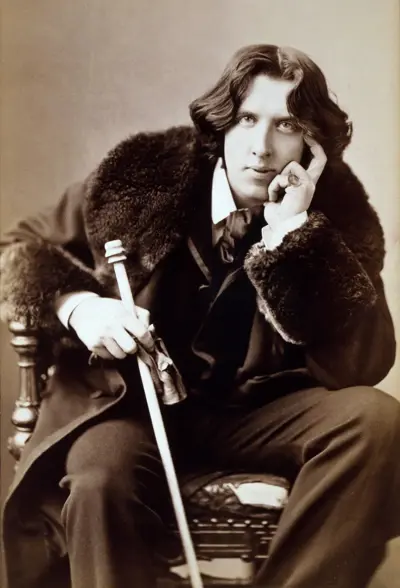
Oscar Fingal O'Flahertie Wills Wilde was an Irish poet and playwright. After writing in different forms throughout the 1880s, the early 1890s saw him become one of the most popular playwrights in London. He is best remembered for his epigrams and plays, his novel The Picture of Dorian Gray, and the circumstances of his criminal conviction for gross indecency for consensual homosexual acts in "one of the first celebrity trials", imprisonment, and early death from meningitis at age 46.
