Vladimir Lenin Quotes
To hoard surpluses of grain and other food products at a time when the people in Petrograd, in Moscow, and in dozens of non-agricultural uyezds are not only suffering from a shortage of bread, but are cruelly starving, is an enormous crime deserving the most ruthless punishment.
Vladimir Lenin. Uyezds were small towns and cities in an administrative subdivision of Russia. For Americans, hoarding has been a reprehensive policy for greed and personal gain, where the consequence for most people was inconvenience and loss of money. But in Russia hundreds of thousands of people starved to death while hoarders of food wanted to hold out for higher prices. To Lenin and many others, hoarding was mass murder and that was exactly its effect.
Nikolai Lenin, 1870-1924, Russian Communist Premier Collected Works, Vol. 42
Sourced by: Eigen's Political and Historical Quotations


Islamic modernists like Serageldin are many among the educated Muslims but their views are often drowned out by the violence and extremist statements of the fundamentalists.

The president was right. There is enough food to go around. The problem however is logistical, economic, and political. Some countries use food as a weapon to keep their own people under control. The major problem is the distribution of the food. It has to be transported from where it is gown to where it should be consumed. Much food in the third world rots because the transportation system cannot move the food efficiently enough. Even when food is donated to nations, the free or cheap food undercuts the local farmers who go out of business and there is even less food the following year.


This is exactly what happened in Scotland, and accounts for the large number of Scottish emigrants who populated many countries of the world.

During the Irish potato famine, other crops continued to be exported from Ireland. Some argued that without the exports the Irish economy would totally collapse exacerbating the pain to Ireland, but many others disagreed and argued that all available food should be used for the people of the country. For his seditious activities he was sentenced to penal servitude for life. He escaped and came to America where he entered politics

The President was supporting birth control programs over church opposition

England had a high protective tariff called the "Corn Laws" which artificially maintained a high price of grain. Cobden had made a condolence call to a wealthy friend whose wife had just died. In a dramatic call to public service:. The friend joined Cobden and their team traveled throughout England arguing their case. As a result of their efforts the Corn Laws were repealed saving tens of thousands of lives and the friend became one of England's most illustrious politicians.

As the son of a former president he fought in both WWI and WWII and was awarded the Congressional Medal of Honor. See {593105} for another quotation on the poverty of Puerto Rico.
In 1921, there was a terrible famine in Communist Russia. The United States was ambivalent about humanitarian relief to the leading Bolshevik county while there were Communist supporters in the U. S. who were setting off bombs and calling for the overthrow of the democratic government. Herbert Hoover persuaded President Warren G. Harding that food aid relief was a moral obligation and would do much to weaken Bolshevism. 400 ARA Americans went to Russia and hired over 120,000 Russians to implement the relief program. Rarely in human history have this few people with the resources made available to them saved as many lives as Hoover and his staff did. A number of the Americans died in Russia from disease and those who survived worked under near impossible conditions. Ironically, while it created much good will towards the United States, many including Hoover suspected that the program and the pressure that the Americans put on the Soviet Government officials for more efficient administration may have forced the Soviet Government to learn how to organize much of othe society like the railroads, thus strengthening the Communist Party’s control over the country.


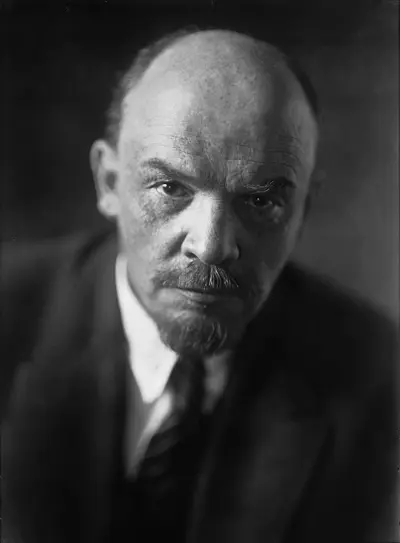
Vladimir Ilyich Ulyanov, better known by his alias Lenin, was a Russian revolutionary, politician, and political theorist. He served as the first and founding head of government of Soviet Russia from 1917 to 1924 and of the Soviet Union from 1922 to 1924. Under his administration, Russia, and later the Soviet Union, became a one-party socialist state governed by the Soviet Communist Party. A Marxist, he developed a variant of this communist ideology known as Leninism.
