Daniel Webster Quotes
An unlimited power to tax involves, necessarily, the power to destroy.
Webster, Daniel. "McCulloch v. Maryland." The Works of Daniel Webster, Vol. 6, Charles C. Little and James Brown, 1851, p. 327.


This is opposite to the view that the power to tax is the power to destroy. See Oliver Wendell Holmes {603715}, Daniel Webster {37299} and John Marshall {320000}.

This quotation was used throughout American history. See Oliver Wendell Holmes {603715}, Daniel Webster {37299}. Maurice L. Duplessis of Canada had a contrary variant: {600341}.


See Daniel Webster and John Marshall for earlier expressions of this famous quotation: {37299} and {320000}. Also, Maurice L. Duplessis {600341} for a contrary view.


The American Revolution’s ideas spread. This Cahier was the consensus of the Clergy of Blois in 1789. There were cahiers of several provinces of France—some by the clergy, some by the nobles. What is fascinating is the emergence of many of the pre-Revolutionary French concepts. The example of the American revolution and its principles was known throughout the educated classes of France.


The speech was never actually delivered, but instead the Bishop published it. It received wide distribution including in America where it was published by the Maryland Gazette on September 29, 1774.
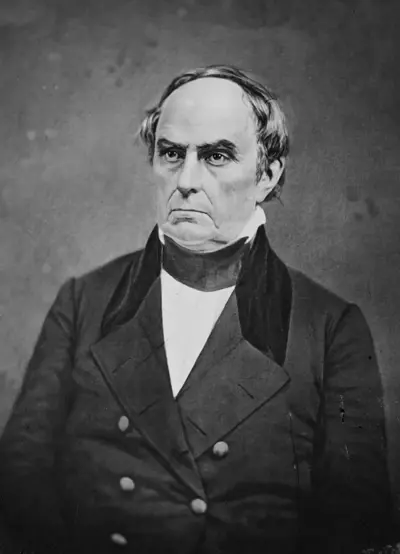
Daniel Webster was an American lawyer and statesman who represented New Hampshire and Massachusetts in the U.S. Congress and served as the U.S. Secretary of State under Presidents William Henry Harrison, John Tyler, and Millard Fillmore. As one of the most prominent American lawyers of the 19th century, he argued over 200 cases before the U.S. Supreme Court between 1814 and his death in 1852. During his life, he was a member of the Federalist Party, the National Republican Party, and the Whig Party.
