Elliott Abrams Quotes
American power remains today what it was in the Second World War and the Cold War: the greatest force for freedom in the world.
Abrams, Elliott. Realism and Democracy: American Foreign Policy after the Arab Spring. Cambridge University Press, 2017.


The occasion was the visit to Washington of French Minister M. Jean Letourneau. The French were fighting the communists in Vietnam and the U. S., not yet in the fight, promised material and political aid, but no military participation. It was almost a decade later that America sent its first military personnel to Vietnam. The West was persuaded that the French could handle the situation. When they were defeated, America and Britain assumed that it was the notorious military incompetence of the French that accounted for the situation rather than the competence and commitment of the Vietnamese Communists and their support of the majority of the people.


He was referring to the Early Cold War. The American official position and propaganda called for Russian military and political control of Eastern Europe to end and supported uprising and revolution, but the U. S. did not have the power to dislodge Russia without risking a nuclear war.


Russia announced ballistic missile testing in response to NATO announced deployment of a missile shield across Europe. It was the first mini arms race since the fall of the Soviet Union.


This editorial marked what most people agreed was the end of the Cold War.


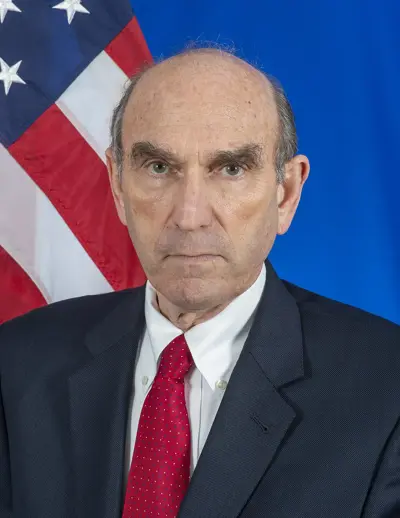
Elliott Abrams is an American politician and lawyer, who has served in foreign policy positions for Presidents Ronald Reagan, George W. Bush, and Donald Trump. Abrams is considered to be a neoconservative. He is currently a senior fellow for Middle Eastern studies at the Council on Foreign Relations. On January 25, 2019, he was appointed as Special Representative for Venezuela. On September 1, 2020, he was further appointed to concurrently serve as the U.S. Special Representative for Iran.
