Barry Goldwater Quotes
American forces there could probably be cut by at least one-third if NATO commanders had the power to use nuclear weapons on their own initiative in an emergency.
One of the many Goldwater statements that made most Americans believe he was not prudent enough to trust with the nuclear “trigger”, See {622850}.
Barry Goldwater, 1909-1998, U. S. Senator (Republican, AZ), Republican Nominee for President, Interview with Chalmers Roberts, “Goldwater Backs Army Cuts Abroad: Would Give NATO Commanders Power to Use A-Weapons,” Washington Post, October 25, 1963
Sourced by: Eigen's Political and Historical Quotations

The ad, created by Tony Schwartz, only ran once, on September 7, 1964. It was so dramatic that News and other media replayed it and discussed it up until the election. LBJ’s opponent Barry Goldwater was a military hawk in the midst of the Cold war where nuclear war was everyone’s greatest fear. The Daisy ad was crystal clear and made overt what many Americans concern was about Goldwater. Johnson won in a landslide. See {586351} for the kinds of views that made Goldwater so vulnerable.

Sandia is a company that has gotten almost all their business from the Federal Government for doing research and development of nuclear weapons. Based on this view and others the AEC and the military not only developed small atomic bombs with short range rockets that could be transported in jeeps, but actually developed a 51 lb. atomic bomb that a soldier carried on his back. The idea was for these solders to parachute behind enemy lines, place the bomb near an important enemy facility and escape the critical zone on foot before the bomb exploded. It was never used in combat and receded in interest except for the fact that it proved it was possible for a terrorist suicide bomber on foot to place and explode a nuclear weapon.

The alternative deterrent was to maintain an army of over 2 million men overseas in both Europe and Asia, and the cost was much greater than the then perceived cost of nuclear weapons. At the time no one figured the cost of coping with the radioactive material and waste as well as the cleanup of nuclear bomb factories like Hanford. These costs were still not known byt the 21st century.


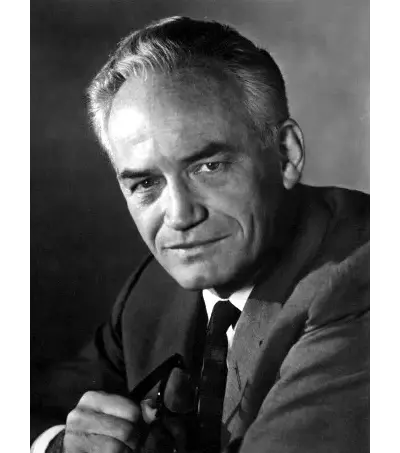
- Born: January 2, 1909
- Died: May 29, 1998
- Nationality: American
- Profession: Politician
Barry Morris Goldwater was an American politician, statesman, businessman, United States Air Force officer, and author who was a five-term Senator from Arizona (1953–1965, 1969–1987) and the Republican Party nominee for president of the United States in 1964. Goldwater is the politician most often credited with having sparked the resurgence of the American conservative political movement in the 1960s. Despite his loss of the 1964 presidential election in a landslide, many political pundits and historians believe he laid the foundation for the conservative revolution to follow, as the grassroots organization and conservative takeover of the Republican party began a long-term realignment in American politics helped to bring about the "Reagan Revolution" of the 1980s. He also had a substantial impact on the libertarian movement.
