Karl Marx Quotes
Although usury is itself a form of credit in its bourgeoisified form, the form adapted to capital , in its pre-bourgeois form it is rather the expression of the lack of credit .
Marx, Karl. Capital: Volume III. Progress Publishers, 1959, p. 600.


This was the equivalent of 8.3 percent.

The bill which passed required people who went into bankruptcy to continue to pay for credit card obligations incurred before the bankruptcy except if they are very rich and have bought very expensive homes in the five states which offer this shelter.


Manava Dharma Shastra. Ancient Jewish law prohibited the charging of interest. The early Christian world frowned upon it and morally and legally vacillated from time to time. Islam outlawed interest completely and some orthodox Muslims and Muslim counties loans with interest are illegal. However the ancient Hindus not only allowed interest but felt that it was such an important component of the economy that there were numerous regulations, religions and legal regulating it. This example made 5 percent the maximum allowable interest rate. This text is a part of the Hindu Holy Texts. Hindus believe that Manu was a prophet whose text is revealed or inspired.


See Daniel Webster for an earlier expression of this notion.

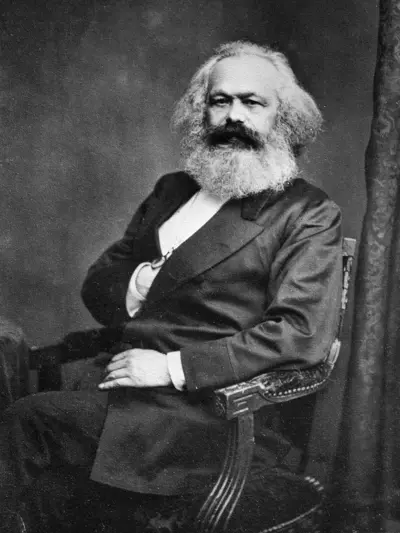
Karl Heinrich Marx was a German philosopher, economist, historian, sociologist, political theorist, journalist and socialist revolutionary. Born in Trier, Germany, Marx studied law and philosophy at university. He married Jenny von Westphalen in 1843. Due to his political publications, Marx became stateless and lived in exile with his wife and children in London for decades, where he continued to develop his thought in collaboration with German thinker Friedrich Engels and publish his writings, researching in the reading room of the British Museum. His best-known titles are the 1848 pamphlet The Communist Manifesto and the three-volume Das Kapital (1867–1883). Marx's political and philosophical thought had enormous influence on subsequent intellectual, economic and political history. His name has been used as an adjective, a noun, and a school of social theory.
