Ernie Pyle Quotes
About every two minutes a new wave of planes would be over. The motors seemed to grind rather than roar, and to have an angry pulsation like a bee buzzing in blind fury.
Pyle, Ernie. Ernie Pyle in England. Robert M. McBride & Company, 1941, p. 227.

The Germans saw this concern as partisan party politics and hysteria. See {594618}.


In WWII the Germans bombed London causing many civilian casualties. In retaliation, the allies bombed German cities such as Hamburg and others. The resolution’s effect was very short lived. There are similar restrictions in the Geneva Conventions but again, if one side breaks the conventions, most other sides will retaliate. Note that in the 3rd condition, the one that is most contentious in the 21st century “negligence” is the operative word. An error or mistake is not necessarily or even usually negligence. Many people believe that international law prohibits the bombing of civilians from reading 3) and similar statements from treaties. However, an honest error, mistake or equipment malfunction which kills

There were few military thinkers at that time who would agree with Goebbels on this point.

One of the predictions of the oncoming war with Germany.

The smaller German towns had not been targets for allied bombing and German censorship kept most Germans from realizing that the factories in the larger cities were being attacked. But the “rules of war” which the Germans had abandoned early in the war by bombing civilian targets in England and other European cities, required that only military targets be attacked. If a nation placed its factories or military bases in the midst of civilian populations, then the rules of war no longer protected the civilians. So the allies were within their rights by bombing the smaller towns where they targeted factories. However, this quotation is used by some critics to show that FDR’s motive was not the destruction of factories per se, but the breaking of German civilian morale. They argue that the allies were following the letter of the law, but not the spirit.


TR was then a Lieutenant Colonel and the regiment he organized was an unusual combination of Ivy League College men, cowboys from the West, and Black Buffalo Soldiers.


At Potsdam the Allies had called for the unconditional surrender of the Japanese and reiterated what had been allied policy that the surrender must be unconditional. Even after the Hiroshima bombing, the Japanese military cabinet voted not to surrender. After the second atomic bomb, the Emperor decided to surrender, but even then there was an attempted military coup to prevent that. Fortunately, the coup failed. We did not have any more atomic bombs immediately ready and it would have taken months to construct more.

Some scholars look back at the allied bombing of German Cities in WWII with criticism that it was morally improper to bomb populated cities, and that the use of the adjective “exterminating” indicated that Churchill was more interested in killing Germans than strategic victory. This revisionist history has two failings. First, the Germans had already bombed Coventry, London and other civilian targets in England as well as cities in Holland, Poland and other countries killing many civilians. As a result, under the rules of war, Germany was no longer entitled to protection for their cities. Further, Hamburg and other targets were manufacturing sites of war material and as such lost the protection anyway. Even Dresden, which had very little war manufacturing was the main location for R&R of German Officers and by their military presence in the city converted it into a legitimate target. FDR agreed with Churchill, that the bombing was a good strategy to cause Hitler to fall as they thought the public would rebel. They were wrong however and his grip on the population through the Gestapo and the military was so strong that, it took a land invasion and occupation to put an end to Hitler. However, the devastating bombing all but crippled the German weapons development and deployment. For example. The Germans had developed the Jet Airplane Engine and actually put a few in the fight at the end if the war. Without the bombing, they would have had many more and countered the allied air supremacy. However, it is also true that Churchill and many Englishmen and some Americans believed that the English were morally entitled to retaliation for the innocent civilians killed with the German bombing of civilian targets.


He was the author of the first “spy novel” and one of the first English writers to use his art and craft to promote public opinion to support more military spending to defend against Germany.


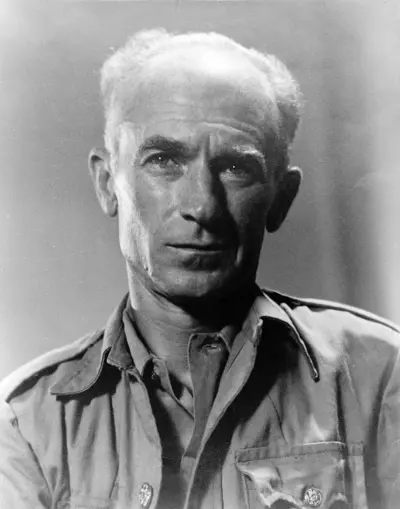
Ernest Taylor Pyle was a Pulitzer Prize—winning American journalist and war correspondent who is best known for his stories about ordinary American soldiers during World War II. Pyle is also notable for the columns he wrote as a roving human-interest reporter from 1935 through 1941 for the Scripps-Howard newspaper syndicate that earned him wide acclaim for his simple accounts of ordinary people across North America. When the United States entered World War II, he lent the same distinctive, folksy style of his human-interest stories to his wartime reports from the European theater (1942–44) and Pacific theater (1945). Pyle won the Pulitzer Prize in 1944 for his newspaper accounts of "dogface" infantry soldiers from a first-person perspective. He was killed by enemy fire on Iejima (then known as Ie Shima) during the Battle of Okinawa.
