Anthony Kennedy Quotes
A husband has no enforceable right to require a wife to advise him before she exercises her personal choices.
In many countries, wives must have the permission of their husbands to have any major medical procedure. In some she cannot leave the home, travel, or make a contract without the permission of the husbands. Each year, in the third world, many women die in from not being able to have medical care because they were not allowed to leave the village to go to a hospital or clinic in an emergency, until the husband could be found to grant permission. Under American and most law of developed countries, either spouse had the unilateral right to have any medical procedure and neither is required to inform or obtain the permission of the other.
Anthony Kennedy, U.S. Supreme Court Justice, Writing for the Court, Planned Parenthood v. Casey, 1992
Sourced by: Eigen's Political and Historical Quotations


the legal power automatically then given to a husband over his wife’s body and property


This is the passage of the Bible that causes many fundamentalist Christians to believe that wives should obey and be subservient to their husbands. Other Christians believe that this as archaic as stoning adulterers or executing children who are not obedient to their fathers. Ironically, this is one area where many fundamentalist Christians and fundamentalist Muslims are in agreement.


At the time the law in the United States gave a husband control of all property of the wife including any money she might earn. In this sense the English Christian legal tradition was far less fair and modern than even Islam which guaranteed some property and inheritance rights to women.


This type of religious sexism is not unique to Islam. Fundamentalist Christians place women in a secondary role as do fundamentalist orthodox Jews although both allow a man to take only one wife. The Islamic scripture tells us that the Prophet allowed multiple wives only if the man had the resources to care for the wives and all the children. 4 is the maximum.


Although she was very outspoken about the plight of women in society, she was very disapproving of women insisting upon rights. See {585321}.


The case was a protest against the 1921 law which gave equal rights to women of Wisconsin. See {587976}.

This relatively radical viewpoint regarding equal rights for women was expressed by Roosevelt as his Senior thesis at Harvard in 1880. In those days, the kind of scrutiny of everything a candidate ever wrote or said that is characteristic of modern politics, did not exist. It is very doubtful that if the Republican Party officials had ever known that he had espoused these views—even as a young student, that he ever would have risen so high in the party, much less get nominated at the Vice Presidential candidate which was his entree to the Presidency. When in office however, there is no record of him reviving his youthful proposal that women who marry retain their maiden names.

This is a particularly interesting passage of the Koran. On the one hand it provides the religious justification for the sexist dominance of the male in a marriage. However, at the same time, it gave wives rights at a time when few cultures and religions did--such as the right to own and inherit property. Women in the Western world did not obtain some of these rights until the last hundred years. So historically, Islam was somewhat ahead of Christianity when Muhammed lived, but while most Western interpretations of gender role and rights have changed and advanced, a small minority of Islam has been reformist and modern so Islam has gone from a leader in modern gender relations to an obstacle to equality and fairness by not changing and reforming.
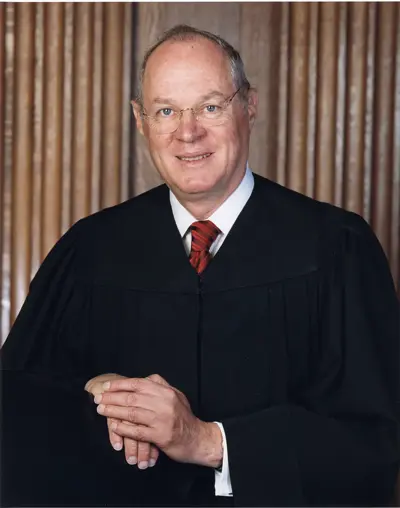
Anthony McLeod Kennedy is a retired American lawyer and jurist who served as an Associate Justice of the Supreme Court of the United States from 1988 until his retirement in 2018. He was nominated to the court in 1987 by President Ronald Reagan, and sworn in on February 18, 1988. After the retirement of Sandra Day O'Connor in 2006, he was the swing vote on many of the Roberts Court's 5–4 decisions.
