Theodore Roosevelt Quotes
… a federal industrial commission comparable to the Interstate Commerce Commission and the protection of the people from concerns offering worthless investments under highly colored and specious appearances
More than 20 years later, after unregulated finance enabled the Great Depression, Franklin Delano Roosevelt, finally got the Securities and Exchange Commission passed by Congress. By the beginning ot the 21st century
Theodore Roosevelt, 1858-1919, 26th President of the United States (Republican, NY), Phrase he used in the 1912 Bull Moose Party Platform
Sourced by: Eigen's Political and Historical Quotations

The result was regulation of the banks and the creation of the SEC to regulate the stock market, However, over the years, the regulations were not able to keep up with the sophisticated development of new forms of investments and financial instruments and the financial industry were able to speculate with other people’s money in ways that FDR and his reformers never imagined. Finally, even the regulation that did exist was weakened by the policies of the George W. Bush administration and the combination brought about the Great Recession of 2008 where the profits from excess speculation were privatized and the losses, socialized with the taxpayer and the American worker bearing the brunt while most of the speculators were bailed out and made more money than ever. The Obama administration tried to reform the situation, but was unable to put an end to the legal speculation with other people’s money or of having institutions that were “too big to fail.”


Marcopolos had discovered the Bernie Madoff Ponzi Scheme Fraud 9 years before the government discovered the largest consumer fraud ($68 billion) in American financial history. He repeatedly sent warnings and explanations to the SEC investigators, most of which turned out to be exactly right. They ignored all of it I an era of deregulation, and never even investigated Madoff to see if there might be anything amiss.

This was a very important quotation because Cox was a strong advocate of deregulation and voluntary regulation, and that is why he was appointed to head the SEC by George W. Bush. He was the leading Republican expert on Regulation of the Stock Markets and sale of public securities. However when the Meltdown of 2008 hit, it was clear to all but the extreme ideologues that some Federal regulation was necessary. Nonetheless, it took several years to reform the regulations for the financial industry with the Banks and Wall Street fighting it all the way and by that time the Republican Party had been so dominated by ideological conservatives that the views of Cox and others no longer had much influence. They fought the Dodd-Frank reforms to go preserve self regulation to a great extent.

The Stock Market went up slightly as a result of his efforts.

The then attorney general had begun a series of investigation which discovered that most of the major Wall Street brokerage houses were engaged in systematic frauds to cheat small investors. One dramatic fraud he uncovered was that the research expert analysts of major firms would recommend the stock of businesses that their firm was doing investment banking for even when they knew that the companies were not doing well or were even in deep financial trouble. See {627544}.
The hearing dealt with the crash of the Enron Corporation stock and the subsequent loss of jobs and pension money of employees.

He and others believe that no matter what regulatioms government officials might impose, Wall Street, the banks and financeers will find a way around the reulations.

At the time, it was generally felt that gambling was particularly harmful for poor and middle class people, than for wealthy aristocrats who could afford losses more easily. The solution was to make gambling casinos difficult and expensive to get to and so discourage their use by all except for the rich. Keynes, however, observed that the stock market was essentially a gambling system, and should socially and legally be treated the same as other gambling forms.
All three of the credit rating agencies gave securities of bundled very risky mortgages the highest and most secure ratings. They never examined the underlying securities, and continued to give these AAA ratings even after many had defaulted and they were in “junk bond” status. The rules then were that the financial companies who wanted a rating would “discuss” the rating that they would get BEFORE they paid the rating companies to do the rating. In no case did they ever pay a rating agency for a rating unless there would be a AAA rating despite the fact that these securities were among the highest risk public securities in American financial history. Under the law at the time, the rating agencies could not be held liable for there irrational ratings.


For many general government regulations—labor, environment, non discrimination—the small business has a proportionately heavier burden of compliance. So large businesses have always been able to count on small business to lobby against regulation and for deregulation. However, when it comes to financial regulation such as the Dodd-Frank regulations essentially apply to large businesses. As a matter of fact, small businesses were on many ways the most frequent victims of the large banks and investment bank excesses in the Meltdown of 2008. Before most of the regulations could even take effect, the financial industry was already trying to get small business to lobby to roll back the protective regulations preventing future meltdowns and bank failure resulting from loose regulation and greedy irresponsible financial industry behavior. The President campaigned to convince the small business not to support the finance industry over their usual “knee jerk” reaction to any regulation.
This bill set up the Securities and Exchange Commission (SEC). Prior there was no regulation or limit as to what a corporation could say to raise money from the public. Lies and fraud were common. There were no accounting standards as to when a company was profitable. Things improved much but each year that are companies caught lying or exaggerating to get people to buy their stock.


At the time, the financial industry spent more money for lobbyists and campaign contributions than any other sector of the economy. The result is that they had extraordinary access to and influence upon members of Congress and their staffs, that more often than not, the actually drafted the language for laws, amendments and regulations and then les the strategy to pass the legislation or finalize the rule. Moreso than any other industry, they wrote their own rules. Even after the Meltdown of 2008 and the Great Recession where there was a public outcry for reform, the Dodd Frank legislation was influenced by the industry and after passage most of the rules and interpretations were written by the industry or greatly influenced by them.

The Dodd Frank bill was designed, in the aftermath of the large bank induced meltdown of 2008 and the Great Recession, to regulate the banking industry so that no bank would be “too big to fail”. However, although the bill placed many restrictions on the banks to prevent much of their risky economic behavior, which the banks complained inhibited their growth and profitability. However, the bill did not put any limits on the size of the large banks and their critical proportion of the U. S. Financial System. If a bank was large enough, the government did not dare allow the bank to fail regardless of how profligate the Bank had been with its depositors’ money. So the shareholders made big money from the Bank’s risky behavior if it turned out well, and if not the taxpayers had to bail the banks out, because they were too big to fail without causing much of the rest of the country to also fail. Warren and others wanted a simple solution. Break up the large banks into smaller ones and then if any one of the small units makes poor investments, the bank could fail and other than its shareholders and creditors, the effect would not be so serious that the government could not allow the bank to go into bankruptcy. Mismanaged banks could fail like other mismanaged companies and not take down much or the rest of the country with them. But the banks lobbied to prevent that, and by 2014, 6 years after the taxpayers had to bail out banks that were too big to fail, many of the banks were twice as large as they were when they were already too big to fail.


First female presidential candidate & first divorcee to run for that office. Woodhull and her sister became the first women to obtain a seat on the New York Stock Exchange. They made a great deal of money, and then Woodhull wrote an exposé of Wall Street and the way the Stock Exchange was rigged. It was almost 100 years before the New York Stock Exchange would take a chance on another woman.

The Commission is not a law enforcement agency in the sense that it can initiate or prosecute a civil or criminal lawsuit against a party that is breaking the law. The Commission however, can refer cases to the Justice Department and turn over their findings with a recommendation to prosecute. However, under George W. Bush, the policy was not to even do that. Chairman Majoras actually persuaded the Bush Justice Department to terminate efforts to prosecute Intel and other companies that previous Commissions had recommended prosecuting.
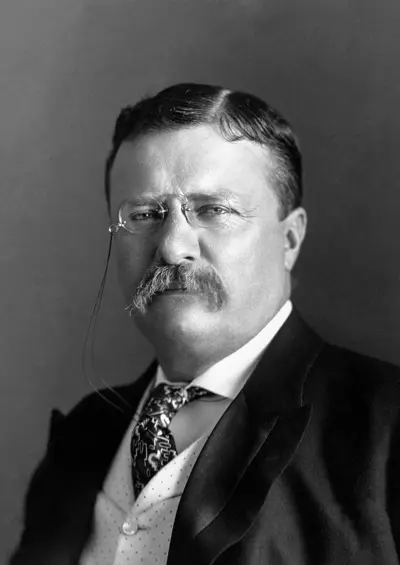
Theodore Roosevelt Jr., often referred to as Teddy or his initials T. R., was an American statesman, conservationist, naturalist, historian, and writer, who served as the 26th president of the United States from 1901 to 1909. He previously served as 33rd governor of New York from 1899 to 1900 and the 25th vice president of the United States from March to September 1901. Roosevelt emerged as a leader of the Republican Party and became a driving force for anti-trust and Progressive policies.
