Robert M. Gates Quotes
[William J.] Casey was guilty of Contempt of Congress from the day he was sworn in.
Casey frequently withheld information from Congress that he was legally required to report, did things without Congressional authorization and often lied in his testimony and reports to Congress.
Robert M. Gates, U. S. Secretary of Defense (Republican, Director of the CIA, Quoted in Tim Weiner, Legacy of Ashes: The History of the CIA, 2007
Sourced by: Eigen's Political and Historical Quotations

He was not referring to economic corruption but intellectual and moral corruption. Regan who appointed many excellent key officials picked a very unfortunate choice to lead the CIA. William J. Casey had many faults and weaknesses—See {637472}, {636743} and {637469}. But the worst of his damage was imposing his ideology on the agency and having the intelligence analysts shape their intellectual product to conform with a particular world, political, and religious view. See {634408}. This became acceptable and as future administrations took power their ideologies were considered by the CIA professionals and reports were edited and shaped accordingly. Reform was instituted by some of the future CIA directors but there were precedents from the Casey days for years. One particularly bad manifestation of this intellectual corruption occurred when Vice President Richard Cheney imposed a neocon world view on the agency with a pliant CIA director and the agency gave the President a totally inaccurate assessment of Iraq nuclear capability and intention which triggered the disastrous Iraq war, made all the worse when there were not only no nuclear weapons in Iraq as had been reported, but there was not even a single laboratory trying to develop nuclear weapons or even nuclear power.


Senator Church was the chairman of the committee. It’s reports (14 in all) are the most extensive documentation of U. S. intelligence ever compiled.


The appropriations committee allocates the monitory appropriations of all the agencies and it is a large committee. The appropriations committee members read the reports of the committee with oversight over an agency and makes judgments about the appropriation size compared to what the agency committee has authorized. But with intelligence there is nothing of detail in the report so the appropriations committee have little or no idea of what they are appropriating money for. But the appropriations committee will not delegate the appropriation decision to the Intelligence Committee.

If Casey had listened to Sofaer as the State Department did, President Reagan would have been spared the worst Scandal of his Presidency—Iran Contra. Casey had a great antipathy to lawyers. See {637470}.


In an ironic precursor to the Iran-Contra scandal to come a decade later:

This notion seems to have first been expressed by Edward S. Corwin in 1940

This was written when Wilson was a Professor. When he became President, his view of the importance of Congress and Congressional oversight diminished.


The intelligence agencies had in many cases not shared critical information with the oversight committees and the White House and in a number of cases actually lied to them.


President George W. Bush had ignored a federal law and tapped the phones of Americans without probable cause and a warrant issued by a court. The President’s defenders argued that the President, as Commander in Chief, has the Constitutional responsibility to lead the military and protect the nation. Intelligence gathering is part of military activity. Therefore the intelligence gathering is a Constitutional duty and the Congress, under the separation of powers doctrine, may not interfere with the President’s Constitutional Duty to conduct intelligence. Under this doctrine, the President need not obey laws that he believes impinge on his management of the war effort and the defense of the nation. Most legal scholars believe that this argument is nonsense, but the George W. Bush administration has stated the doctrine and it was the subject of much litigation.


The drafters of the Constitution were well aware of this view of Montesquieu’s which was one of the main bases of separation of powers and checks and balances in America.
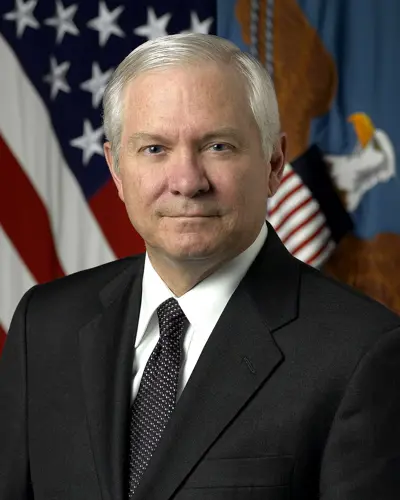
- Born: September 25, 1943
- Nationality: American
- Profession: Politician
Robert Michael Gates is an American intelligence analyst, and university president who served as the 22nd United States secretary of defense from 2006 to 2011. He was originally appointed by President George W. Bush and was retained for service by President Barack Obama. Gates began his career serving as an officer in the United States Air Force but was quickly recruited by the Central Intelligence Agency (CIA). Gates served for 26 years in the CIA and the National Security Council, and was Director of Central Intelligence under President George H. W. Bush. After leaving the CIA, Gates became president of Texas A&M University and was a member of several corporate boards. Gates served as a member of the Iraq Study Group, the bipartisan commission co-chaired by James A. Baker III and Lee H. Hamilton, that studied the lessons of the Iraq War.
