Tommy Douglas Quotes
Will it be a great source of comfort to certain Canadian boys to know that the bullet that maimed them for life was made from Canadian nickel sold by the International Nickel Company?
This was one of the first Canadian political concerns about a multinational corporation and its patriotism and duty to its home nation and region. International Nickel Company was selling Canadian Copper and Nickel to Germany, Italy and other enemies. This is an old story. In America, New England merchants sold beef and other produce to the British during the War of 1812. While America was arming England at the beginning of WWII, IBM was supplying and servicing strategic data processing equipment through its European subsidiaries. A few American companies sold strategic materials to Iraq when they were working on weapons of mass destruction at the beginning of the 21st century. However, International Nickel was one of the first real Multinational Companies which fundamentally had no loyalty to any nation.
Thomas Clement Douglas, 1904-1986, Canadian MP and Premier (Governor) of Saskatchewan, Leader of the Co-operative Commonwealth Federation, Baptist Minister, Debate, House of Commons, Ottawa, Ontario, April 3, 1939
Sourced by: Eigen's Political and Historical Quotations


General Motors in Germany had started manufacturing trucks for the Nazi regime. Ford also was building dual use—military and civilian—vehicles. A number of American corporations, with World War II having started in Europe, owned subsidiaries in Nazi Germany which under Nazi laws and regulations were required to produce products for the Nazi government. IBM machines were being used to keep track of all the anti-Nazis, Jews and other perceived “enemies”. Nazi contracts were very profitable and most American firms in Germany just closed their eyes to what the Nazi regime was doing and even fired their Jewish workers rather than close down their German factories. With this horrible experience with large corporations helping what was to be our enemy, after WW2 Congress passed legislation which allows the President to make it illegal for American firms to trade with, manufacture in, or provide technical assistance to Countries that are potential enemies.

This speech to over 100,000 people galvanized the Indian nationalists They had been asking the British to change the constitution to give India more independence. Churchill was opposed to any policy that would diminish the British Empire, but needed the Indians as men of India served in the British Army in every major theater of WWII. So instead of saying "No" Churchill held out the possibility but at a later time. He argued that it was inopportune to alter the Constitution in the midst of a world war.

“Lord Haw Haw” was the name that he used in his propaganda broadcasts from Germany to England. Despite the fact that the broadcasts were anti-British and pro German, many in Britain listened to him regularly. He was very witty and many of his criticisms of British society were views held by many patriots in Britain. As pure entertainment, he was better than most of the BBC broadcasts during WWII. At the end of the war, Joyce was captured, tried and executed for treason.
“Lord Haw Haw” was the name that he used in his propaganda broadcasts from Germany to England. Despite the fact that the broadcasts were anti-British and pro German, many in Britain listened to him regularly. He was very witty and many of his criticisms of British society were views held by many patriots in Britain. As pure entertainment, he was better than most of the BBC broadcasts during WWII. At the end of the war, Joyce was captured, tried and executed for treason.


At Hamburg Harris organized a massive fire bombing of the German industrial city and the fire storm was so great that it sucked the oxygen out from huge sections of the city and thousands of people were roasted alive. Even with 100,000 Germans killed, Harris was convinced that it was a relatively humane way of waging a necessary war when compared to the classic artillery barrage followed by invading soldiers and street to street fighting.
The last phrase was a variation of the famous Bismarck quotation {594849}.

The Centograph is a war memorial monument in London. On Remembrance Day, a British Patriotic Holiday, veterans march past the Centograph. The quotation is text uttered by one of her characters.
The America First Committee consisted of right wing Americans who admired the fascist states of Nazi Germany and Italy. They were very anti-English and wanted the USA to have an alliance with Hitler against England and above all to not support England in the Second World War. Once Hitler declared war on the United States, the absurdity and danger of the American First groups became clear. A few changed their minds, but most remained ultra right wing fascists. They were a public group and under surveillance by the FBI so they never participated in any sabotage or successful spying for the enemy. Ironically, the organization with the most patriotic sounding name was so disloyal and in support of those who warred on America. Great Britain had an equivalent organization arguing for England to support Germany and let Hitler control Europe.

This was a Nationally Broadcast Speech speech in the run up to American entry to WWII, Lindbergh had been a national here for being the first aviator to fly over the Atlantic to Europe. Politically, the National Hero became an active fascist supporter of Mussolini and Adolph Hitler who awarded him a Medal for Supporting Fascism, Anti-Semitism and advocating for America to allow Hitler to conquer German and the rest of Europe. After WWII he was in disgrace. This quotation is one of his many attempts to keep America from interfering with Hitler in Europe as he was a great admirer of Fascism and the two leading proponents in Europe.


This may have been one of the most indelicate and insensitive true public statements ever made by a politician. The English population and their political representatives were angry and worried very much that bombing of cities might become a German pattern (which it did.)

In 1938 Germany had rearmed and resumed its aggressive designs of expansion. Hitler wanted the Sudetenland part of Czechoslovakia and threatened an invasion of that country. England had France had a treaty obligation to militarily support Czechoslovakia if it were attacked. British Prime minister Neville Chamberlain and the French were desperately trying to avoid war, not realizing that with Hitler, that position was the very thing that would bring on war. So they agreed to Hitler’s demand and allowed Czechoslovakia to be partitioned and the Sudetenland was annexed to Germany. This craven appeasement emboldened Hitler who then decided to conquer all of Europe as he had no serious opposition from France and England—the two powers that might have stopped him. (At the time, the French had a larger army than the Germans.)


His predecessors had lied about the status of the Greek Economy and then squandered the money with waste, fraud, and corruption. To avoid total national bankruptcy, Greece needed a large bailout which was given subject to a set of required conditions of reform and transparency. This “austerity” package created a great hardship for many of the average Greek citizens while the wealthy who had benefitted from the previous incompetence and corruption took their money out of the country. The Greek voters elected a new government without much experience but who were committed to lifting the burden of the austerity package. The problem was that the major nations of the Eurozone, whose taxpayers would have to pay for the bailout, had been burned before by Greek government lies and incompetence and did not trust the Greeks, insisting on the austerity measures if any bailout money would be forthcoming. The new Greek government was caught in a great dilemma. Agree to the same kind of Austerity package and continue the great hardships on the people or go into Bankruptcy and leave the Eurozone the consequences of which would probably be worse. The finance minister was hoping for a compromise.

Helms was then a young agent of the Office of Strategic Services (OSS) in Berlin.

1st Viscount Grey of Fallodon
The Boers had just a few years before lost their war with the British who were then in control of South Africa. However, the British did not treat the Boers harshly in defeat and most Boers were at the time farmers and land owners who were a major force in democratic South Africa and had much invested in the nation. Others were still resentful of the British. The Boers sided with the British and fought the Germans who had troops and colonies in Africa. Like the Irish, culturally, they were always up for a good fight.

The concept of race then was not what it is today where it is, if anything, a genetic or anthropological distinction. Then race was a combination of blood (genetics) and culture. Wittgenstein, an Austrian by nationality, considered himself German racially. This concept of race was common in 1914 and rose to be absolute in the Nazi era. So the absorption of Austria by Germany did not seem to most Austrians a diminution of anything but a natural recognition of the unity of one people—the German race. Wittgenstein was not alone among intellectual “Germans” who believed the English “race” superior. Their ability to operate a democracy without a powerful leader was considered a great strength as was the diffusion of power and control were both admirable accomplishments which some German intellectuals envied.

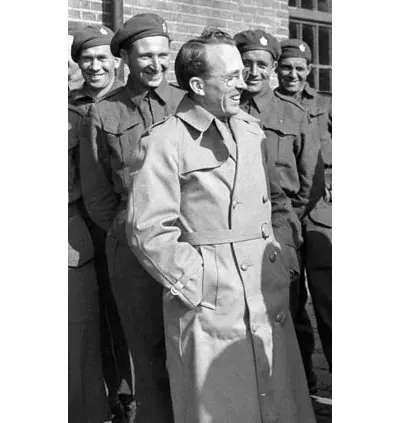
Thomas Clement Douglas PC CC SOM was a Scottish Canadian politician who served as Premier of Saskatchewan from 1944 to 1961 and Leader of the New Democratic Party from 1961 to 1971. A Baptist minister, he was elected to the House of Commons of Canada in 1935 as a member of the Co-operative Commonwealth Federation (CCF). He left federal politics to become Leader of the Saskatchewan Co-operative Commonwealth Federation and then the seventh Premier of Saskatchewan. His cabinet was the first democratic socialist government in North America and it introduced the continent's first single-payer, universal health care program.
