John Kenneth Galbraith Quotes
There is something uniquely obscene about competition to promote weapons of mass destruction for purposes of improving the stock market position of a corporation.
John Kenneth Galbraith, 1908–2006, Economist, U. S. Ambassador to India (Democrat), 1969
Sourced by: Eigen's Political and Historical Quotations


It is with this certainty that the Vice President led the effort to invade Iraq in a preemptory war. After the invasion it was discovered that Iraq did not have any nuclear weapons or any other WMDs. Further, Iraq had no WMD development program of any kind. The rationale for the Iraq War was nill.

Fermi was the scientist who organized and planned the first controlled nuclear chain reaction as a part of the Manhattan Project and was one of the major scientific advisors to the Atomic Energy Commission until he, Oppenheimer, and several other scientists opposed the development of the Super (the name Edward Teller had given to the proposed hydrogen bomb). The scientists knew that we had and could make enough atomic bombs to destroy any nation and to make it doable with just a few bombs as opposed to many they saw as of little military
value. They further expected that the Russians and some others would be forced to keep up with us in an arms race and that the bomb would never be able to be used without retaliation in kind and the destruction of most of America. The politicians and military did not really believe that the Russians had the scientific capability to develop hydrogen weapons and some thought if we had them and no one else did, we could dictate a “pax Americana” to the world. Others feared that Russia or some other country would develop a hydrogen weapon and then dictate to us. We did have a monopoly on the Super for a few years and America never dictated to the rest of the world. When other countries developed the weapons, we entered the era of Mutually Assured Destruction (MAD).


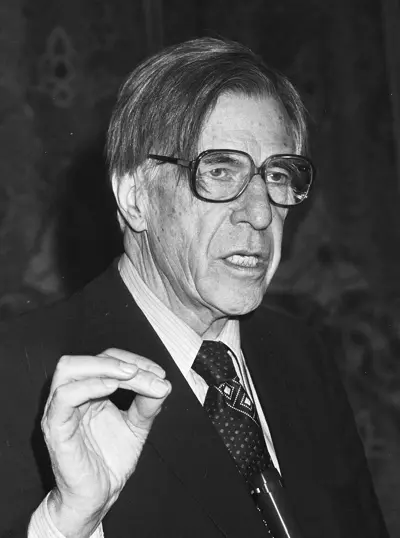
John Kenneth Galbraith OC, also known as Ken Galbraith, was a Canadian-American economist, diplomat, public official and intellectual. A leading proponent of 20th-century American liberalism, his books on economic topics were bestsellers from the 1950s through the 2000s. As an economist, he leaned toward post-Keynesian economics from an institutionalist perspective.
