Henry Clay Quotes
Who is James K. Polk?
In May of 1844 the Democratic National Convention was deadlocked between ex-President Martin Van Buren and Lewis Cass. On the 9th ballot they turned to a dark horse, James K. Polk. The odds-on favorite, however, was the Whig nominee, and great statesman, Henry Clay, who was informed of the Democrat's choice:. Clay soon learned, in one of the great American political upsets in American history.
Henry Clay, 1777-1852, U.S. Congressman and Senator (National Republican & Whig, KY), Speaker of the House, U.S. Secretary of State, Unsuccessful presidential candidate, May, 1844
Sourced by: Eigen's Political and Historical Quotations

The Mexican War was as controversial as any war in American History. President Polk ordered action independent of the Congress, In all of American History there have been two Congressional censures of American Presidents. This was one. See {594521} for the other.


The '44 referred to the 1844 election of James K. Polk as president.

His Indian Removal Policy forced Native American to leave their lands which were theirs by treaties signed by the United States and marched to the poorest land in Oklahoma where they were "resettled". This is often referred to as the "Trail of Tears". What made his actions evern wors was the fact that The Supreme Court had already ruled that such land belinged to the Cherokee Indian Tribe and the government of the United States may not force them from it. Jackson was the only President in Amrican History to defy a Supreme Court order.


Referring to America claiming Western land which had been held by Russia, England and Spain up to the 54°40' parallel. Polk's presidential campaign used this slogan, but there is no record that Polk ever did. However, he never disavowed the position dispite many opportunities to do so.


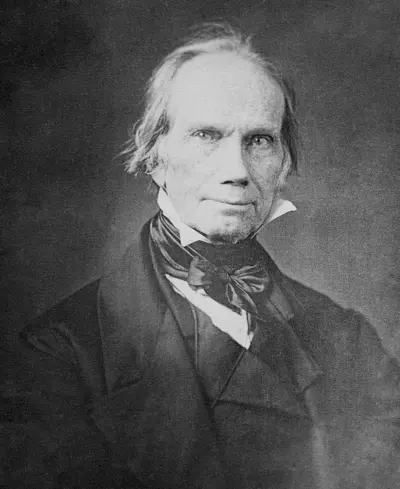
Henry Clay Sr. was an American attorney and statesman who represented Kentucky in both the Senate and House. He was the seventh House Speaker and the ninth Secretary of State. He received electoral votes for president in the 1824, 1832, and 1844 presidential elections. He also helped found both the National Republican Party and the Whig Party. For his role in defusing sectional crises, he earned the appellation of the "Great Compromiser" and was part of the "Great Triumvirate".
