Manuel II Palaiologos Quotes
Whenever the [Ottoman] Turks begin to be troublesome, send embassies to the West at once, offer to accept union, and protract negotiations to great length. The Turks so greatly fear such union that they will become reasonable. And still, the union will not be accomplished because of the enmity of the Latin nations.
Rome & the Roman Catholic Church Islam, led by the Ottoman Turks, were in a constant state of tension against the Christian World of Europe. However there had been a huge schism in Christianity where the Christian Roman Empire was split in two—a Western (Latin) Empire led by the Roman Catholic Church in Rome, and the Eastern (Greek) Roman Empire led by the Orthodox Church headquartered in Constantinople (Byzantium). The two churches were not only in a theological conflict but violence broke out and the armies of the two religious empires attacked each other now and then. This was a great advantage to the Muslims who were essentially unified under the Ottoman Turkish Sultan. Manuel knew that the reunification of Christianity was about the worst thing that could happen from the geopolitical view of the Ottomans and they always placed a high priority on doing whatever they could to magnify the stress between the two Christian empires. Manual and the Orthodox hierarchy were absolutely opposed to union as the schism had been precipitated by them to begin with. However, Manuel knew that the hatred of the East and the Orthodox Church was so great amongst the Latins that even if some of the Roman Catholic leadership might be interested in healing the schism and having a “unity in Christ”, the kings and nobles of the Western European nations would never accept unity and would scuttle the negotiations. This quotation is an excellent example of the kind of complex, foreign policy and political intriguing that caused our language to have an adjective—byzantine—which is in common use today.
Manuel II Palaeologus, 1350-1425, Byzantine Christian Emperor, Deathbed advice to his sons, 1425
Sourced by: Eigen's Political and Historical Quotations


The British suspected that the Turks of Anatolia were complicit with Bolshevism


With promises the success lies in following through and keeping the promise which is usually very costly. A threat that fails meanwhile can be the most expensive thing. We make a threat to deter a foreign power from something. Failure occurs when they are not intimidated and go ahead anyway. Then if we follow through on the threat, that is very costly—a war, a trade embargo, or whatever. Not following through on the threat is the costliest of all as we lose our credibility, trust and honor.

At the time the United States was leading a very effective set of economic sanctions against Iran for the express purpose of pressuring them to abandon their nuclear development program that could also be used for nuclear weapons development.
The “Vegas Rules” emanate from the slogan and practice that “Whatever happens in Vegas, stays in Vegas.

FDR was not always pro-British as many conservative opponents claimed. He was actually quite suspicious of the British though his concerns evaporated with the crisis of the rise of Hitler and WWII.

The Byzantine emissary had pointed out that Mehmed’s predecessors had signed a treaty agreeing to “consult” with Constantinople before building any fortified structure in the area surrounding Constantinople. Mehmed was only 19 years old at this time. His intention f building a fort was to have a platform from which to attack and capture Constantinople itself which he did 2 years later. Earlier, the Eastern Roman Empire was much stronger and the Ottoman sultans were more cautious in dealing with them. However, the various Christian factions were all feuding with each other, and Mehmed II, despite his youth, was much better organized and was a better leader than his predecessors.


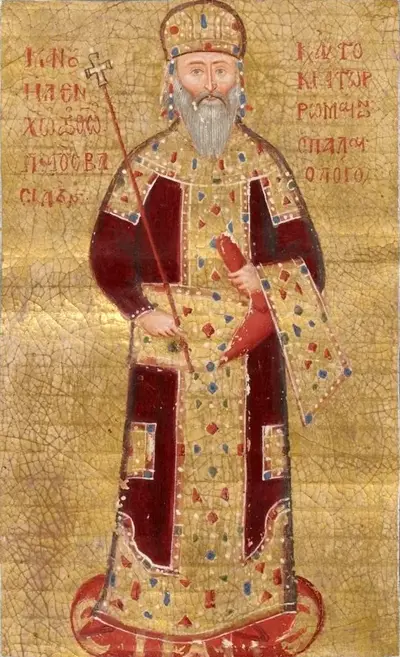
Manuel II Palaiologos or Palaeologus was Byzantine Emperor from 1391 to 1425. Shortly before his death he was tonsured a monk and received the name Matthew. His wife Helena Dragaš saw to it that their sons, John VIII Palaiologos and Constantine XI Palaiologos, become emperors.
