Eduard Shevardnadze Quotes
You know in the West they support realistic forces.
Shevardnadze, Eduard. Interview. The Daily Telegraph, Telegraph Media Group, 25 Nov. 2003.

Ironically, at the time she wrote this column, Mrs. Roosevelt was being accused of being a communist by some Southerners who associated her strong views against racism and segregation. Some in the North thought she was a communist because of her active role in the New Deal, Yet here she was, willing to use military force to prevent Soviet expansion.


Kissinger had observed in his unpopular view that he was saying exactly what the George W. Bush administration had officially said on several occasions. This response is quoted by those who use it as an example of how low the reputation of the George W. Bush administration had sank with America’s foreign allies. Kissinger was seen as a much more important and influential factor despite the fact that he had been out of office for over two decades. At the time, many American allies had given up on Bush and because he was so unpopular with Americans as well as foreigners, they assumed that his statements would not represent American policy or opinion as soon as Bush’s term was over. The new President of whichever party would, it was assumed, repudiate most of the Bush actions and try and rebuild America’s shattered reputation. In that scenario, Kissinger’s views would not only be more representative of American positions than that of Bush and his diplomatic representatives.

They were both children of Queen Victoria of England.

Most experts believe that this objective was sustained all through the Afghanistan War in the early 21st century.

Rome & the Roman Catholic Church Islam, led by the Ottoman Turks, were in a constant state of tension against the Christian World of Europe. However there had been a huge schism in Christianity where the Christian Roman Empire was split in two—a Western (Latin) Empire led by the Roman Catholic Church in Rome, and the Eastern (Greek) Roman Empire led by the Orthodox Church headquartered in Constantinople (Byzantium). The two churches were not only in a theological conflict but violence broke out and the armies of the two religious empires attacked each other now and then. This was a great advantage to the Muslims who were essentially unified under the Ottoman Turkish Sultan. Manuel knew that the reunification of Christianity was about the worst thing that could happen from the geopolitical view of the Ottomans and they always placed a high priority on doing whatever they could to magnify the stress between the two Christian empires. Manual and the Orthodox hierarchy were absolutely opposed to union as the schism had been precipitated by them to begin with. However, Manuel knew that the hatred of the East and the Orthodox Church was so great amongst the Latins that even if some of the Roman Catholic leadership might be interested in healing the schism and having a “unity in Christ”, the kings and nobles of the Western European nations would never accept unity and would scuttle the negotiations. This quotation is an excellent example of the kind of complex, foreign policy and political intriguing that caused our language to have an adjective—byzantine—which is in common use today.


After the economic & power collapse of the Soviet Union, the United States was the only remaining superpower. Givern Russia's diminshed capability and many Americans still carrying resentments about the Cold War, America's foreign policy and diplomacy did not treat Russia as if they were a very important power in the world. Puten greatly resented the fact that Russia was no longer considered or treated like a world power, Russia had a nuclear arsenal and a total delivery system what was in the same destructive potential class as the United States. There were many Russiabs who had similar resentments and Putin sert out to adopt policieis and practices that would force the United States and the other nations to consider them with more dignity, respect and consdideration. This was a typical statement of the period when he was "stoking the fires of Russian resentment.

Assad was the autocratic ruler of Syria. In the second decade of the 21st century, a number of dissident groups started a rebellion. The Unied States and most of the EU countruies wanted to assist the rebels as Assad had been butchering his own people to put down the rebellion. Russia, in addition to having an allaince with Assad for a Navel Base in Syria, was very coincerned about the people replacing Assad if the revolution succeeded. The coalition of rebels was not at all a coalition and there was considerable fighting and hatred between them ISIS was one of the stringest groups and the Russians were worried that they might take over so they supported Assad and in 2016 actually intervened using Russian air power to support the Government troops. That turned the tide and teh rebellion was prevented from succeeding. The Russian leadership was distressed that the United States did not take their concerns seriouly enough and indeed after they were in teh fight, the United States had to deal with them about the fate of Syria, so it was a successful tactic.
This was more than a decade after the fal of the Soviet Union.

During the Cold War and afterwards many Americans attributed the problems we were having with the Soviet Union emenated from the fact that they were Communists, and our focus was anti-communism. Kennen, however argued that it was not Communism that was the cause of the Aggression of the Soviet Union. It was an extension of the Russian Culture. After the Soviet Union collapsed, and Communism was rejected by the Russians, we still had a great deal of Russian aggression and Foreign Policy problems with Russia. Kennan was right. It was the Russian culture, history, values and traditions that were the primary cause of most of the problems with Russia.
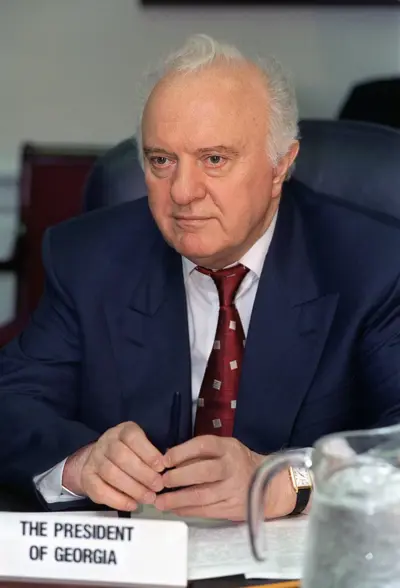
Eduard Ambrosiyevich Shevardnadze was a Georgian politician and diplomat. He served as First Secretary of the Georgian Communist Party (GPC), the de facto leader of Soviet Georgia from 1972 to 1985 and as Minister of Foreign Affairs of the Soviet Union from 1985 to 1991. Shevardnadze was responsible for many key decisions in Soviet foreign policy during the Gorbachev Era including reunification of Germany. Following the dissolution of the Soviet Union, he was President of Georgia (or in equivalent posts) from 1992 to 2003. He was forced to retire in 2003 as a consequence of the bloodless Rose Revolution.
