George Francis Train Quotes
When you will explain why, in His wisdom, He made one mountain overtop another mountain--formed one ocean larger than another ocean--planned one valley wider than another valley; when you can make me understand why He made the oak stronger than its neighbor--the rainbow more beautiful than the storm-cloud--the lily more lovely than the lilac; when you will tell me the reason that Providence ordained that the fair Saxon should be permitted to express, in the blush upon her face, all the emotions of her soul, while the African knows not the signification of the word--when these things are made clear to me, I will tell you how and why He has made the African the servant of the Anglo-Saxon race, but not till then. They were born and bred servants, they cannot be masters
George Francis Train, 1829-1904, Businessman, Promoter, and Orator, Independent Candidate for President of the United States, Speech, London, March 12, 1862
Sourced by: Eigen's Political and Historical Quotations

Charleston was in the Southern part of the state where most people supported slavery. Douglas made an unequivocal pitch for the racist vote {600060} and forced Lincoln to take a stand. Like many politicians today, Lincoln decided to give the audience what they wanted to hear. It is not clear whether or not he ever believed this statement or was just pandering in a political campaign. He had never said this in the Northern part of the state of before. Lincoln’s views on race changed and matured over the years, culminating in the Emancipation Proclamation. Lincoln lost the Senate seat to Douglas.


Newsletter of the United Sons of Confederate Veterans


Captain W.W. Polk, commanding the Coast Guard revenue cutter Florida, wrote Treasury Secretary asking permission to employ a young Negro on board. Existing regulations prohibited such. The Negro in question was a free Black born in New York who was an “expert sailor for his age and competent to the duty of a boy of the first class.” Polk had hired the boy as a servant after he had worked at sea for another Captain. Good seamen were hard to come by, decision was extremely contentious. Ingham “compromised” by limiting the allowable role of Negroes at sea—a practice that lasted till the Second World War.


Blacks were fighting and dying in WWII. They were equal when they were under fire, but otherwise not. The war was against fascist protagonists whose creed was inequality while the allies were upholding freedom and equality. But making that aspiration a reality was difficult.

This quotation illustrates how extensive and virulent anti-Asian racism had become. Gompers was a left wing liberal, but also a labor leader, and the prospect of millions of oriental immigrants competing for the existing American jobs was frightening. The irony of this quotation was that most of the labor constituency that Gompers represented had been immigrants or were the children of immigrants who earlier had frightened American workers and whose ethnicity had been opposed—Irish, Italians, Jews.

Interestingly, before 1705, there was no legislative prohibition against Indians and Free Negroes being full citizens including holding public office and voting. This act prohibited them from holding public office, but did not prohibit them from Voting provided they met the general voting requirement of being a landholder. However, 18 years later, voting by these minorities was no longer allowed. See Quotation 643588.

This concept was one of the main selling points that the Southern leadership used to invest poor whites in the Confederate cause. The poor white, no matter how bad off he’s was, cold always see himself above the Negroes who were fit for being a servant while he was above that. See Jefferson Davis Quotation


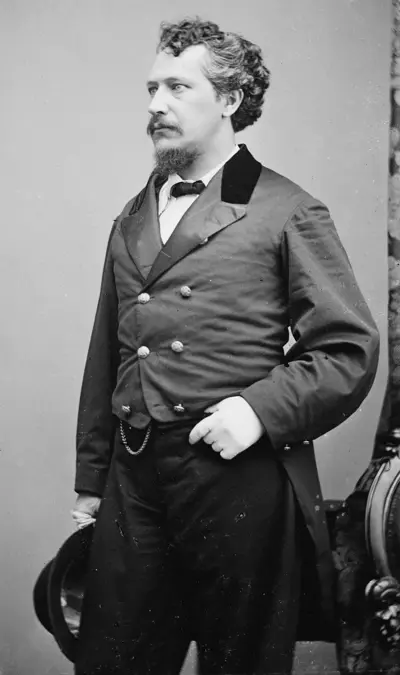
George Francis Train was an American entrepreneur who organized the clipper ship line that sailed around Cape Horn to San Francisco; he also organized the Union Pacific Railroad and the Credit Mobilier in the United States in 1864 to construct the eastern portion of the Transcontinental Railroad, and a horse tramway company in England while there during the American Civil War.
