Neville Chamberlain Quotes
Whatever may be the reason, whether it was that Hitler thought he might get away with what he had got without fighting for it, orwhether it was that after all the preparations were not sufficiently complete--however, one thing is certain: he missed the bus.
Chamberlain, Neville. Speech to the Conservative Central Council. 4 April 1940, Central Hall, Westminster, London. Published in The Times [London], 5 Apr. 1940, p. 8.


Both Hitler and Stalin were gross egomaniacs who each thought that they had gotten the better of things. The result was that 22 million Russians were killed and the industrial base if Russia Was destroyed. On the German side, the German military was virtually destroyed, many civilians were killed, the nation reduced to rubble and starvation, German leaders were killed, jailed or committed suicide including Hitler, and the country was occupied for years. Neither leader appeared very smart if one judges by the results.

Hopkins was a social worker with no military of political experience. But the President trusted him implicitly. Most American military officers and Ambassador to England Joseph P. Kennedy, a Nazi sympathizer & father of JFK, believed that England could not stand up to Hitler. Any military aid we gave England would fall into the hands of the Germans. Everyone was shocked when Roosevelt sent Hopkins to England to make a military recommendation. To impress Hopkins with something he thought Hopkins would be interested in, Churchill led a tour of workers cottages built by the government. Hopkins surprised Churchill and his aids who would never forget this statement & then asked to see the military facilities. Hopkins distressed the American military by recommending that Britain could hold out against invasion if they received military aid. Despite the contrary military advice, FDR accepted Hopkins’ recommendations, and the rest is history. He had been right and much of the military wrong.


He defeated Adolf Hitler at the polls in 1932, but the next year he was compelled to yield to Nazi power and appointed Hitler Chancellor of Germany.

The reference to Munich was to the famous appeasement of Adolf Hitler and the Nazis by British Prime Minister Neville Chamberlain. See {585941}.


In this case, the Speaker of the House attacked the President of his own party for being willing to conduct disarmament discussions with the Russians. He implied that the outcome could be the appeasement of the Russians just as British Prime Minister Neville Chamberlain appeased Hitler in 1938 in Munich, giving the German Fuhrer the “green light” to take over Europe. The Conservative Caucus went even further and explicitly called it “appeasement”. Reagan however always talked about military strength and power, and provided plenty of money for the military and weapons a few of which were boondoggles but he was a very cautious American president in authorizing military force. And he not only was willing to discuss arms control and reductions and enter into treaties for disarmament, much to the distress of the hawks of his own party. Few American Presidents have so well balanced the use of diplomacy with the threat of military force as well as Reagan.

The British and American bombing of Germany had become so effective that most of the German industrial system was destroyed. However, early in the War, Germany had violated the Geneva Convention and was indiscriminately bombing London and other part of England. In addition the German Air Force had bombed Warsaw, and many other cities throughout Europe. The German’s had killed over 20 million Europeans. When the Allied bombing produced high collateral damage against civilians, some argued that even though German had deliberately used this tactic, the allies should stop the saturated bombing if there were to be high civilian collateral damage. Others argued that it was unfortunate but a military necessity. There were others like Brenen, who argued that killing German women and children was desirable and just.

Although a fervent Nazi, he detested Hitler. When Hitler consolidated power, one of the first things he did in 1934 was to order his guards to murder Strasser, just as Strasser had feared.

When the doubts began to be expressed, the scientists were briefed on the planned invasion of the Japanese mainland and the military medical preparations for treating and caring for ½ million serious wounded casualties. In addition, given the state of war, there was expected about the same number of American Military deaths. On top of that, there would be many more Japanese military casualties plus even more Japanese civilian deaths and wounded. The use of the Atom Bomb would save all those lives but have casualties of its own, but far fewer. At the time, surprising to most people now, the use of the atomic bomb was not an issue of controversy at all. There were no Congressman who questioned it, no newspapers which editorialized against the use of the bomb. There were not even any other counties which protested its use.
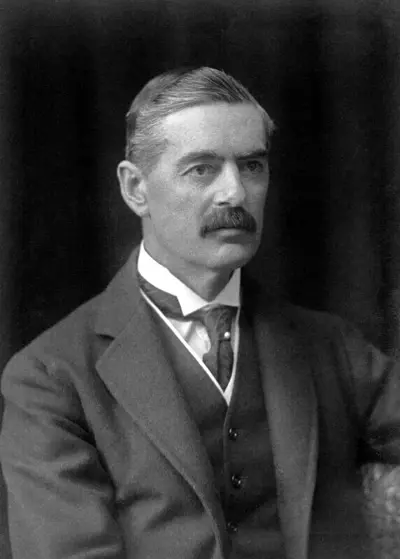
Arthur Neville Chamberlain FRS was Prime Minister of the United Kingdom and Leader of the Conservative Party from 1937 to 1940. He is best known for his foreign policy of appeasement, and in particular for his signing of the Munich Agreement on 30 September 1938, conceding the German-speaking Sudetenland region of Czechoslovakia to Germany. Following the German invasion of Poland on 1 September 1939, which marked the beginning of World War II, Chamberlain announced the declaration of war on Germany two days later and led the United Kingdom through the first eight months of the war until his resignation as prime minister on 10 May 1940.
