Joseph Stalin Quotes
I know what Hitler is up to. He thinks he has outsmarted me, but actually it is I who have outsmarted him.
Both Hitler and Stalin were gross egomaniacs who each thought that they had gotten the better of things. The result was that 22 million Russians were killed and the industrial base if Russia Was destroyed. On the German side, the German military was virtually destroyed, many civilians were killed, the nation reduced to rubble and starvation, German leaders were killed, jailed or committed suicide including Hitler, and the country was occupied for years. Neither leader appeared very smart if one judges by the results.
Joseph Stalin, 1879-1953, Russian Premier, Statement to Nikita Khrushchev after them signing of the Treaty between Germany and Russia called “The Molotov-Ribbentrop Pact”
Sourced by: Eigen's Political and Historical Quotations

Hopkins was a social worker with no military of political experience. But the President trusted him implicitly. Most American military officers and Ambassador to England Joseph P. Kennedy, a Nazi sympathizer & father of JFK, believed that England could not stand up to Hitler. Any military aid we gave England would fall into the hands of the Germans. Everyone was shocked when Roosevelt sent Hopkins to England to make a military recommendation. To impress Hopkins with something he thought Hopkins would be interested in, Churchill led a tour of workers cottages built by the government. Hopkins surprised Churchill and his aids who would never forget this statement & then asked to see the military facilities. Hopkins distressed the American military by recommending that Britain could hold out against invasion if they received military aid. Despite the contrary military advice, FDR accepted Hopkins’ recommendations, and the rest is history. He had been right and much of the military wrong.

He defeated Adolf Hitler at the polls in 1932, but the next year he was compelled to yield to Nazi power and appointed Hitler Chancellor of Germany.


In this case, the Speaker of the House attacked the President of his own party for being willing to conduct disarmament discussions with the Russians. He implied that the outcome could be the appeasement of the Russians just as British Prime Minister Neville Chamberlain appeased Hitler in 1938 in Munich, giving the German Fuhrer the “green light” to take over Europe. The Conservative Caucus went even further and explicitly called it “appeasement”. Reagan however always talked about military strength and power, and provided plenty of money for the military and weapons a few of which were boondoggles but he was a very cautious American president in authorizing military force. And he not only was willing to discuss arms control and reductions and enter into treaties for disarmament, much to the distress of the hawks of his own party. Few American Presidents have so well balanced the use of diplomacy with the threat of military force as well as Reagan.

Although a fervent Nazi, he detested Hitler. When Hitler consolidated power, one of the first things he did in 1934 was to order his guards to murder Strasser, just as Strasser had feared.


The “fool” was Neville Chamberlain, 1869-1940, the British Prime Minister who refused to stand up to Hitler and instead negotiated a peace pact, returned home declaring that he had preserved peace. (See {585941}.) Then Hitler invaded more of Europe and WWII was begun. Ford was a Hitler admirer and pro-German (Hitler supported him for the American Presidency--{586988}—and awarded him a medal) but he thought that England had bungled the negotiations by sending someone who was very weak. In this sense his views were the same as most who were anti-Hitler.

He had been part of a plot to assassinate Adolf Hitler. There were a small group of Anti Nazi Germans during WW II. Carnaris was one. Most were killed.
Not understanding this point has been the cause of much difficulty for military leaders from the war of 1812 through the Iraq war, the success or failure of the effort depended on a successful peace.


See a similar sentiment by Tallyrand


A reversal of Calusewitz's famous dictum--see {361616}

The reference to Munich was to the famous appeasement of Adolf Hitler and the Nazis by British Prime Minister Neville Chamberlain. See {585941}.


This quotation is important because there are some who believed that the professional German Soldiers did not respect Hitler and his murderous policies. This quotation shows that at least publicly Donitz had no problem extolling Hitler above all others. After the war Donitz was found guilty of Unrestricted Submarine Warfare and using thousands of slave laborers in his shipyards. He was sentenced to 10 years, one of the lightest sentences if the German War Crimes Trials.
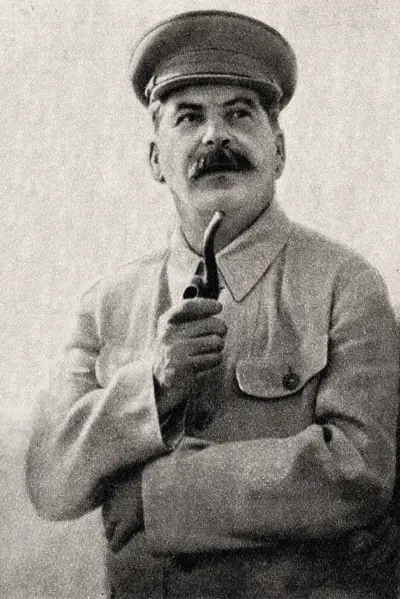
Joseph Vissarionovich Stalin was a Georgian revolutionary and the ruler of the Soviet Union from 1927 until 1953. He served as both General Secretary of the Communist Party of the Soviet Union (1922–1952) and Chairman of the Council of Ministers of the Soviet Union (1941–1953). Despite initially governing the country as part of a collective leadership, he ultimately consolidated power to become the Soviet Union's de facto dictator by the 1930s. A communist ideologically committed to the Leninist interpretation of Marxism, Stalin formalized these ideas as Marxism–Leninism while his own policies are known as Stalinism.
