William Lloyd Garrison Quotes
Whatever may be the guilt of the South, the North is still more responsible for the existence, growth and extension of Slavery. In her hand has been the destiny of the Republic from the beginning. She could have emancipated every slave, long ere this, had she been upright in heart and free in spirit …. the sin .of this nation is not geographical--is not specially Southern--bus deep-seated and universal
William Lloyd Garrison, 1805-1879, Editor & Abolitionist, Address delivered in the Broadway Tabernacle, New York, February 14, 1854
Sourced by: Eigen's Political and Historical Quotations


As an entertainer she had toured much of the world and seen American slavery and that of some other nations. She became a staunch abolitionist and like entertainers in the 20th and 21st centuries she used her celebrity to give anti-slavery lectures and perform for audiences where she donated the proceeds of the event to the abolition cause. She is a particularly interesting political figure in that she seems to be one of the first entertainers to perform for a social cause and become an activist.
The amendments failed as did the compromise.


This moral statement from a New jersey Quaker abolitionist is not particularly noteworthy, However what makes this quote important is that Woolman traveled throughout the South preaching this as his main theme. At that time — before the American Revolution — he did so and was not attacked or intimidated; he was mostly ignored by the Southern authorities. At the time, the South was very confident of its ability to continue slavery. Years later, when the abolition movement grew larger and stronger, a Northern Quaker Preacher doing this not not escape with his life.

And so they were. However, Calhoun had already concluded which alternatives the South would take. See {635930}
See Mark {606304}; also Matthew {606727}. Lincoln had used the “house divided” biblical metaphor in 1843 when arguing for Whig solidarity. The first political use of the Biblical metaphor and quotation with respect to American slavery appears to have been by Sam Houston in 1850 {603970}. The first use with respect to American slavery was byMassachusetts abolitionist, Edmund Quincy, in 1852. The second sentence of this famous quotation was forsaged earlier. See Lincoln, {619494} & {584918}. Also See Felix Rohatyn who used the Lincoln line to refer to poverty: {70611}.

Some Southerners, in order to obtain support in England for the Confederate cause claimed in their propaganda that slavery was not the issue but their issue with the Union was just one of local and regional autonomy. The British and most Europeans at that time were strongly against slavery so this “spin” might have gotten some support. Stowe and others put the lie to this, and the Confederacy never did get any significant material support from any country in Europe. The secession resolutions of the Southern States all state that Slavery was the cause (and often the ONLY cause stated) of secession. Also Southern General Mosby, called the spin for what it was. See {584991}.


Even before we had a Constitution there was major opposition to slavery. The “price” of the American Union was the acceptance of the slavery of the South. But the hypocrisy of a country based on liberty to allow and enforce slavery was not lost on the founding fathers. Ironically the abolitionists among the founding fathers were certain that they could persuade the Southern slaveholders of the error of slavery in a few years and things would be set right in the land. Even George Washington {630626}, and Thomas Jefferson and some other slaveowners at the time wished to see its abolition. Slaveholding Southern Founding Fathers in general were so wary of the abolitionists that they achieved structural, disproportionate, power in the new Constitution to ward off the abolitionists attempts to reform slavery.


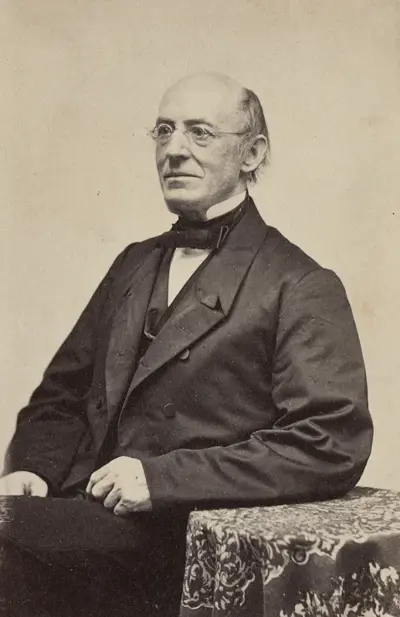
William Lloyd Garrison, who signed and printed his name Wm. Lloyd Garrison, was a prominent American abolitionist, journalist, suffragist, and social reformer. He is best known for his widely-read anti-slavery newspaper The Liberator, which he founded in 1831 and published in Boston until slavery in the United States was abolished by Constitutional amendment in 1865. He was one of the founders of the American Anti-Slavery Society, and promoted immediate and uncompensated, as opposed to gradual and compensated, emancipation of slaves in the United States.
