Alcuin Quotes
What security is there for the churches of Britain if St Cuthbert with so great a throng of saints will not defend his own? Either this is the beginning of greater grief or the sins of those who live there have brought it upon themselves
People of this era not only saw epidemics as the wrath of God, but also saw military catastrophe, invasion and raids as a punishment of God for the sins of the people of the area.
Alcuin [Flaccus] of York, ~735-804, English Scholar & Abbot, Letter to Higbald, Bishop of Lindisfarne
Sourced by: Eigen's Political and Historical Quotations


This sura is interpreted by some Islamic fundamentalists as absolution for the killing of a non-Muslim by a Muslim. It was Allah who did it. In a greater sense, critics of Islam observe that many Muslims and Islamic nations have a double standard of responsibility for crimes. If the victims are Muslims, the normal standards of morality hold; but if a non-believer there can be no crime. Terrorism, torture, beheading, mass murder can all be done with a clean conscience if a Muslim takes this interpretation of this sura. Many Muslims however take an opposite point of view. These people do not have the concept of fatalism and lack of free will that others believe. There is a parallel to this problem in Judeo Christian countries although it is less common statistically. But the murder of physicians who perform abortions, and the Jewish radical fundamentalist who killed innocent Arabs at worship are examples of people who viewed themselves as instruments of God in their heinous activities.


Ivan the Terrible. He was referring to himself as God’s Chosen One. He and the Church were aligned against the Nobles, whose lands Ivan wanted. He would execute hundreds of “traitors” every month. He even executed the families of his enemies in very cruel ways. He claimed to be “cleansing” the land of sinners in preparation for the coming judgment day, and the church backed him up on this. The Church gave him carte blanche to “punish” all sinners and his paranoia eventually got around to the church fathers themselves who became the final victims.

This was a practical argument to justify government paying for religious education.


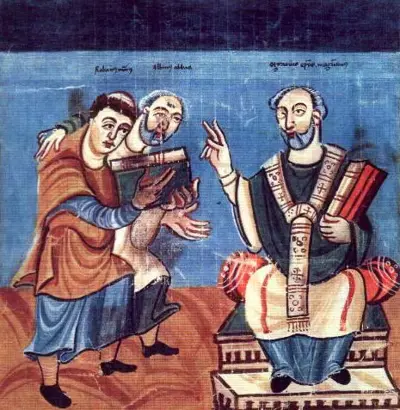
Alcuin of York – also called Ealhwine, Alhwin, or Alchoin – was an English scholar, clergyman, poet, and teacher from York, Northumbria. He was born around 735 and became the student of Archbishop Ecgbert at York. At the invitation of Charlemagne, he became a leading scholar and teacher at the Carolingian court, where he remained a figure in the 780s and 790s. "The most learned man anywhere to be found", according to Einhard's Life of Charlemagne (c. 817–833), he is considered among the most important intellectual architects of the Carolingian Renaissance. Among his pupils were many of the dominant intellectuals of the Carolingian era.
