Genghis Khan Quotes
I come as a punishment from God.
Genghis Khan, c. 1152-1227, Temujin, Mongol Conqueror, Statement to the people of Bokhara when he invaded. He was one of history’s most successful terrorists, where his atrocities caused many cities and countries to pay tribute rather than fight and risk his wrath.
Sourced by: Eigen's Political and Historical Quotations

For many extremists Muslims, this sura calls for the torture or killing of the enemies of Islam. For the more moderate Muslims, the penalty of opposing Islam should be expulsion or banishment. The further modern complication of this sura is the definition of “making war with Allah.” To some extremists, it is writing or publishing anything contrary to their view of Islam; it is occupying any Islamic nation or warring with that nation even though the basis of the war might have nothing to do with religion; it is bringing a Bible into an Islamic nations; it is allowing alcohol to be sold and served; it is opposing their discriminatory customs and laws; it is pressuring them not to stone adulteresses.


This sura is interpreted by some Islamic fundamentalists as absolution for the killing of a non-Muslim by a Muslim. It was Allah who did it. In a greater sense, critics of Islam observe that many Muslims and Islamic nations have a double standard of responsibility for crimes. If the victims are Muslims, the normal standards of morality hold; but if a non-believer there can be no crime. Terrorism, torture, beheading, mass murder can all be done with a clean conscience if a Muslim takes this interpretation of this sura. Many Muslims however take an opposite point of view. These people do not have the concept of fatalism and lack of free will that others believe. There is a parallel to this problem in Judeo Christian countries although it is less common statistically. But the murder of physicians who perform abortions, and the Jewish radical fundamentalist who killed innocent Arabs at worship are examples of people who viewed themselves as instruments of God in their heinous activities.

Referring to one of his harshest critics, Rev. Jerry Falwell:

On May 26, 1887 President Grover Cleveland, himself a Union Army Civil War veteran, issued an Executive Order providing that the captured Confederate regimental flags held as trophies by the War Department be returned to the States of the regiments from which they were captured. Union veterans were outraged:. Within three weeks the president rescinded the order, caving in to pressure from the major veterans organization of the day, The Grand Army of the Republic. Many years later President Theodore Roosevelt ordered the flags returned to the former Confederate states.


The hatred of the English was so great in Germany during WWI that this phrase substituted for the usual “Good Morning” and “Good Bye” etc.
Terrorism is not new to Islam. It was proscribed by the Prophet when fighting the “enemies of Allah.” There are those who believe that he was not advocating terrorism as we know that term today. Instead they believe that he meant that they should scare and intimidate the enemies of God, and the sura does not explicitly promote or sanction the murder of innocent civilians. They would interpret this quotation to mean “Attack the military enemies of God so severely that they well fear you and be intimidated.” Others see the quotation as an explicit endorsement of terrorism. What better than beheading or exploding random members of a society that is opposing Islam and Allah in order to “strike terror into the hearts of the enemies of Allah.”


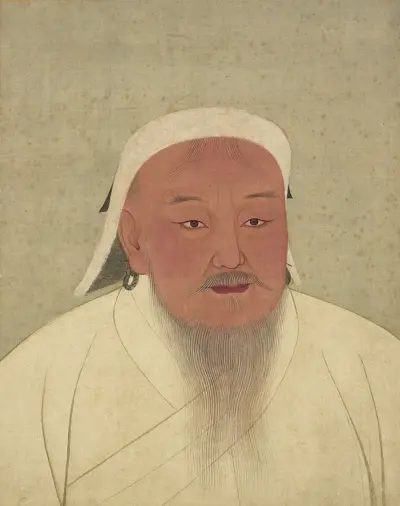
Genghis Khan, was the founder and first Great Khan (Emperor) of the Mongol Empire, which became the largest contiguous empire in history after his death. He came to power by uniting many of the nomadic tribes of Northeast Asia. After founding the Empire and being proclaimed Genghis Khan (an honorary title possibly derived from the Turkic "tengiz" — sea, meaning "the oceanic, universal ruler"), he launched the Mongol invasions that conquered most of Eurasia, reaching as far west as Poland in Europe and the Levant in the Middle East. Campaigns initiated in his lifetime include those against the Qara Khitai, Khwarezmia, and the Western Xia and Jin dynasties, and raids into Medieval Georgia, the Kievan Rus', and Volga Bulgaria. These campaigns were often accompanied by large-scale massacres of the civilian populations, especially in the Khwarazmian and Western Xia-controlled lands. Because of this brutality, which left millions dead, he is considered by many to have been a brutal ruler. By the end of his life, the Mongol Empire occupied a substantial portion of Central Asia and China. Due to his exceptional military successes, Genghis Khan is often considered to be one of the greatest conquerors of all time.
