Euripides Quotes
Those whom God wishes to destroy, he first makes mad.


He was reacting to the fact that the Supreme Court had ruled that a State could not criminalize adult, consensual, homosexual behavior.

A massive earthquake struck Japan, destroying most of Tokyo and Yokohama. The deaths were so extensive that no official count was ever made. At the time, Japanese politics was polarized by two factions: One urged Japan to become democratic and modern like the West; the other, urged Japanese right wing militarism and expansionism. The shock of the Japanese population of such an enormous natural disaster, were seem by most Japanese as a punishment from God as Yasubumi and many other Japanese leaders stated. The reason for the punishment claimed by most was the recent adoption of Western ideas, lifestyles and particularly the trend away from traditional Japanese authoritarian government and toward Democracy. Japan then rejected democratic ideas and followed a militaristic, expansionistic, aggression leading directly to WWII.


For many extremists Muslims, this sura calls for the torture or killing of the enemies of Islam. For the more moderate Muslims, the penalty of opposing Islam should be expulsion or banishment. The further modern complication of this sura is the definition of “making war with Allah.” To some extremists, it is writing or publishing anything contrary to their view of Islam; it is occupying any Islamic nation or warring with that nation even though the basis of the war might have nothing to do with religion; it is bringing a Bible into an Islamic nations; it is allowing alcohol to be sold and served; it is opposing their discriminatory customs and laws; it is pressuring them not to stone adulteresses.


The hatred of the English was so great in Germany during WWI that this phrase substituted for the usual “Good Morning” and “Good Bye” etc.


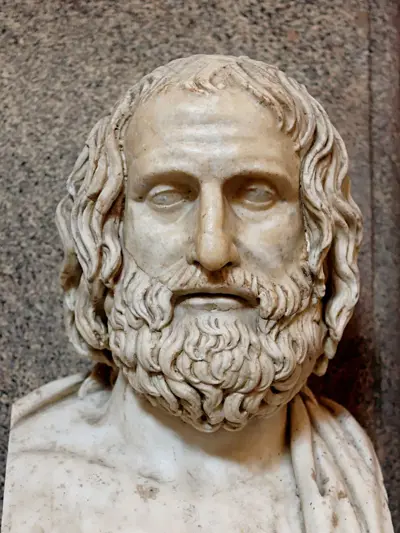
Euripides (/jʊəˈrɪpɪdiːz/; Greek: Εὐριπίδης Eurīpídēs, pronounced [eu̯.riː.pí.dɛːs]; c. 480 – c. 406 BC) was a tragedian of classical Athens. Along with Aeschylus and Sophocles, he is one of the three ancient Greek tragedians for whom any plays have survived in full. Some ancient scholars attributed ninety-five plays to him, but the Suda says it was ninety-two at most. Of these, eighteen or nineteen have survived more or less complete (Rhesus is suspect). There are many fragments (some substantial) of most of his other plays. More of his plays have survived intact than those of Aeschylus and Sophocles together, partly because his popularity grew as theirs declined—he became, in the Hellenistic Age, a cornerstone of ancient literary education, along with Homer, Demosthenes, and Menander.
