Gianni Agnelli Quotes
Well, Italy had been overrun by the War, there had practically been civil war, north and south of the Gothic Line, heavy bombing, the northern industrial cities had been bombed heavily and we had political disorder before 1948.
Agnelli, Gianni. Interview. Cold War, episode 3, "Marshall Plan, 1947-1952", CNN, 11 Oct. 1998.


The general was replacing George S. Patton as commander of the Third Army. Patton had opposed the deNazification policy of the allies and caused a great deal of public relations difficulty for the army command and the administration, as reporters would frequently print his views. Truscott was one of Patton’s loyal assistants. The minute he took over, the press wanted to find out if his views were the same as his former boss regarding the Nazis. They were quite different. Reporters had no story.

After the sneak attack on Pearl Harbor, Stimson drafted the Declaration of War that President Roosevelt would ask Congress to vote for. However, there was a small but very vocal group of extreme Republican conservatives who opposed assisting England against Hitler and saw German and Italian Fascism as positive forces. They would oppose any administration declaration of war against Germany and Italy who had not yet attacked any American facilities. The President realized that German and Italy had a Mutual Defense Treaty with Japan, and when we declared war against Japan, would have to ally with Japan or reneg on their treaty. So FDR removed Germany and Italy from the Declaration and Congress just declared war against Germany. In the next days, Germany and Italy declared war against the United States, and the de facto situation was as Stimson had drafted it, but FDR had not given the right wing American Fascist sympathizers any issue to criticize the administration.

One of the predictions of the oncoming war with Germany.


In 1930, Japan, Britain, and the United States had signed an agreement that submarines would not sink merchant vessels without having first placed passengers and crew in a place of safety. However, when Japan attacked Pearl Harbor and bombed civilians as well as military and had a pattern of bombing and shelling civilians in China, the U. S. took the position that Japan had abrogated all treaties and therefore abrogated the 1930 treaty. It was more of a symbolic gesture as at the time the American forces were in no shape to attack Japanese merchant shipping though later in the war, it became material. By that time, the Japanese had murdered American prisoners of war on the Bataan Death March and elsewhere and had slaughtered civilians in the Philippines and all the other territories that they invaded. The niceties of the 1930 treaty was one of the first casualties of Japanese aggression.


Committee of the Congress. This was the prevailing Congressional and public view except for the South which had coalesced around an intellectual rationalization. See {618013}.


Note that he assumes that not only will there be another World War, but he assumes that we will be on opposite sides.

The British and American bombing of Germany had become so effective that most of the German industrial system was destroyed. However, early in the War, Germany had violated the Geneva Convention and was indiscriminately bombing London and other part of England. In addition the German Air Force had bombed Warsaw, and many other cities throughout Europe. The German’s had killed over 20 million Europeans. When the Allied bombing produced high collateral damage against civilians, some argued that even though German had deliberately used this tactic, the allies should stop the saturated bombing if there were to be high civilian collateral damage. Others argued that it was unfortunate but a military necessity. There were others like Brenen, who argued that killing German women and children was desirable and just.

After the Presidential years of James Buchanan who protected the South from slavery reform and abolition as the North was gaining political power and the abolitionists were having a greater and greater effect on public opinion in the North. While Southerners did not believe Lincoln would emancipate the slaves, they realized that the majority of the growing nation was opposed to slavery, and more and more Northern states were passimg laws making any slave who sets foot in the State a free person. Slaves coud not only have more reason to run away, but slave owners would not be able to get their “property” back. Lincoln would not help the South as Buchanan did, and the Southerners realized that over time, slavery would no longer be feasible or profitable. Cobb, very experienced at Washington politics, realized the changes that would come and thought that they would be “certain and speedy.” The irony was that if the South had not seceded and simply dragged its feet legislatively, it would have taken two or three decades for slavery to end. However, by seceding and initially fighting so hard and well while poor Union generals were in command, Lincoln was forced to try more drastic measures and issued the Emancipation Proclamation after only a few years. The Civil War and seccession was not only a tactical and strategic error for the South, but rapidly brought about just what the Southerners were fighting to prevent.

While this assessment was true up until the 1980s. By the 21st century there were almost no serious historians who thought that the motivation of the Confederate States for the Civil War was anything but slavery and the economic impact that abolition might bring. However, one of your advantages having this collection of historical quotations is that you can see for yourself why the Southern states say they were seceding. This following are four of the official secession resolution documents. Read these and you will see that all the claims that there were other major reasons for secession are just attempts to make the Confederacy a little less brutal and greedy. See {621371}, {619793}, {621372}, {621375}

Many German officials, after the war, tried to justify the Concentration Camps. However, the argument has little historical merit as by the time the Nazis implemented them, they had complete control of the country and were in no danger of Civil War. And certainly the torture, medical experiments, and murders were not required to prevent civil strife. And using inmates as slave laborers in Donitz’s shipyards had nothing to do with civil war. After the war Donitz was found guilty of Unrestricted Submarine Warfare and using thousands of slave laborers in his shipyards. He was sentenced to 10 years, one of the lightest sentences if the German War Crimes Trials. He himself was not only an enthusiast about the concentration camps but was a murderous anti-Semite as well. See {624978}. The thought that the Germans had to kill little children to avoid civil war is as absurd as any argument could be.

Wade was one of the Radical Republicans who advocated a much more vigorous prosecution of the Civil War effort in the North. It is important for two reasons: First, it illustrates the position of the “Hawks” who constantly pressured Lincoln to counter the Democrat lack of enthusiasm for the fighting. Many believed that the South would come to its senses and end the rebellion. Second and more important, this is one of the quotations that apologists for the South during the Jim Crow segregation issue use to show that there was a strong desire to impoverish the South. This is partly true. Wade and the other radicals did argue to impoverish the South only so long as they were continuing the war and rebellion. They did not argue that the South should be impoverished after the war was over. However, the reality was that the Southern economy had become so dependent on slave labor, that after Emancipation, it was very difficult to rebuild the Southern Economy. With Slavery Southern Cotton sold to England was cheaper than Egyptian Cotton. If labor had to be paid, the Egyptian cotton became cheaper. The South had squandered almost all of their capital resources on financing the war and had no capital to finance modern manufacturing enterprises. And they so resented Northerners that it was very difficult for Northern businessmen who did have capital to start and finance enterprises in the South. There also was little money for good public schools after the war, and the inferior education of the South made the situation very hard to change.
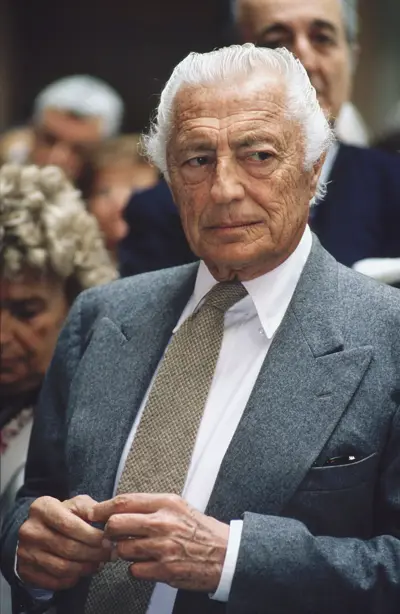
Agnelli was educated at Pinerolo Cavalry Academy, and studied law at the University of Turin, although he never practiced law. He joined a tank regiment in June 1940 when Italy entered World War II on the side of the Axis powers. He fought on the Eastern Front, being wounded twice. He also served in a Fiat-built armoured-car division in North Africa, where he was shot in the arm by a German officer during a bar fight over a woman. After Italy surrendered, due to his fluency in English, Agnelli became a liaison officer with the occupying American troops. His grandfather, who had manufactured vehicles for the Axis powers during the war, was forced to retire from Fiat, but named Valletta to be his successor. Gianni's grandfather died, leaving Gianni head of the family but Valletta running the company. Fiat then began producing Italy's first inexpensive mass-produced car.
