Timothy Geithner Quotes
We were operating outside the boundaries of established precedent.
Geithner and Federal Reserve Chairman Bernanke went way “out of the box”, using creative methods of preventing the crash of 2008 from turning into a major Depression. See {639655} for Geithner’s further explanation.
Tim Geithner, U.S. Secretary of the Treasury (Democrat), President, New York Federal Reserve Bank, Characterizing the Federal Government’s actions in response to the Meltdown of 2008, Testimony, Civil Court Case, 2014
Sourced by: Eigen's Political and Historical Quotations

In the Meldown of 2008 which caused the Great Recession, he, his Republican Predecessor and Ben Bernanke, the Federal Reserve Chairman, I the opinion of most on ideological economists saved the American economy from a collapse that would have been as bad or worse than the Great Depression. However, to accomplish that they had to in effect bail out the banks, 2 of the 3 American Auto companies, and the largest insurance company with taxpayer money. Worse, they could not do much for the millions of Americans whose homes were “under water” as a result of the banks’ handling of home mortgages and mortgage backed securities. To help them, they would have had to force the banks to admit that their assets were much lower than the banks were claiming and the banking and financial executives had to be appeased. Meanwhile, they had few other resources and did not provide any help to Main Street, small business or even small banks. Worse, they were intimidated into allowing the subsidized and saved banks to pay huge bonuses to their executives whose performance was terrible while millions of normal Americans were unemployed and the others were getting no increase in compensation. See {639655} for Geither’s explanation of the problem.


Greenspan, and his huge staff of economists all completely missed predicting the Meltdown of 2008. They had the power to regulate many of the banks and other companies that got into trouble in the Great Recession. However, all the financiers and economists of the banks of America with their staffs, not only missed the predictions but recommended the disastrous course of activity that almost destroyed the nation’s economy. Only a handful of economists predicted the Meltdown. Those few were not connected with any of the banks or any of the government bank regulators which had become so much like each other as the result of the revolving door, that there was little difference in their thinking.

Sovereign credit substitution is where the government, one way or another, assumes and guarantees the debts of private corporations. This is an elegant way of saying: “taxpayer bailouts”

U. S. Treasury Secretary Larry Summers called Rajan a “Luddite” for this view, but what Rajan observed and predicted was exactly what happened in the Meltdown of 2008 which led to the Great Recession. Rajan was one of the few economists to call this right. Several, invested their own money assuming a crash and made billions. Most, like Summers and the Federal Reserve Chairmen in retrospect admitted that they missed the signs and didn’t connect the dots. See {637168}, {637987}, and {620038}

When the Meltdown hit America, the crisis drew attention to the fiscal solvency and stability of banks in most of the world. The Irish banks were much more overextended than those of most counties and when that came to light there was a bank panic in Ireland. Ahern and the Irish Dail (parliament) decided to bail out the Irish bank at a very great cost to the rest of the Irish economy and people. He believed if Lehman Brothers had been bailed out, as America did with other institutions, the Irish bank bubble would not have burst. It is not known whether he actually meant to use the word “testicles” or he made a gaff intending to use the word “tentacles”. Both have relevant meaning in the situation with a significant shade of difference in meaning between the two.
He was discussing his unprecedented steps that as Federal Reserve Chairman he took to cope with the Great Recession after the Meltdown of 2008. He had, as a graduate doctoral student, studied the economic history of the Great Depression of 1929 and the government attempts to ameliorate some of the effects. He was one of the few people in government who had this historical perspective.


"Market mispricing" is an economic euphanism for the bankers and major investors of the nation (and abroad) bidding up the prices of the assets in order to continue to squeeze large profits even after they knew that the assets had been far overpriced. Few wanted to stop playing hoping the music would not stop in the economic game of musical chairs. When it did, there were not enough "seats" and failures casued other failures and the contagion spread.


President George W. Bush had forestalled the Automobile Industry bankruptcy so that incoming President Obama could organize a rescue and reform of the industry. This was very effective and the industry was more profitable than ever in a few years. Romney however, had already changed his political persona from his previous moderate Republican to the hard right ideological base of the Republican party. In the election of 2012, he lost every Midwestern state whose economy was dependent on the auto industry, even though a number of them had elected Republican Governors and legislatures. This quotation was the subject of tens of thousands of pro-Obama campaign commercials. It made Romney’s last minute attempt to morph back to being a moderate seem silly in those Midwestern states.

Zhou, more than any other Chinese official, was responsible for the dramatic change in the Chinese economic shift from a classical socialist model to a modern market driven competitive economy.

Economic is often called “the dismal science” as its ability to make predictions has never been very good. The Great Depression was also missed, else it would not have come as such a shock. There have been a few economists who correctly predicted these economic downturns but they generally continuously predict recessions and depressions that never happen.
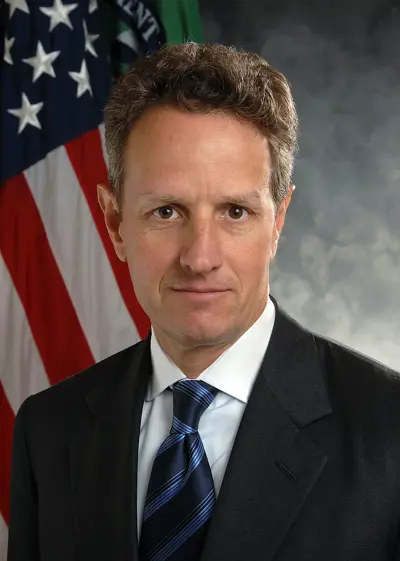
- Born: August 18, 1961
- Nationality: American
- Profession: Public Servant
Timothy Franz Geithner is a former American central banker who served as the 75th United States Secretary of the Treasury under President Barack Obama, from 2009 to 2013. He was the President of the Federal Reserve Bank of New York from 2003 to 2009, following service in the Clinton administration. Since March 2014, he has served as president and managing director of Warburg Pincus, a private equity firm headquartered in New York City.
