J. Robert Oppenheimer Quotes
We propose to let it be known that the Los Alamos Project is working on a new type of rocket and that the detail be added that this is a largely electrical device… the story will have a certain credibility; that the loud noises which we will soon be making here will fit in with the subject, … and the fact that we have a large group of civilian specialists would fit in quite well …
The Scientific Project that developed the Atomic Bomb. The quotation is very interesting for two reasons. The first is the cover story that people were told in the New Mexico communities surrounding Los Alamos. Second, it shows the incredibly extensive and detailed degree to which the Scientific Director was involved in the details of the Manhattan Project. The more that Oppenheimer could do, the less the army needed to do and the cultural gap between the army and the scientists was huge. Whatever the military handled ending up being insensitive to the scientists and their families as the military was used to simply making decisions and ordering its troop to live with the decisions. Oppenheimer, in one of the great leadership and management achievements in history was trusted by all the scientists and by General Groves and the Civilian advisors. As a result, when he did something it would be accepted and there was much hardship the scientists had to live with in this isolated area with few amenities and he was believable when he told the scientists and their families that this was the best that could be done at the time. The Army mid level officers and security agents were never happy with the project and kept identifying possible “security risks” on the staff. Every one they identified turned out to have been totally loyal. There was one spy—a British scientists working for the Russians, but he had all his credentials and history in order and was never identified as a potential security risk.
J. Robert Oppenheimer, 1904-1967, Physicist and Scientific Director of the Manhattan Project Memo to General Groves proposing the cover story for the Atomic Bomb Development Project at Los Alamos
Sourced by: Eigen's Political and Historical Quotations

Oppenheimer was cleared but many of the rest of the staff were including those with access to the highest, most critical secrets in the land. See {629854} for a greater understanding of the situation.

Feynman was then a young brilliant graduate students working with colleagues far senior to him. He not only criticized the lax security of the safes, but when combination safes were later installed, he would infuriate the army security people by “hacking” the safes when scientists had lost their combinations.

This vague criterion was in effect and was initially used to clear scientists at Los Alamos and their spouses who were part of the team that was to develop the Atomic Bomb. The Army security people however had never been in such a situation before. Few distinguished scientists wanted to come to Los Alamos to begin with as once there, they were there for the duration of the war and were cut off from friends and relatives. But there were very few people in the entire country who had the unique education and training. When the security people rejected a candidate before that time, another person was recruited. But for many of the scientists at Los Alamos, they were one of a kind. There were not two Enrico Femi’s or Luis Alverez’s. “Moral fiber” could mean anything and the American academic world has always tolerated a wider variety of behavior then most of the rest of society. Sexual activity, left wing views, parental irresponsibility, failure to pay debts, attacking religion or religious organizations all created problems. But the biggest problem was association with others of “demonstrated weakness in moral fiber” including communists and left wingers. In most university settings, with a norm or tolerance, almost all associated with “undesirables”. As a result many scientists or family members could not get cleared. But the project could not function without them, and if some were fired for that reason, many others might have quit. Finally, General Groves, relaxed the standards, yet the army security officers were constantly suspicious. This criterion was in use as late as the 1960s where a brilliant scientist working in the Executive Office of the President was threatened with dismissal for this reason. She had borne an illegitimate child years earlier.


Wikileaks had just released 400,000 classified American documents relating to the Iraq War. Many accused him and Wikileaks of endangering the lives of not only soldiers, but Iraq civilians who might be identified as cooperating with the coalition forces by the released documents. The heart of the problem is that governments tend to use classification to hide embarrassing facts or policies that might be controversial as well as to protect legitimate national security secrets and sources and methods of information. The majority of the 400,000 leaked documents, when examined, were clearly not protecting any legitimate people or secrets but just staved off criticism or embarrassment; in many cases, there was no value to the contents and the maw of the censorship and classification process was applied indiscriminately to many documents. A much better argument than Assange made, can be gleaned from the vast number of WWII documents that America, England, France, Russia and others still keep secret, when the people who might have been protected have already died and the methods are long since obsolete.
He was referring to the Vietnam war. The amount of lying and propaganda to the American people during the Vietnam war was extreme at the time but established a trend where the Department of Defense was less overt about lying but when they did so did it with more impunity.
The security system at Los Alamos while the atomic bomb was being developed was absurd. Scientists from all over the country had to be hired quickly. Many of them had friends and relatives who had various left-wing associations; some came from Germany or had German connections. A number of the key scientists were German refugees from Hitler's persecution. The military security people, using their traditional standards, would not clear people if they had any left wing friends or associates or they came from Europe and there were no records to prove that they were not fascists or communists. Most of the refugees got out with their lives and had no records, but they were among the best scientists in the world. J Robert Oppenheimer, the scientific director, and General Leslie Groves needed the scientists as the work had to be done. Groves approved important personnel for hire pending security clearance which never came and which Groves knew would never come. Nonetheless the people were working by the time intelligence officers outside the project realized what was going on. People without clearance had some of the most sensitive jobs at Los Alamos. Not a single one of those people turned out to be a security risk or a spy. There was a spy however who had come the English scientific delegation, but the security people had cleared him. Barnett however, as Oppenheimer’s personal assistant had access to almost everything having to do with the development of the bomb. She never did get cleared for her job.

The military security people were so used to ferreting out communists in the 1930s that they had a hard time adjusting to the fact that the security risks or people who might have German connections or backgrounds. Many immigrant scientists were recruited for work on the Manhattan project to build the atomic bomb and they only did security clearances. The military security people kept checking on any communist background they might have had as opposed to possible connections with fascist organizations. By the end of the war they had adjusted but then had to go back to looking for communists as the Cold War evolved.
The cultural difference between the Army and the scientists was vast. Groves constantly was at odds with the scientists, but he himself was an engineer and had a closer understanding of scientists than most other military officers. He learned a great deal, adjusted his own procedures and thanks to Groves and Robert Oppenheimer, who worked very well together, everyone compromised a little on the cultural and security issues and the project was a great success.

Conant, a great scientist in his own right, had the confidence of the political, academic, and industrial establishment and was appointed to the Committee that was to set policy for the Manhattan Project representing President Roosevelt. Germany had been the world leader in Physics before the war. American leaders and scientists were certain that we were in a scientific race with the Germans. Even after Germany had been defeated, President Truman was told that we had beaten the Germans in the race for the bomb. Actually, although almost no one in the US government realized it then, the Germans had NO PROGRAM of nuclear weapons development at all. Hitler did not trust the Theoretical Physics and Theory of Relativity because Einstein and other Jewish scientists had been instrumental in its development. He derogatorily referred to it as “Jewish Science”. Germany bet its scientific efforts on the V2 Rockets and the Jet Airplane, both of which they were successful with but too late to have any material effect on the war. Ironically, even after most of the great German physicists were run out of Germany, there were still two of the greatest who may well have been capable of nuclear weapons development. But neither Werner Heisenberg or Otto Hahn were inclined to engage in that kind of research, and neither of them were even asked whether or not they thought it was possible. The anti-Semitic Nazis just assumed that it could not be. Truman and his associates did not find out for another year or more that there was no race. There was one OSS spy, Moe Berg, who had actually talked to Heisenberg in the midst of the war, and concluded that he not only was not working on an atomic bomb, but was not up on the latest pre-war critical research needed to develop a bomb. Hahn knew and had created the first chain reaction for which he later won the Nobel prize but he was a chemist and didn’t really understand the Physics and mathematics involved in making a weapon and was a confirmed pacifist. Ironically, his colleague, Lise Meitner who had done the physics and mathematics on that experiment was Jewish and had to flee Germany. In Denmark she gave the results to Niels Bohr, who shared them with Leo Slizard and Einstein when Bohr came to the United State and that initiated the famous letter that was sent to FDR which triggered the Manhattan Project. The German first nuclear reaction was used by the Americans because the politicians listened to the scientists, while in Germany, the politicians gave no credence to their scientists and their experiments in nuclear fission.

While the President had total faith in American scientists, at the time the state of American physics was not world class in several key areas. Oppenheimer, was for example, the ONLY senior American theoretical physicist at the outbreak of the war, and he had been trained in Germany. What the President did not quite realize was how many of the key scientific positions on the Manhattan Project were foreign refugees who had fled the Nazis in Europe. Many American scientists and engineers did not want to go to Los Alamos where they could not leave for the duration of the war, had to give up their own personal research, and whose relatives who did not accompany them would never know where they were or what they were doing. But there were enough great American scientists who Oppenheimer recruited that combined with the Europeans formed the greatest and most effective concentration of scientific manpower working in history.

He was referring to the testimony given before the Senate of James R. Clapper, U. S. Director of National Intelligence. He denied that the NSA was collecting data on millions of American communications. Then Edward Snowden revealed that the NSA was capturing data on ALL U. S. phone calls and e-mails. See {634917} for details on the false testimony.

Arguably, in the intelligence world, most of the classified documents are not truthful because there are many different work products that are designed to obtain all points of view. There have been major areas were NONE of the documents on a subject were true as they were all based on faulty assumptions or ignoring critical information. None of the classified intelligence documents even hinted at the breakup of the Soviet Union for example. By number, most of the documents in the FBI secret files are raw intelligence reports and are full of unverified opinion—including biased and self-serving statements.

The Scientific Project that developed the Atomic Bomb. Oppenheimer, like most sophisticated intellectuals and scientists of the time had acquaintances who were communists or Communist sympathizer in Oppenheimer's case his brother and wife were both members of communist organizations. They too severed their connections. At the time Russia was on major ally in the war against Hitler and fascism. However since the Communist Revolution of 1917 there had been an animus between the American and Russian governments. The work on the atomic bomb was so secret that everybody was a potential suspect and security risk, even our allies. In the final analysis it was a spy in the Manhattan project who was there as part of the British contribution to the project. The security people were chasing after all the scientists who had friends or acquaintances who were communists and missed the real spy who had no such connections.
The Scientific Project that developed the Atomic Bomb. The focus of the scientists had been to beat the German’s who were terribly evil might develop a bomb first. After the defeat of some scientists began to have concerns about their purpose. Most were very distrustful of the army and believed little of what they were told, by the military at Los Alamos. However, in a remarkable our de force of leadership, Oppenheimer had the trust of virtually all of the staff. This memo and a briefing of the invasion plans of mainland Japan (see {629858} ) convinced the scientist to maintain their intense and punishing pace.


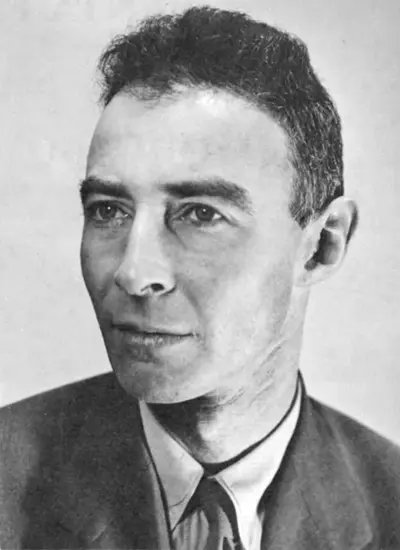
J. Robert Oppenheimer was an American theoretical physicist and professor of physics at the University of California, Berkeley. Oppenheimer was the wartime head of the Los Alamos Laboratory and is among those who are credited with being the "father of the atomic bomb" for their role in the Manhattan Project, the World War II undertaking that developed the first nuclear weapons. The first atomic bomb was successfully detonated on July 16, 1945, in the Trinity test in New Mexico.
