Richard P. Feynman Quotes
All our secret papers were kept in wooden cabinets with rods and padlocks. If you wanted to, you could tilt the cabinets and remove the papers from the bottom.
Feynman was then a young brilliant graduate students working with colleagues far senior to him. He not only criticized the lax security of the safes, but when combination safes were later installed, he would infuriate the army security people by “hacking” the safes when scientists had lost their combinations.
Richard P. Feynman, 1918-1988, Nobel Laureate in Physics, Member, Commission investigating the Challenger accident, Description of the lax security during the early days of the Manhattan Project to develop the Atomic Bomb
Sourced by: Eigen's Political and Historical Quotations


The “wrong” people to Helms. Were Americans who disagreed with his methods and politics—especially members of Congress who wanted to make the CIA more accountable for its actions. If nothing is ever written down and everything is secret, there is no practical way of holding the agency accountable in a democracy. Helms was later convicted to perjury for lying to Congress.


Oppenheimer was cleared but many of the rest of the staff were including those with access to the highest, most critical secrets in the land. See {629854} for a greater understanding of the situation.


Glaxo issued Avandia a drug for diabetes, but the company began receiving reports of heart attacks and other cardio-vascular problems occurring with the drug. A team gathered the data and summarized it for the Senior Management. Drug companies are required by law to inform the FDA of any adverse data that they may know about relative to any of their drugs. Glaxo did not. Further, the Senior management ordered the data “suppressed” and it was so for a decade. Finally the e-mail was leaked to a Congressional Committee when there were other data coming in about the problems with Avandia. The FDA began a new review of the safety of Avandia, but the company had the profits for a decade. Some people had dead friends and relatives. It was generally thought that this sort of thing would never happen in an industry where all the companies are very substantial and a loss of income of any drug would not bankrupt the company, but more and more incidents began coming to light in the early 21st century.

The security system at Los Alamos while the atomic bomb was being developed was absurd. Scientists from all over the country had to be hired quickly. Many of them had friends and relatives who had various left-wing associations; some came from Germany or had German connections. A number of the key scientists were German refugees from Hitler's persecution. The military security people, using their traditional standards, would not clear people if they had any left wing friends or associates or they came from Europe and there were no records to prove that they were not fascists or communists. Most of the refugees got out with their lives and had no records, but they were among the best scientists in the world. J Robert Oppenheimer, the scientific director, and General Leslie Groves needed the scientists as the work had to be done. Groves approved important personnel for hire pending security clearance which never came and which Groves knew would never come. Nonetheless the people were working by the time intelligence officers outside the project realized what was going on. People without clearance had some of the most sensitive jobs at Los Alamos. Not a single one of those people turned out to be a security risk or a spy. There was a spy however who had come the English scientific delegation, but the security people had cleared him. Barnett however, as Oppenheimer’s personal assistant had access to almost everything having to do with the development of the bomb. She never did get cleared for her job.

The military security people were so used to ferreting out communists in the 1930s that they had a hard time adjusting to the fact that the security risks or people who might have German connections or backgrounds. Many immigrant scientists were recruited for work on the Manhattan project to build the atomic bomb and they only did security clearances. The military security people kept checking on any communist background they might have had as opposed to possible connections with fascist organizations. By the end of the war they had adjusted but then had to go back to looking for communists as the Cold War evolved.

When discussing and planning redistricting What makes this quotation so noteworthy is the fact that to the expert at redistricting, security is so important and E-mail an anathema. The reason is that most redistricting by a majority in a state legislature has little to do with fairness and protecting the meaning of peoples’ votes. It is very often motivated by something that is illegal (eg diluting Black’s voting impact) or untoward, embarrassing and scandalous (eg getting rid of a Congressman the party leaders do not care for—not being ideological enough. Very often, courts or the Justice Department overturn redistricting schemes or the media embarrasses the party who controlled the redistricting. In almost all these cases, the “smoking gun” is the statements or writings of the redistricting leaders. (For an example, see {634844} .)Therefore some redistrictors behave in methods similar to the Mafia, foreign spies, or an illegal monopoly conspiracy.

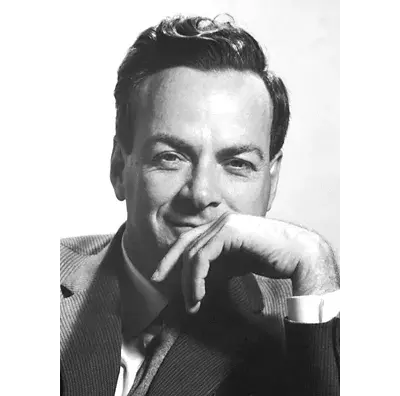
Richard Phillips Feynman was an American theoretical physicist and Nobel Prize winner who made significant contributions to quantum mechanics, quantum electrodynamics, and particle physics. He's known for his work on the Manhattan Project, developing Feynman diagrams, and explaining the interactions between light and matter. While studying for his PhD, Feynman participated in the Manhattan Project and helped develop the atomic bomb. For contributions to the development of quantum electrodynamics, Feynman received the Nobel Prize in Physics in 1965 jointly with Julian Schwinger and Shin'ichirō Tomonaga.
