Adolf Hitler Quotes
We may go down, but we will take a world with us.
Adolf Hitler, 1889-1945, Fuhrer of the Third German Reich, Statement to an aide when Hitler realized he had lost the war but refused to surrender, 1945, Quoted in Antony Beevor, The Fall of Berlin 1945
Sourced by: Eigen's Political and Historical Quotations

Stalingrad was the bloodiest battle in human history with over 2 million casualties, many produced by Hitler’s order. The Germans were bogged down, could not take Stalingrad, the Russian Winter was closing in on them, the Germans were not equipped or dressed for the winter, and the Luftwaffe had not been able to resupply the armies who were out of food and ammunition. Paulus requested permission to surrender the army and received this response. Shortly thereafter, he disobeyed orders and surrendered what remained of the German forces who by that time were in terrible shape. Professional military men have criticized the Field Marshall for not having surrendered much earlier and saved so many of his men.


He was a brutal, sadistic war criminal who was assassinated by one of his many enemies in 2000 before he could be brought to trial.
The Germans allied themselves with the Islamic insurgency of the day as a strategic maneuver. The Grand Mufti of Jerusalem broadcast propaganda from Nazi radio in Berlin and was dispatched to organize Muslim fighters in Iraq. Fascism was introduced into the Middle East and the Arabs and Persians saw it as a natural extension of their authoritarian and highly prescriptive forms of religious and civil government. 60 years later, there would be Islamic Fascists throughout the Middle East in control or vying for control of many of the countries.

This appears to be the origin of the “bear the unbearable” phrase which appeared in many other documents around the Japanese surrender. See {604741}

At that point the Japanese were losing the war on every front. It is not clear whether Hirohito would actually have done such and not tried to escape in the end, however he certainly expected his subjects, military and civilian to do so. That expectation and the behavior of the Japanese troops fighting to the death on many islands was a powerful factor in leading Truman, Marshall and other key American leaders to use the Atomic Bomb. See Marshall: {641063}
Response to an offer by Commodore Preble to exchange prisoners.


The reference to Munich was to the famous appeasement of Adolf Hitler and the Nazis by British Prime Minister Neville Chamberlain. See {585941}.

The Prime Minister, Neville Chamberlain, preceded him with the announcement of declaration of war against Germany, but it was left up to the Foreign Minister to explain the implications. This was the first time in history that a nation had used radio to communicate such momentous events to its population.
“Lebensraum” was a German expansionist concept of the time which has no good English translation. Literally, it means “living room”. The Germans had this notion that the German race and nation had to have more land to accommodate the growth of the German people. And because the Germans were a superior race, they were entitled to the land surrounding Germany in which to have Germans grow and thrive. The “inferior” peoples who lived on the land could be exterminated so that Germany would have this expansion room. The “Death’s Head units” were special German elite troops who used the Death’s Head as a symbol on their uniforms. Some of the Generals were concerned that the rest of the world would condemn Germany and possibly interfere if they exterminated the Poles. Hitler pointed to the example of the Turks who had killed most of the Armenians in the Armenian Genocide in the early 20th century. They got away with it with no outside interference, and there were no international consequences for Turkey. Hitler, convinced that the Armenian genocide was the precedent, thought Germany could easily get away with murdering the Gypsies, seriously handicapped, homosexuals, Russians, Poles and Jews. For other quotations on the Armenian Genocide, see {51838}, {638251}, {620602}, {620603}, {620604}, {620605}, {620600}, and {620606}

On his trip to Germany, Reagan was invited to lay a memorial wreath at the German military cemetery in Bitberg. His staff assistant Michael Deaver had set the trip up but did not know that German Waffen SS Officers were also buried at the cemetery along with the far more numerous Wehrmacht. American Jews and Veterans Groups protested this honor to the SS murderers of millions of people including American prisoners of war. The proposed trip was covered very heavily by the press and editorials throughout the country called for the President to cancel the cemetery part of his trip. He did not. This quotation shows how symbols can take on a meaning that was never intended by the parties.


After the war Donitz was found guilty of Unrestricted Submarine Warfare and using thousands of slave laborers in his shipyards. He was sentenced to 10 years, one of the lightest sentences if the German War Crimes Trials.

He was shot in 1944 for his involvement in an attempt to kill Hitler

There were other factors which Stalin did not mention. There was a major factor of revenge and retaliation. The Germans had killed 22 million Russians (many murdered deliberately), and forced millions of others into slave labor. They had looted everything of value, artistically or commercially from Russian, homes, churches and other buildings. Many of the Russian officers believed that treatment of the Germans was only just given the barbaric behavior of the Germans and applauded by most of the German population.

The Nazis occupied the cities, but the partisans survived in the mountains. The resistance was ferocious and very effective. From a German Soldier’s point of view, the Yugoslav front was the most dangerous assignment where his odds of being killed was even greater than the Russian front.
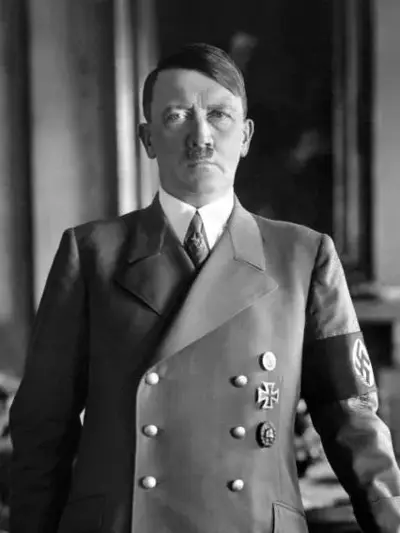
Adolf Hitler was an Austrian-born German politician who was the dictator of Germany from 1933 to 1945. He rose to power as the leader of the Nazi Party, becoming Chancellor in 1933 and then assuming the title of Führer und Reichskanzler in 1934. During his dictatorship from 1933 to 1945, he initiated World War II in Europe by invading Poland on 1 September 1939. He was closely involved in military operations throughout the war and was central to the perpetration of the Holocaust, the genocide of about 6 million Jews and millions of other victims.
